




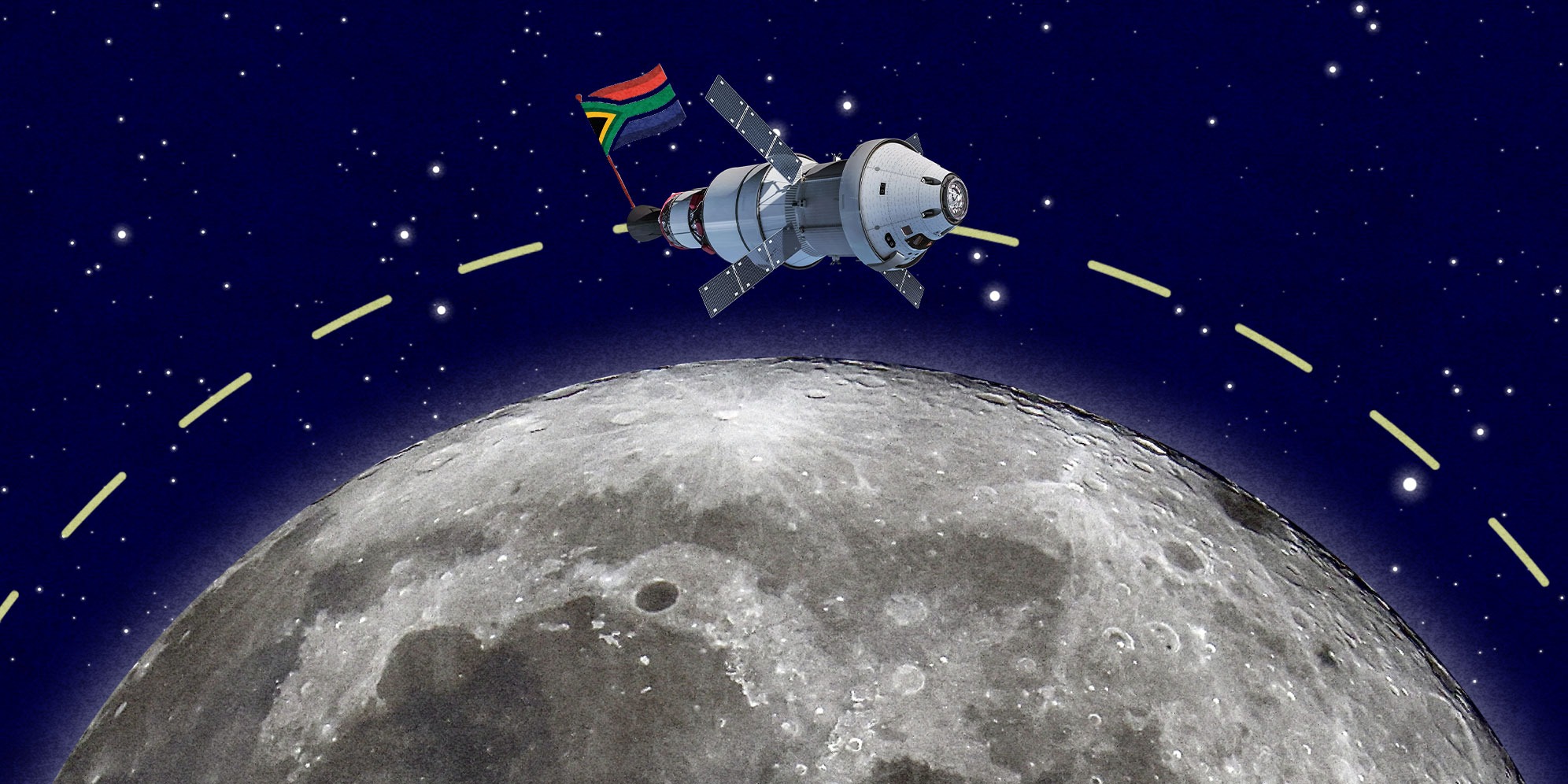
 Illustrative Image: Orion spacecraft. (Image: iStock) | Moon and starry night. (Image: Freepik) | (By Daniella Lee Ming Yesca)
 /file/dailymaverick/wp-content/uploads/2025/10/label-Op-Ed.jpg)
Artemis 2 was one of the most consequential milestones in space exploration in decades. As the first crewed mission to travel beyond low Earth orbit in more than 50 years, it took humanity farther than any previous mission, marking the beginning of what many see as a new golden era for deep-space missions.
It also captured global attention – drawing focus both to the intricate planning required to slingshot the Orion capsule around the Moon, and to more human details, such as how astronauts eat, sleep and pass time while 400,000km away from Earth.
In that sense, its ability to capture public attention was as important as its technical achievement – something many in the South African space industry believe should be urgently replicated locally (albeit at an appropriate scope and scale).
/file/attachments/orphans/13878705_571546.jpg "The rocket carrying the Orion capsule for the Artemis II mission lifts off from Launch Pad 39B at the Kennedy Space Center in Titusville, Florida, on 1 April. (Photo: Cristobal Herrera-Ulashkevich / EPA)")
A constrained talent pipeline
South Africa faces a well-documented shortage of engineers and technical specialists. Estimates vary, but industry bodies have for years pointed to a gap running into tens of thousands. Universities, hamstrung by poor school-level outcomes in science, technology, engineering and mathematics, produce far fewer graduates each year than the economy requires – particularly in fields such as electrical, mechanical and systems engineering.
This limited pool of graduates is then pulled in multiple directions. Locally, sectors such as energy, automotive, information technology and advanced manufacturing compete aggressively for the same skills, often offering attractive salaries and established career paths.
Internationally, the global space industry, amid a “new space” boom, is increasingly recruiting South African graduates and young professionals. While this outward flow can help build experience and networks, it further reduces the number of skilled engineers available to the domestic market.
The result is sustained pressure on South Africa’s space sector. In the Western Cape, a cluster of space engineering companies — many with roots in university-led satellite programmes — has established itself as a credible global player, exporting roughly $1-billion annually in high-value components and subsystems. These firms are growing, but they draw from the same limited and increasingly contested talent pool.
Feeding this pipeline is a university system that is narrow and fragile. Institutions such as Stellenbosch University and the Cape Peninsula University of Technology play a key role here, but they are among a small number of schools offering specialised training in space engineering – a constraint compounded by the fact that only a handful of individuals oversee these programmes, making them vulnerable and difficult to scale.
The power of large projects
Addressing this constraint requires creating a critical mass.
There are several ways to do this. School outreach programmes like MaxIQ.Space introduce learners to space and engineering concepts early; bursaries, such as those offered by the South African National Space Agency (Sansa) for space science and related research, help reduce financial barriers; while internship and graduate programmes provide pathways into industry.
These interventions are necessary, but their reach and visibility are limited.
Space engineering projects – for example, satellite builds – act as focal points that capture attention and help the sector compete for scarce engineering talent. They show students and early-career professionals that it is possible to work on technically demanding, meaningful and stimulating projects without leaving the country.
Large programmes also create space for a broader range of stakeholders across academia, industry and government to participate in a coordinated effort. This sparks collaboration, strengthens pathways between institutions, and stimulates the flow of people, ideas and activity within the ecosystem.
South Africa has seen this dynamic before. The SunSat programme in the 1990s and SumbandilaSat in the 2000s – the country’s first and second civilian Earth observation satellites – helped catalyse the training of more than 120 postgraduate engineers, including master’s and PhD graduates. Many went on to found or staff companies that now form part of the country’s space industry.
Scale, however, is central to this effect. While smaller satellite initiatives that followed SumbandilaSat – including ZACube-1, ZA-AeroSat and the MDASat constellation – contributed to skills development and research outputs, their limited scope, combined with varying levels of institutional and government support, constrained their influence and their ability to generate broad, sustained impact across the sector.
South Africa is ready for it
Importantly, South Africa already has many of the building blocks required for a major space engineering project.
Local firms such as CubeSpace, Simera Sense and Cubecom design and manufacture satellite components, subsystems and, in some cases, complete spacecraft. Universities have experience overseeing postgraduate research linked to real satellite builds. Private facilities such as NewSpace Systems and Dragonfly Aerospace offer advanced cleanroom and testing capabilities.
A large, coordinated project would bring this capability together, providing an anchor around which existing strengths can be organised towards a shared objective.
In doing so, it would help stimulate the broader value chain. A more active domestic build programme would strengthen the case for developing complementary capabilities, including launch systems and infrastructure undertaken by the Aerospace Systems Research Institute and Mura Space, as well as offering commercial opportunities for Sansa’s established tracking, telemetry and command services.
Over time, this would support the country’s efforts to reposition itself not only as a supplier of components and talent, but as a partner capable of delivering end-to-end space solutions.
A strategic imperative
This is an ambitious proposition, but it aligns with existing policy goals. Government strategies already emphasise strengthening digital infrastructure, supporting high-tech manufacturing and developing scarce skills. A well-designed space engineering project would reinforce each of these priorities and deliver public value.
Public perception will need to be addressed, however. Space remains largely invisible, and unlike roads or power stations, its benefits are less immediate and harder to see. This makes it more difficult to justify spending, particularly in a constrained fiscal environment where issues relating to water, energy, policing and a range of other day-to-day service delivery challenges dominate public discourse.
A tangible, well-executed space engineering programme can help address this by providing something concrete that the public can engage with, understand and assess. Done properly, it would also contribute to a broader sense of national capability and pride.
This does not remove the need for strong governance. Large public projects in South Africa carry well-founded concerns around cost, oversight and execution. These are not reasons to avoid them, but they do set a higher bar for how they must be designed and managed.
Ultimately, the argument for a national space engineering programme is strategic. Without sustained, ambitious projects, South Africa risks stagnating in a sector where it has a solid foothold. Skills will continue to drift, and opportunities will be missed.
With the right project, the opposite becomes possible: a stronger talent pipeline, a more integrated industry, and a firmer position in a growing global market. South Africa does not need to start from scratch; rather, it needs to decide whether it is prepared to build on what it already has. DM
Dillon Birns is a director at Plane Talking, a strategic communications agency specialising in the African aviation, defence and space industries. Professor Willem Jordaan is an associate professor in the Department of Electrical and Electronic Engineering at Stellenbosch University. Dr Arno Barnard is a senior lecturer in the Department of Electrical and Electronic Engineering at Stellenbosch University.