




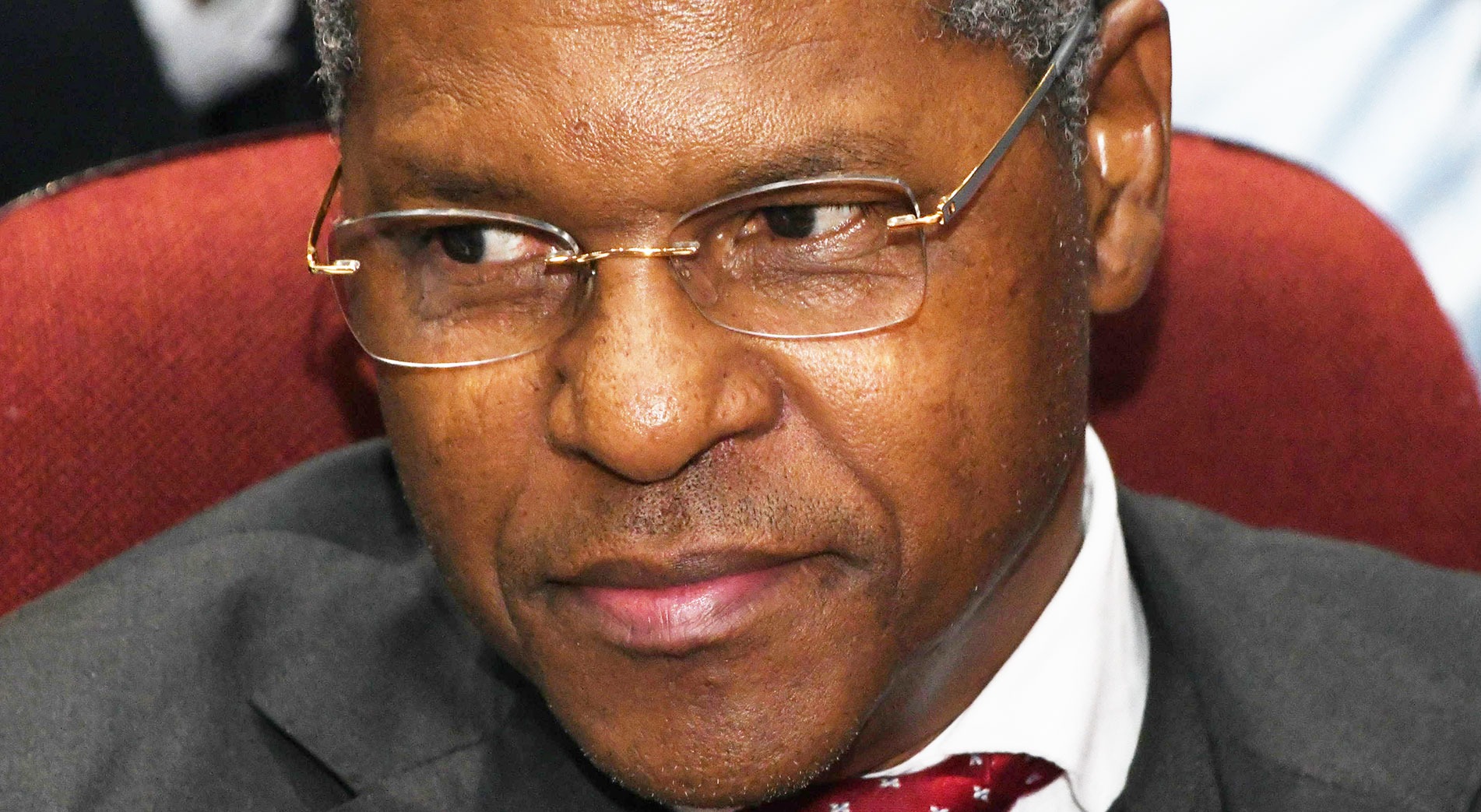
 Cooperative Governance Minister Velinkosi Hlabisa, who has emphasised that local government failures erode the SA economy’s growth potential. (Photo: Frennie Shivambu / Gallo Images)
 The latest Business Leadership South Africa (BLSA) Reform Tracker shows that while South Africa’s reform programme continues to move forward, the gains are uneven — and in some critical areas, momentum is slowing.
The tracker’s overall completion index has climbed to 71.75, up 27% since March 2024, suggesting that the structural reform agenda driven through Operation Vulindlela is delivering measurable progress.
But beneath that headline number lies a more complex reality.
Quarterly momentum has slowed sharply, with gains of just 0.4 points in the latest quarter, while governance — a foundational pillar of reform — has shown no movement for a second consecutive quarter.
And in freight logistics, a key constraint on growth, the index has actually declined.
For Junaid Kader, the head of public-private partnerships and infrastructure at the integrated workplace management solutions provider Tsebo, the message is clear: South Africa’s reform programme is working — but it is bumping up against structural limits that are increasingly difficult to ignore.
“South Africa’s infrastructure difficulties stem from a governance, financial discipline and asset management crisis,” said Kader. What appears as engineering failure is, in his framing, a financial governance crisis manifesting as an engineering failure, the visible expression of deeper structural gaps that have built up over time.
“Infrastructure has often been delivered without a genuine lifecycle approach,” he explained. “Assets are built and commissioned, but the long-term plan for maintaining them, the funding, the staffing, the systems, has not always followed. Decisions have historically been driven by upfront capital costs rather than the total cost of ownership over the lifespan of the asset.”
A reform programme that is working — on paper
Operation Vulindlela, the joint initiative between the Presidency and National Treasury, was designed to unblock structural constraints to growth — from electricity and logistics to water, visas and digital infrastructure.
Its Phase 2 progress report shows tangible movement across multiple fronts.
In electricity, reforms are advancing towards a competitive market, with the establishment of the Eskom restructuring task team and progress towards an independent transmission system operator.
In logistics, steps towards opening rail and ports to private participation are under way, alongside the creation of a transport economic regulator.
In water, institutional reforms and investment pipelines are expanding, with projects worth more than R100-billion under development.
And in visas, the roll-out of digital systems and new categories is aimed at attracting skills and investment.
Taken together, these reforms are designed to “reduce input costs, improve competitiveness, and create opportunities for private investment in key sectors of the economy,” according to the report.
But the system is hitting a wall
The problem, increasingly, is not the design of reforms, but their execution.
The BLSA tracker points to a structural tension at the heart of the reform process: state-owned entities such as Eskom and Transnet are both implementing and resisting change.
“This framework explicitly incentivises Eskom and Transnet to put their interests first,” notes BLSA CEO Busisiwe Mavuso, warning that reform progress can be slowed by institutional resistance.
/file/dailymaverick/wp-content/uploads/2021/12/ED_179802.jpg "Busi Mavuso, the chief executive of Business Leadership South Africa. (Photo: Masi Losi)")
But even that is not the most critical constraint.
The deeper issue lies closer to home — at the municipal level.
‘Our main problem is at local government’
That point was made bluntly by Cooperative Governance Minister Velinkosini Hlabisa during the BLSA engagement.
“We have agreed and confirmed that our main problem is at a local government space,” he said.
The implications are far-reaching.
“Any local government reform is an economic reform,” Hlabisa said, adding that South Africa’s growth trajectory depends fundamentally on whether municipalities function effectively.
“It is at the municipal level where the economy either succeeds or fails. If municipalities are dysfunctional, South Africa will not work, and the economy will not grow,” he said.
The frontline of failure
The consequences of municipal dysfunction are immediate and visible.
Businesses face unreliable electricity distribution, water supply disruptions, poor road infrastructure and delays in approvals and licensing processes.
/file/attachments/orphans/Pothole1a_406965.jpeg "A pothole at the intersection of Langerman Drive and Queen Street in Kensington, Johannesburg, on 3 March. (Photo: James Oatway / Our City News)")
“These challenges increase the cost of doing business and reduce competitiveness,” said Hlabisa.
Many companies have been forced to invest in private solutions — from generators to water storage — diverting resources away from expansion and job creation.
At the same time, investors are becoming increasingly wary.
“They ask whether infrastructure is reliable, whether services are stable and whether municipal processes are efficient,” he said.
Where the answer is no, investment goes elsewhere.
A governance problem at its core
At the heart of the municipal crisis is a governance failure.
Hlabisa did not shy away from identifying the causes.
“What caused this problem … deployment was at the centre,” he said, pointing to politically driven appointments and a lack of technical competence.
“The competency of the political leadership … is desired in most of them.”
This has created a system in which weak governance undermines administration, which in turn drives financial distress, infrastructure decay and service delivery failures — a cycle that reinforces itself over time.
“Financial weaknesses accelerate infrastructure decay, and service delivery failures erode trust. That cycle must be broken,” he said.
Reform meets reality
This is where the tension between national reform and local implementation becomes most visible.
Operation Vulindlela can design policy frameworks, pass legislation and coordinate reforms across sectors.
But it cannot fix a municipality that cannot manage its finances, maintain infrastructure or process approvals efficiently.
That gap is increasingly defining the limits of South Africa’s reform story.
The BLSA tracker reflects this disconnect. While areas such as financial sector reform and criminal justice are showing strong gains, governance — which includes local government performance — remains the weakest and slowest-moving category.
The risk to growth
Municipal performance shapes everything from the cost of doing business to the pace of investment and job creation.
And as Hlabisa pointed out, every business — large or small — operates within a municipal context.
“If that local space is dysfunctional, it affects the entire economy,” he said.
This is why reforming municipalities is now being treated as a central pillar of the broader economic reform agenda.
Can the system be fixed?
There are signs that the government is beginning to grapple more directly with the problem.
Operation Vulindlela’s latest report highlights growing momentum in local government reform, including the launch of the Metro Trading Services Reform Programme and progress on a new white paper on local government.
These reforms aim to professionalise administration, improve financial management and strengthen accountability.
But they are long-term interventions.
The immediate challenge is to stabilise municipalities and restore basic functionality.
Speaking at the launch of the Metro Trading Services Reform programme in March, the National Treasury director-general, Duncan Pieterse, noted that the Budget 2026 confirmed plans for R1-trillion of public investment over the medium term, with municipalities responsible for R205-billion of this and major allocations to transport, water and energy.
“The question that confronts us is the following: Which reforms will ensure that the R205-billion spent by municipalities is spent efficiently and effectively, in the interest of service delivery and growth?” he asked.
/file/dailymaverick/wp-content/uploads/2025/11/20251113_090145.jpg "The National Treasury director-general, Duncan Pieterse. (Photo: Neesa Moodley)")
Pieterse said that within the context of broader reforms, the Metro Trading Service Reform targeted a specific problem.
“Many of our cities are failing to provide services or to collect revenue adequately. Even when they do, the revenue they collect goes into the general municipal pot instead of being invested to maintain and upgrade infrastructure. As a result, the water leaks, the lights go out, the rubbish piles up. Bankers will not lend, and investors will not invest,” he said.
He cited an example. “The City of Johannesburg budget for 2025/26 estimates the city will collect R11.9-billion in revenue for water, but will spend only R1.3-billion on water infrastructure — less than 10%! eThekwini plans to collect R22-billion in 2025/26 from electricity charges. Almost 85% of this will pay for bulk charges to Eskom, and the city plans to spend only R784-million on electricity infrastructure — so not even 5%.”
The bottom line
South Africa’s reform programme is no longer about whether the right policies are in place. It is about whether the system can deliver them.
The BLSA tracker suggests that progress is real — but uneven.
Operation Vulindlela shows that the state can move when it is focused and coordinated.
But the municipal crisis reveals the limits of that progress.
And until that changes, South Africa’s growth story will remain constrained — not by a lack of ideas, but by a failure to execute them where it matters most. DM