




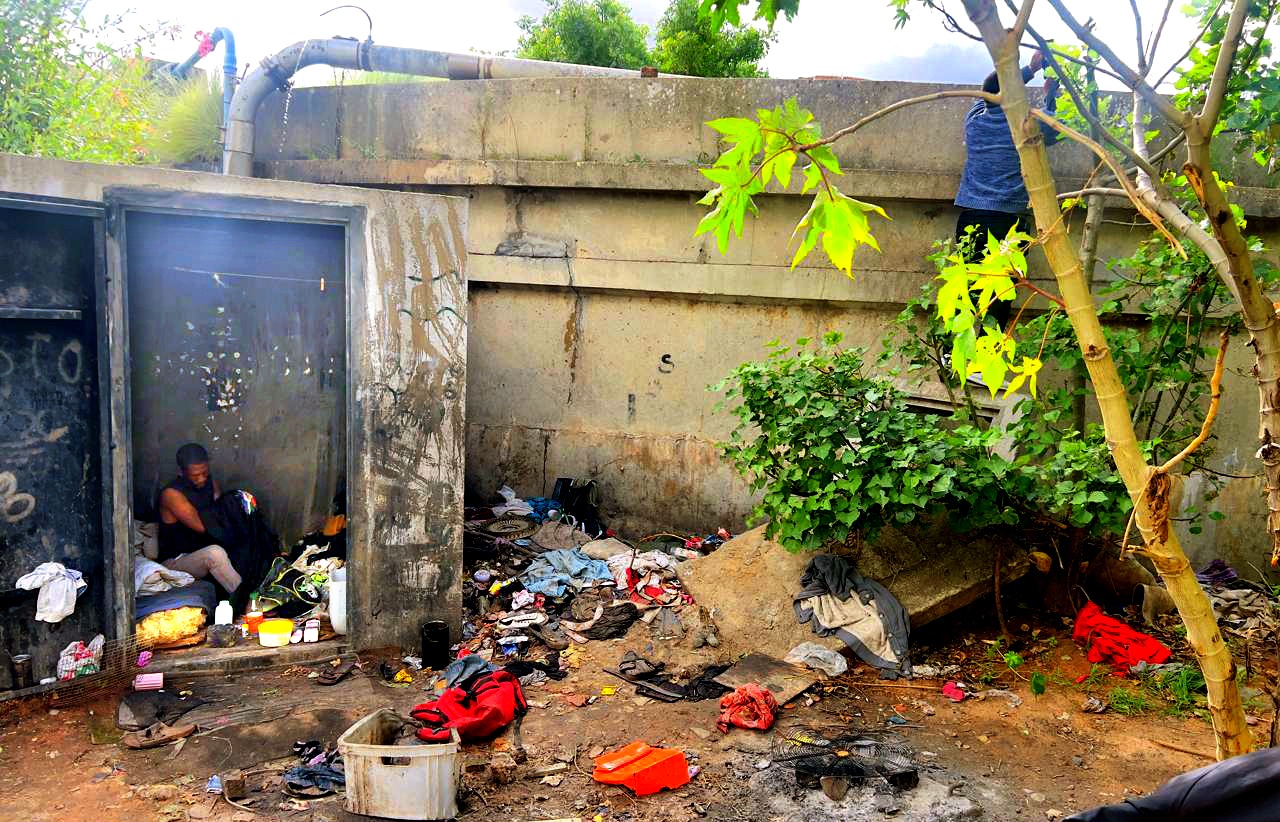
 Unsavoury conditions near the reservoir in Despatch where water contamination was detected early in April. (Photo: Supplied / Mthokozisi Nkosi)
 For two weeks, residents in Despatch, Eastern Cape, unknowingly consumed water from a reservoir that was contaminated with unacceptable levels of E. coli.
The Nelson Mandela Bay Metro detected the bacteria — which can trigger severe diarrhoea, vomiting and fever — between 7 and 21 April. Despite this discovery, the municipality failed to notify the community or issue any precautionary warnings, such as a “boil water” notice. Earlier this month, official testing at the reservoir recorded a count of 3 E. coli per 100 millilitres (ml).
According to the South African National Standard (Sans) 241, any amount of E. coli in water can cause acute health risks.
Municipal spokesperson Sithembiso Soyaya confirmed the detection of E. coli, stating that the recorded level of 3 E. coli per 100ml was “a low level and an isolated deviation which should not be exaggerated”.
He said that upon detection, the city immediately acted and implemented corrective measures to restore compliance.
/file/attachments/orphans/concrete_555948.jpeg "An unsavoury environment next to a water source in Despatch. (Photo: Supplied/ Mthokozisi Nkosi)")
“Municipality confirms that isolated water quality deviations were detected in Despatch through routine, regulated sampling conducted between 7 and 21 April. This constituted a precautionary compliance trigger, not confirmation of a public health hazard,” he said.
“Immediate response and action were undertaken. It is important not to conflate a compliance threshold with risk outcome, otherwise we will recklessly risk misleading residents and causing unnecessary panic.”
Soyaya confirmed that security was being intensified to prevent unauthorised access to the reservoir, specifically through infrastructure reinforcement and the removal of illegal occupants in the vicinity.
The reservoir grounds are currently occupied by a small community of unhoused individuals, some of whom have built structures or utilised the concrete facility itself for shelter. The site has fallen into severe disrepair, characterised by litter, overgrown vegetation, collapsed concrete enclosures and widespread vandalism of critical infrastructure.
Oversight visit
DA councillor Mthokozisi Nkosi conducted a caucus-led oversight visit to the three Despatch reservoirs and, after seeing the conditions, wrote to the office of the city manager on Wednesday to raise concerns.
“What we observed is deeply alarming and warrants immediate intervention. Squatters and vagrants have taken up residence in and around the reservoir sites, and the conditions are filthy. Disturbingly, some individuals are living directly on top of the reservoirs themselves.
“There is clear evidence of human faecal matter in the immediate surroundings, and from what we observed, it appears that these individuals are using the reservoir water for bathing, cleaning, and other sanitation purposes,” he wrote.
Nkosi said this posed a direct and immediate threat to the potable water supply of the entire area.
Additionally, none of the three reservoirs is secured, which Nkosi said creates a significant risk of cross-contamination and sabotage.
“The ward councillor has also received numerous complaints from local doctors reporting an increase in gastrointestinal illness among residents, which strongly suggests a link to the water supply.”
Nkosi referred to serious and elevated water contamination levels a few years ago when Despatch experienced a water safety crisis.
“That placed residents at considerable risk. If decisive action is not taken now, we will inevitably see this scenario repeat itself, and the consequences for public health could be severe.”
/file/attachments/orphans/Filth_687009.jpeg "Rubbish and human faeces are strewn in the vicinity of the reservoir in Despatch where a small community of unhoused people are living. (Photo: Supplied / Mthokozisi Nkosi)")
Environmentalist and Eastern Cape chair of the Wildlife and Environmental Society of South Africa, Gary Koekemoer, said if water testing found E. coli contamination above acceptable levels, the origin was likely to be further upstream and not due to contamination at the reservoir.
“Certainly, if the reservoir is small enough, and there are a lot of people making a mess directly into the water, then E. coli contamination is possible.
“But making a mess near or around the facility would not contaminate the water inside. The mess would not be able to penetrate the concrete reservoir. The far more likely scenario is a broken sewage pipe that is leaking into the system that feeds the affected reservoir.”
Stomach aches
Koekemoer noted that while residents were reporting stomach aches and doctors were seeing an uptick in gastrointestinal cases, linking these ailments directly to the town’s water supply was difficult. He said that without a large-scale outbreak, medical professionals would struggle to definitively trace a few isolated cases to contaminated municipal water.
A doctor in town, who asked to remain anonymous, confirmed this sentiment.
“Sure, we’ve seen maybe three or four more people come in with stomach cramps, nausea and a bit of gastro, but that could be caused by a myriad of factors.
“Yes, it could be the water, but it could also be something they’ve eaten, allergies, or a tummy bug doing the rounds. But stating definitively that it is the town’s water would be irresponsible,” said the doctor.
Soyaya said while the city does not declare water unsafe on its own, after the E. coli was detected, they activated immediate intervention protocols such as chlorination and conducted follow-up sampling to confirm restoration of zero E. coli per 100ml.
“Immediate corrective interventions, including chlorination and compulsory resampling in full compliance with prescribed national standards, were implemented without delay. The municipality’s water quality management system remains fully operational, safe, and compliant with all applicable regulatory requirements,” he said.
“Residents are assured that the water quality management system is actively monitored, controlled and compliant, and that any verified risk will be communicated through official channels without delay.”
Soyaya condemned the circulation of misleading and unverified claims, which he said had created unnecessary public concern and mischaracterised a controlled technical process as a public health crisis.
“Accordingly, any assertion that the municipality has failed in its duty of care, or that the water supply has caused illness, is unsupported by evidence, reckless, irresponsible, inconsistent with scientific assessment, and contrary to the municipality’s demonstrable compliance with legislative and regulatory frameworks.”
Mayor Babalwa Lobishe stated: “The municipality has acted lawfully, responsibly and decisively. Our systems are working, and our response has been immediate and aligned with both legislation and best practice. We will not allow reckless misinformation to distort the facts or undermine public confidence.” DM