



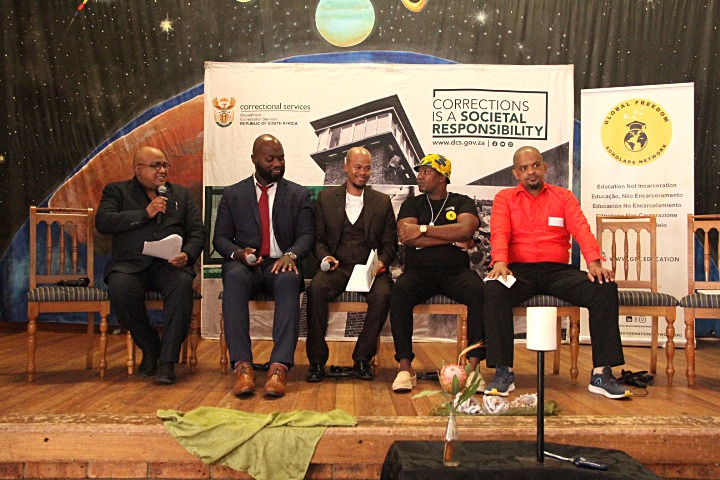
 Incarceration Nations Network panel discussion, at Brandvlei Prison, Western Cape on 16 April 2026. (Photo credit: Danny Murillo)
South Africa’s incarceration rate is ranked among the highest in the world and the highest in Africa, so it was no surprise that a much-needed intervention such as the Incarceration Nations Network’s (INN’s) latest initiative, the Global Freedom Consulting Agency, was launched in Cape Town last week.
The latest estimations put our re-offending rate at 97%, which is shockingly high and is largely attributed to our country’s untenable levels of poverty, unemployment, substance abuse and gang culture.
In October last year, Minister of Correctional Services Pieter Groenewald announced that 18,000 parolees had reoffended in South Africa over the past three years. He attributed this to the overdue parole review process as well as inadequate risk assessments.
A transnational approach to justice
The agency is made up of alumni from INN’s Global Freedom Fellowship programme, which, over three years, brought 46 Fellows from 26 countries to South Africa to learn and build together across borders. The aim is to shift the justice system from one of retribution towards rehabilitation.
/file/attachments/orphans/DrBazDreislingerspeakingatBrandvleiPrisonWesternCapeon16April2026_921700.jpg "Dr Baz Dreislinger speaks at Brandvlei Correctional Centre, Worcester, Western Cape, on 16 April 2026. (Photo credit: Danny Murillo)")
INN founder Dr Baz Dreisinger said, “We are thrilled to give leaders with lived experience a global platform to continue their vital work and launch new projects. In the name of transnational justice, we expect GF Consulting to change lives across all walls and borders”. Dreisinger highlighted that South Africa had the highest incarceration rate in Africa and that GF Consulting was dedicated to being smart on crime.
The event was very much centred on Nelson Mandela, who emerged as an incarcerated political prisoner and went on to be one of the most recognised and respected global leaders. Honouring Mandela’s legacy at St George’s Cathedral on the second day was Verne Harris, Head of the Memory Programme at the Nelson Mandela Foundation’s Centre of Memory and Dialogue.
He spoke of how the world often represented Mandela as having emerged from prison after 27 years with no bitterness. However, Harris said this was not true. Through his interactions with Mandela, he saw the late South African president had a deep wound, but had chosen to channel the bitterness into a force for positive change.
He replayed an interview Mandela had with a journalist on the subject of bitterness, in which he said “…bitterness comes very easily when one is idle and has nothing to do. If you are busy with something positive, constructive and rewarding, you are likely to forget experiences which have been counterproductive”.
/file/attachments/orphans/VerneHarrisHeadoftheMemoryProgrammeattheNelsonMandelaFoundationsCentreofMemoryandDialoguespeaksatStGeorgesCathedralCapeTownatIncarcerationNationsNetworkeventon15April2026_560094.jpeg "Verne Harris, head of the Memory Programme at the Nelson Mandela Foundation’s Centre of Memory and Dialogue, speaks at St George’s Cathedral, Cape Town, at the Incarceration Nations Network event on 15 April 2026. (Photo credit: Danny Murillo)")
This set the tone for discussions at the conference, with Harris affirming that INN exemplified people doing positive and constructive work.
Abigail Noko from the office of the UN High Commission on Human Rights lamented how historically, the law had been used to exclude, and that there was a need for a more “people-centred approach” to issues of justice.
Conversations with a reformed offender
“The same effort you had to do the wrong thing, you must have to do the right thing.”
INN Trinidad and Tobago team leader Nicholas Khan emphasised these words while speaking to Daily Maverick during the three-day conference in Cape Town, where the organisation, in partnership with the United Nations, launched the Global Freedom Consulting Agency, comprised of formerly incarcerated leaders.
Khan’s story spans a period of being in and out of prison from the age of 17, and it was after a murder conviction at just 19 that he said gave him a “reality check” on the dangerous road down which his life was headed.
It was then that he was introduced to rapper Tupac Shakur’s book of poetry titled The Rose That Grew From Concrete, and from there, his love of words and language bloomed.
He has now published two poetry books of his own, from which he shared two during the launch. After his release in 2023, he became a Reintegration Coordinator for the Link Up program, a Prison-to-College Pipeline initiative through the College of Science, Technology and Applied Arts. He was also awarded a full scholarship to earn his degree.
He says working with youth energises him as he can relate to where he found himself in his youth, and that he constantly reinforces taking responsibility for one’s decisions and the resulting outcomes.
/file/attachments/orphans/Kofi-Baso-speaking-at-Brandvlei-Prison-Western-Cape-on-16-April-2026-1_978653.jpg "Kofi Danso speaks at Brandvlei Correctional Centre, Worcester, Western Cape, on 16 April 2026. (Photo credit: Danny Murillo)")
Kofi Danso, who is part of the South African chapter of INN, said that being transferred from Drakenstein Correctional Centre to Brandvlei is what turned the corner for him, leading him on journey where he found a love of education. Danso completed his LLB studies in 2025 and is the reintegration leader at the Ubuntu Learning Community (ULC), a partnership between Brandvlei Correctional Centre and Stellenbosch University, which was launched as part of the Prison-to-College Pipeline-SA initiative.
Danso works with students coming out of prison, supporting them with their reintegration and their continued studies, who were present at the event. Speaking directly to the incarcerated students in attendance, an emotional Danso said, “Brothers, I want to encourage you to know there is life after incarceration, continue to pursue your education…
“We are here today to advise government, philanthropists and others that education saves lives … education reduces recidivism.”
/file/attachments/orphans/WesternCaperegionalcorrectionalservicescommissionerAdvChantelleWilliams-PaulsespeakingatBrandvleiPrisonWesternCapeon16April2026_590638.jpg "Western Cape regional Correctional Services commissioner advocate Chantelle Williams-Paulse speaks at Brandvlei Correctional Centre, Worcester, Western Cape, on 16 April 2026. (Photo credit: Danny Murillo)")
Also in attendance was the Western Cape regional Correctional Services commissioner, advocate Chantelle Williams-Paulse, who welcomed the organisation’s intervention, highlighting that it aligned with the department’s motto of, “corrections is a societal responsibility”.
/file/attachments/orphans/ProfessorMolokoSepotaUNISARegistrarspeakingatBrandvleiPrisonWesternCapeon16April2026_177827.jpg "Unisa Registrar Professor Moloko Sepota speaks at Brandvlei Correctional Centre, Worcester, Western Cape on 16 April 2026. (Photo credit: Danny Murillo)")
With Unisa on board as a key partner, and education identified as a key part of the arsenal towards stemming re-offending, Unisa Registrar Professor Moloko Sepota committed the institution’s ongoing support, noting that education was a “profound instrument of liberation” that shaped critical thought and affirmed human dignity both for individuals and society.
Sepota affirmed that education was “an instrument of rehabilitation, reintegration and advancing justice”. DM
CORRECTION: This article was updated on 24 April to correct the spelling of Kofi Danso's surname, that he was transferred from Drakenstein Correctional Centre and completed his LLB studies in 2025.
Comments
Scroll down to load comments...