




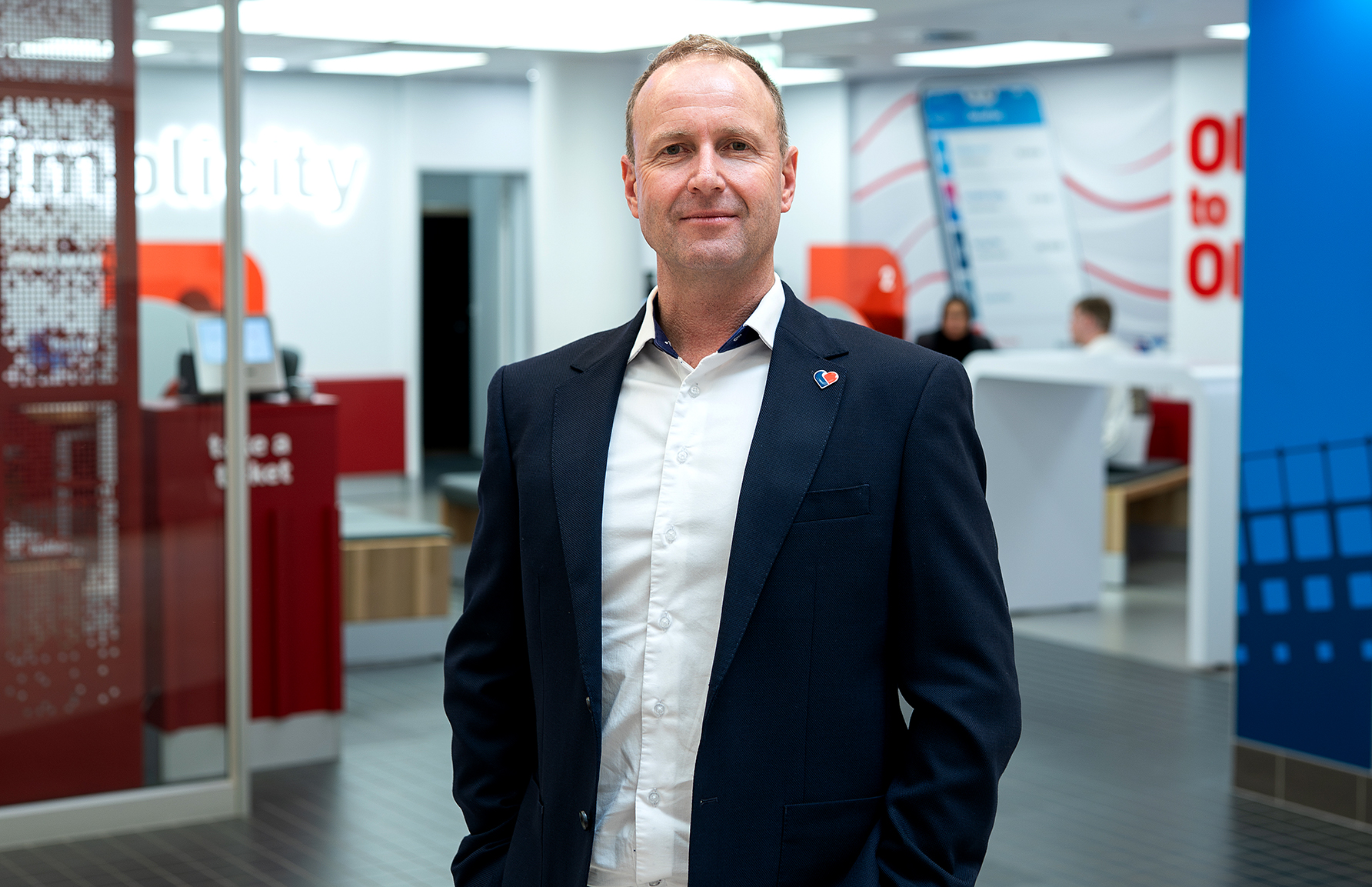
 Capitec CEO Graham Lee. (Photo: Capitec)
 Capitec’s annual results come wrapped in familiar bragging rights: headline earnings up 23% to R16.8-billion, return on equity at 31%, and 26 million active clients now inside its orbit. But the more interesting story is not the size of the profit jump. It is the shape of the business producing it.
Beneath the celebratory gloss, Capitec is steadily reducing its dependence on lending and leaning harder into the sticky, everyday revenue streams that customers are less likely to abandon when times get tight.
For years, the bank has been understood as a high‑efficiency unsecured lender. That description is becoming outdated. The latest results show a business increasingly driven by payments, insurance, mobile services and everyday transactions — the things customers keep doing regardless of where the economic cycle turns.
Non‑interest income now makes up 67% of income from operations after credit impairments.
Capitec CEO Graham Lee framed the results as a continuation of a long‑running philosophy: “Our growth over the past year reflects 25 years of staying focused on what matters most: making banking simpler, more accessible and more affordable for our clients.”
Over the past year, Capitec returned R1‑billion to clients through lower fees, pricing adjustments, cashback and rewards.
Lee explained the logic clearly: “That scale creates economies, and we share those economies back with our clients.”
The effect is cumulative. Lower costs increase engagement. Higher engagement deepens the relationship. A deeper relationship creates more opportunities to sell additional services — insurance, data, payments, credit — at very low marginal cost.
The result is a business that increasingly resembles an ecosystem.
Personal banking: The launch pad
/file/dailymaverick/wp-content/uploads/2022/04/GettyImages-1233020760.jpg "Customers queue at a Capitec branch ATM in the central business district of Johannesburg. (Photo: Guillem Sartorio / Bloomberg via Getty Images)")
This is most visible in the composition of earnings. Fintech and insurance together now contribute more than half of headline earnings, while personal banking remains the engine that powers distribution. Lee described it as a deliberate structure: “The personal bank is the launch pad from which all of our other businesses fly.”
That launch pad is expanding quickly. Insurance income grew 38% over the year, supported by strong demand for simple, low‑cost cover. Value‑added services and Capitec Connect also grew 38%, driven by everyday usage — airtime, data, electricity and payments.
These are small transactions individually, but at scale, they become a powerful revenue stream.
It is also a more resilient one.
Consumers under pressure may reduce discretionary spending, but they still transact. They still buy airtime, pay bills, move money and maintain essential services. That behaviour underpins a more stable earnings base.
The shift matters because the macro environment is turning again. Oil price shocks, global instability and the knock‑on effects for inflation and interest rates are already filtering through.
Lee acknowledged the reality during the results presentation: “Consumers and businesses in South Africa will remain under pressure, and we will support them through that pressure.”
Gary Davids, an investment analyst at Sanlam Private Wealth, says the bank’s growth trajectory looks increasingly structural, driven by revenue diversification across lending, insurance, payments and value‑added services, alongside scalable growth in business banking and the optionality of AvaFin.
“The evolving earnings mix makes Capitec more defensive on volatility, assuming insurance persistency holds, fintech pricing remains regulator‑safe, and growth is not driven by loss‑leading behaviour. Usage‑based revenues (payments, VAS, mobile) tend to be less cyclical than unsecured credit; fintech volumes may soften, but they rarely cliff in tough times, unlike lending,” he noted.
Davids says funeral insurance earnings are also relatively resilient, with lapses typically stable unless consumer stress escalates sharply. “The trade‑off is higher platform execution and conduct risk, as success increasingly depends on ecosystem scale and operational discipline rather than traditional banking spreads.”
A lending hand
Capitec continues to grow its credit book aggressively, with total loan disbursements up 34% to R98.3‑billion. At the same time, the credit loss ratio ticked up to 8.1%.
/file/dailymaverick/wp-content/uploads/2025/10/Branch-Photos-02.jpg "Capitec’s latest annual results show a 23% profit increase, but the bigger story reveals its shift from traditional lending towards a multifaceted ecosystem of services, including payments and insurance. (Photo: Capitec)")
The increase is noticeable, but it sits within the bank’s own expectations and reflects a combination of growth and a more challenging consumer environment.
Lee emphasised that growth was not being driven by looser standards: “We are approving more because we know our clients better — not because we have lowered the bar.”
Which is interesting because it speaks to one of Capitec’s core advantages: data.
With 15 million active app users, the bank has a deep, real‑time view of how customers earn, spend and manage their money. That data feeds into credit decisions, product design and risk management.
It also strengthens fraud prevention. Over the past year, the bank blocked more than 131,000 fraudulent beneficiaries and prevented hundreds of thousands of scam payments, saving clients significant amounts of money.
As Lee emphasised: “The trust that 26 million South Africans place in us is something we value deeply, and it remains the foundation on which we continue to build.”
Trust is reinforced through pricing, reliability and security. It is also reinforced through presence.
One in three South African adults now uses the Capitec app. That level of penetration moves the bank beyond competition and into infrastructure. More importantly, that positioning opens up new avenues for growth.
Let’s get down to business
Business banking is one of them. The number of entrepreneurs and small businesses using Capitec grew 71% over the past year, reflecting demand for simpler, lower‑cost banking solutions.
This segment remains early in its development, but it offers a longer‑term opportunity to embed Capitec more deeply in the productive economy.
The model is familiar: attract clients with low fees and strong service, then expand the relationship over time.
Behind all of this is a consistent emphasis on discipline.
“Earnings quality is further improved by the rising contribution of non‑interest revenue, making the group less exposed to interest‑rate cycles. While weakening consumer conditions would broadly impact the sector, Capitec remains well-capitalised and operationally prepared, with business banking providing an additional medium‑term growth lever,” Davids observed.
Operating expenses grew 12%, broadly in line with investment in technology and strategic initiatives. The cost‑to‑income ratio remains tight, reflecting the bank’s long‑standing focus on efficiency.
Lee framed this as a deliberate choice: “We build that resilience deliberately, and we build it every year.”
Capitec’s trajectory over the past decade has been defined by steady expansion into adjacent areas, each building on the same core principles of simplicity, accessibility and affordability.
Those principles remain intact, but the breadth of the offering to customers has expanded.
Capitec is no longer just a bank that lends money and processes transactions, but is becoming a platform that sits across multiple parts of a customer’s financial life.
That evolution is still under way. For now, the numbers tell a story of strong growth. The underlying structure suggests a business that is positioning itself to remain relevant, and resilient, in a far more demanding environment. DM