




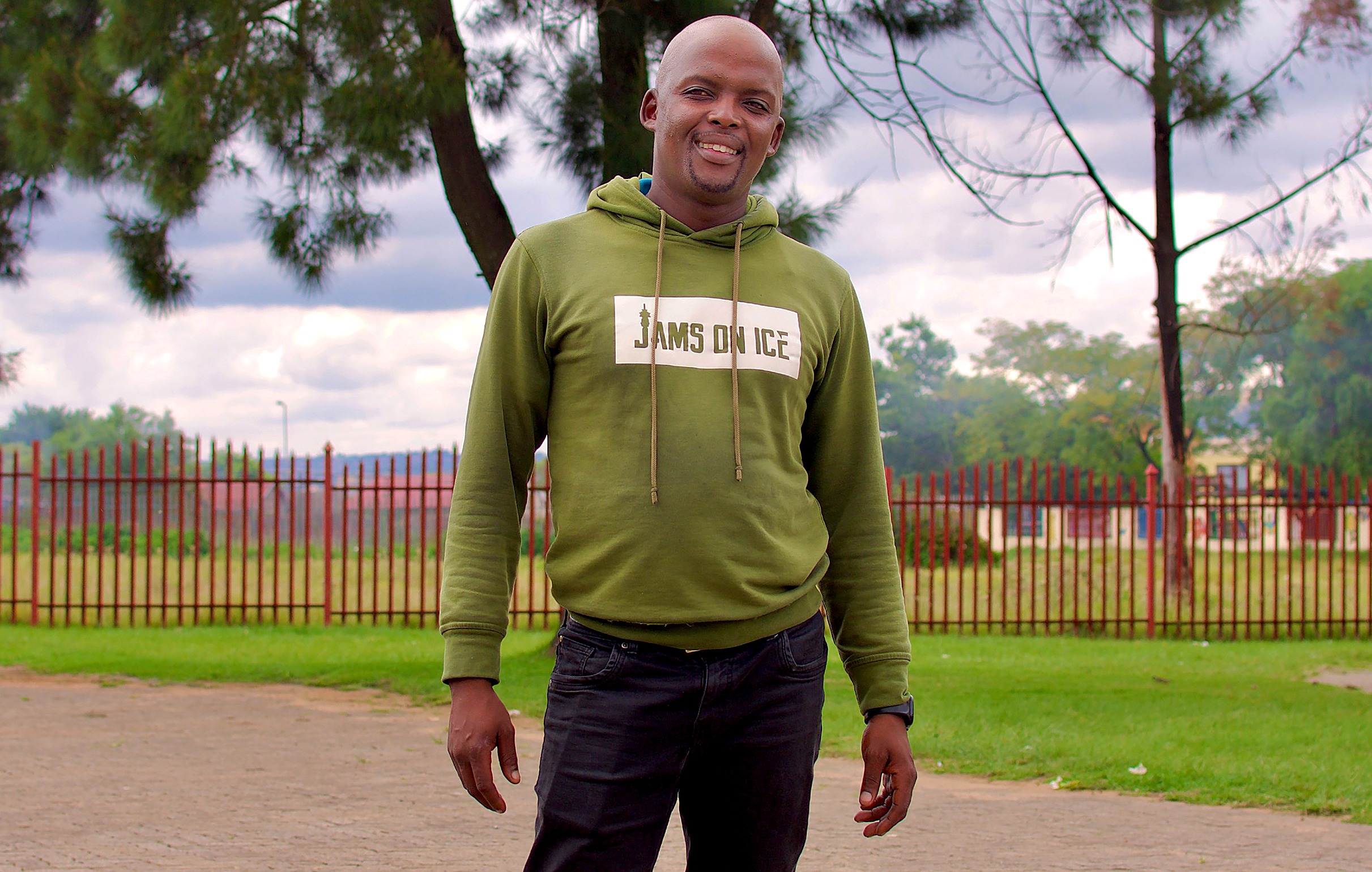
 Tshepo Tlapu stands on steady ground. Once lost to addiction, he is now a source of light for others finding their way back. (Photo: Oliver Roberts)
If you happen to be in Orlando West on a Saturday morning you might hear children’s laughter and shouts of “Badoo! Badoo!” drifting on the warm, clear air. Follow the sound through the streets and you’ll enter the grounds of the Ikageng Itireleng Aids Ministry – you’ll know you’re there when you get to the playground and trampoline. Then, through the windows of one of the buildings, you’ll see it: a classroom of children doing strange dance moves, removing one of their shoes, and singing about peanut butter.
You wouldn’t know it, but minutes earlier these same children were sitting in a lesson, listening bright-eyed, hands shooting up in unison when asked a question. At one point you might even spot the moment one of them – a girl with neat braids – actually corrects the teacher. “You missed the apostrophe on that word,” she says, pointing to the whiteboard.
The man who sparked the joyous disruption – the running, the shouts of “Banana!” “Spiderman!” “Superman!” – is Tshepo Tlapu, who works as an educator, mentor and substance abuse counsellor at Ikageng. The games – “Icebreakers” – are largely his invention, and were created to make learning fun.
But it wasn’t long ago that Tlapu – now 37 – had toppled into a void from which there seemed no escape, no redemption.
The fall
At 18, Tlapu was picked up to play cricket at an elite level. A gifted bowler who started at his local club, Tlapu passed through the lower ranks with ease and seemed on the verge of making it big. Ahead of him, blazing, lay a future of fame, money and international travel.
His secret, though, and the thing that would be his downfall, was an addiction to drugs.
He started smoking dagga heavily in Grade 10. His cricket survived it. Other things didn’t. He failed Grade 11 and lost his bursary at Yeoville Boys’. After training one night, he drank with teammates despite a match the next day. Someone offered him something to avoid the hangover. It was crack cocaine.
Later, on tour in Australia, customs searched Tlapu and found drugs in his kit bag. He was sent home immediately, his cricket career cut short.
“Then,” he says, “because of the pain that shook me, I started using more and more.”
He and a friend who had also been dropped from the team turned to heroin, smoking it daily. He lied to his family, stole from home and spent what little money he had on drugs.
The addiction deepened – he lost weight, sold his phone during withdrawal, and was eventually forced out of the house.
He began living on a dumpsite, sleeping in pipes, scavenging for food and scrap. “I was a walking skeleton,” he says. “The next step was death.”
The turning
One morning in 2019, he woke – surrounded by rats and sewage – and was filled with a clarity he still can’t define. “Something said, ‘This is not you’.” Filthy and ragged, clothes hanging from his depleted frame, he found his way to Ikageng. From there, with the help of founder Carol Dyantyi, he was taken to a rehab centre in Randfontein.
He returned to Ikageng as a volunteer, attending NA meetings and beginning to work with young people. It was there, he says, that he started to see his purpose.
Given a role as a substance abuse coach, he focused on education – training in HIV testing, mentoring vulnerable children and speaking openly about his own addiction. “Speaking with kids is actually what I love,” he says. “Maybe God sent me here – I was not meant to be flying in airplanes, playing cricket all over the world.”
He later worked at Camp Footprint, a programme that brings together children with disabilities and those living with HIV, creating spaces where they can learn, connect and feel seen.
The work of light
“It’s something you can’t explain,” he says about the meaning he gets from the work. “I see it as the fruits of recovery – being loved and being trusted, and being able to help others.”
He remembers one girl in particular. HIV positive, she lost both her parents in a shootout when she was just one. Police found her in the back seat, tiny and sleeping. She was taken in by her grandmother.
Tlapu became her mentor. Now 20, she has finished her schooling and wants to be a flight attendant.
“She’s one of my inspirations,” he says. “She came from a struggle and now she is standing tall.”
But, for all the success stories, there are others that don’t turn out. Gazing out from a doorway overlooking the playground at Ikageng, Tlapu reflects on those he couldn’t save – like the two girls who came to him for help. Brilliant students, both awarded university bursaries. Both now gone, without a trace.
“Yoh, yoh, yoh,” he says. “That’s the part that makes me think I should go back and smoke. Losing someone makes me question if I did something wrong. I blame myself – but I know I shouldn’t.”
Tlapu, though, has come to accept that he cannot save everyone. He is focused on completing matric, while continuing to educate and create opportunities for children.
He believes the change begins young. Teach a child to love books at nine or 10, he says, and by 18 they will be searching for more. Break the cycle of substance abuse at school level – through mentors, social workers and programmes that meet children where they are. “We can be that help inside the school.”
Throughout the interview a small presence sits quietly on the chair beside Tlapu – his daughter, Lesedi, her name meaning “light”. She is nearly four. Her mother works at Ikageng as a caregiver for the Department of Social Development.
He vividly remembers the day she was born.
“I don’t have words for those emotions,” he says, reaching over to rub Lesedi’s small shoulders. “I won’t touch drugs again because of her.”
He pauses.
“I gave her the name. The first time I touched her, I said, ‘This is my light’.” DM
Oliver Roberts is a multi-award-winning journalist, writer and photographer whose work has been published locally and internationally.
Comments
Scroll down to load comments...