




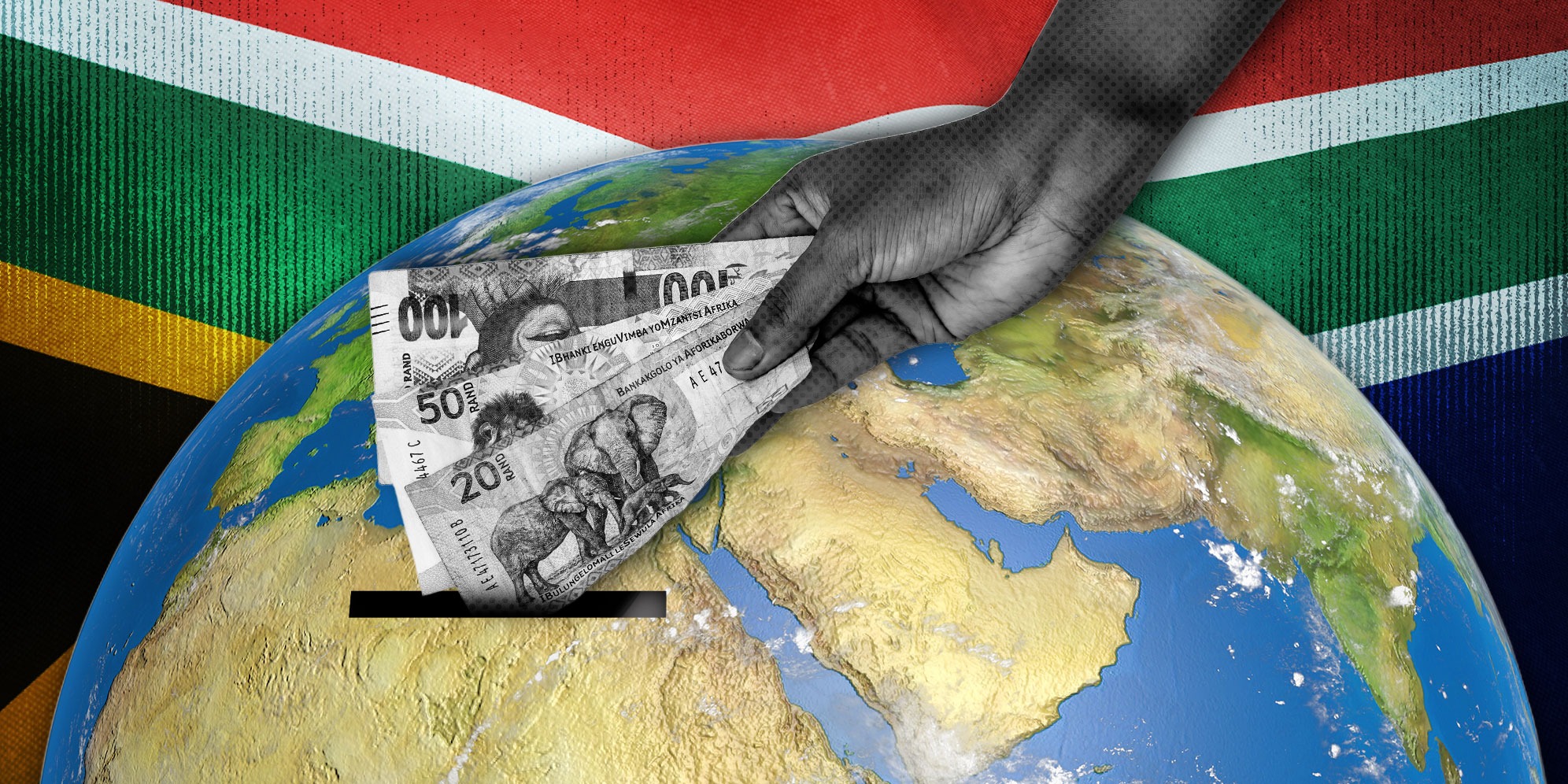
 Illustrative Image: South African flag. | Hand holding SA currency. (Image: Freepik) | Globe. (Image: iStock) | (By Daniella Lee Ming Yesca)
 /file/dailymaverick/wp-content/uploads/2025/10/label-Op-Ed.jpg)
The government’s recent 6th South Africa Investment Conference focused on the cumulative pledged amounts of capital as a yardstick to measure its outcome. This is the wrong metric. The underpinning of such a gathering should be the importance of attracting and embedding intellectual property (through investment) in the economy.
SA is not a stereotypical cash-starved developing country. It has deep capital markets with a highly sophisticated banking sector. The Johannesburg Stock Exchange is ranked 17th globally, with a market capitalisation of R24.3-trillion (60% of the African continent’s total equity market value), while the asset management industry holds assets of more than R12-trillion. More than capital, SA needs the skills, intellectual property and technology that come with the money. And that means foreign direct investment (FDI).
What then makes FDI so essential to the growth of an economy? While many factors contributed to the stagnation of the South African economy, the most important factor is weak, shrinking investment. This is because investment is the prime mover of economic growth, and when the locomotive falters, the entire train slows.
World Bank data show that average annual investment in SA dropped from 17% of GDP in the first half of the 2010s to 15% in the second half of the decade, and has fallen further to 12% in the first half of the 2020s. This compares very poorly with Rwanda and Mauritius, two of the most dynamic African economies, where annual investment averaged 28% and 21% of GDP, respectively.
The government’s structural reform priorities under Operation Vulindlela – intended to address some of the country’s binding constraints choking economic growth – are sensible and necessary, and their effective implementation would certainly create the much-needed enabling conditions to encourage new investment. However, it is surprising that its 19 targeted milestones do not mention the urgent need to mobilise FDI.
There has been an unwarranted, ideologically driven reliance on the public sector to generate the needed capital, and a dependence on government agencies and state-owned enterprises to do the investing. The fact is that SA’s high public sector debt, calculated at between 78.9% and 129% of GDP (depending on whether SOE debts are included) and a fiscal deficit of 4.5% of GDP, seriously constrains the government’s fiscal capacity to invest anywhere near enough to put the economy on track to realise robust growth in the economy. This is apart from questions about the government’s ability to allocate and manage capital efficiently.
Structural and regulatory barriers
The fact is that SA’s ability to attract FDI has waned in tandem with its anemic GDP growth. It dropped from just over 1% of GDP per year in the first half of the 2010s to below 1% per year in the second half of the decade. SA’s FDI has averaged 1.5% of the size of its economy over the past decade where the global average is about 4.5%. A successful emerging market country should attract FDI exceeding 5-6% of its GDP annually. SA’s structural and regulatory environment prevent this.
This dismal record of FDI inflows is part and parcel of SA’s economic stagnation. From an economic development perspective, FDI punches well above its weight because it typically brings with it many benefits that extend beyond capital.
First and foremost is new knowledge (intellectual property). A foreign business regularly brings with it technology, production processes or new product design and service offerings – often hard-to-acquire operational and management capabilities gained from a long history of practice and experience. All these are introduced into the new market through FDI.
Second, there is labour productivity. The international investor creates a working environment where local hires work alongside foreign staff, and where training and skills transfers are not only inevitable but imperative for the foreign business to succeed. The same knowledge transfer happens when the foreign business engages local suppliers and partners. From a host country perspective, it is no surprise that business operations spawned by FDI are a major asset in upgrading domestic human capital.
Third, FDI brings access to new business networks, international connections, and markets. This is especially true when foreign investors export goods or services produced in their host country. They help internationalise the host country’s economy by building connections to new overseas markets, thereby integrating the local economy into global value chains.
Fourth, the entry of foreign companies (in a conducive investment environment) helps to break domestic monopolies that stifle competition, which over time has accumulated to reduce a local market’s economic efficiency, not to mention inflating prices. Foreign companies force local companies to innovate and become more competitive, thus raising overall productivity.
Over-regulated
This last point is crucial. Contributing to SA’s dismal economic growth performance is the “rentier” nature of its economy, stemming from a policy environment that has sought to over-regulate and protect against foreign competition, particularly in the infrastructure and power sectors. Productivity has been stifled by a structure that encourages rent-seeking behaviour.
Flows of technology and intellectual property do not miraculously appear in an economy. Rather, technology is embedded in companies and in the collective minds of their employees. However, of the four economic “flows” that drive globalisation – finance, goods, services and labour – it is the latter that attracts a protectionist sentiment. But it is FDI that carries with it the human capital that provides the skills and innovation that developing countries, in particular, require and are competing for.
In addition, the return of a diaspora also contributes to economic competitiveness. However, a sizeable diaspora is a high-value asset only if they are motivated to return due to improving economic conditions at home. This is where FDI is critical. Historically, successful emerging markets typically exhibit a pattern of rising FDI inflows accompanied by a return of diaspora.
China, India, Israel and Ireland have leveraged their global communities for capital and technology transfer. Emerging examples are Vietnam, Kenya and Egypt, where migrants are becoming the largest investors in their home economy, often surpassing usual FDI and developmental loans combined. SA has yet to recognise this as a vital source of economic renewal.
Now more than ever, the proactive promotion of FDI and all the benefits that come with it will shape the competitiveness of developing countries. A few countries get this. Despite its tremendous success in attracting FDI to power its rapid industrialisation and strong economic growth, China has continued to emphasise the vital role of FDI.
Even though it is now the world’s second-largest economy, China has further liberalised its economy to attract FDI. According to China’s State Council, “foreign investment plays a significant role in fostering new quality productive forces and advancing Chinese modernisation” in sectors including industry, services and finance.
Similarly, the success of Hong Kong SAR, Singapore, Switzerland, and the United Arab Emirates has been due to their ability to entrench multinational firms within their economic DNA, making them strategic gateway economies for their own regions and beyond.
SA’s comparative advantage eroded
SA needs to act urgently to reinforce its incumbent position in the African region. SA’s comparative advantage has been significantly eroded, and so much value has been lost due to counterproductive policies that discouraged FDI.
The bottom line is that FDI is the catalyst of a virtuous economic cycle. FDI brings new knowledge, alongside capital, to the host country. This combination sparks growth in productivity and competitiveness. Rising productivity creates new and better-paid jobs, which in turn increases private domestic consumption, leading to an expanding middle class.
Stronger consumption in turn transforms the host country into a more attractive destination for FDI. DM
Dr Martyn Davies is Chairperson of the Downstream & Industrial Committee, Mining Indaba and a former member of a World Economic Forum Global Agenda Council. Dr Yuwa Hedrick-Wong is Chief Economic Adviser at the Southern Capital Group.