




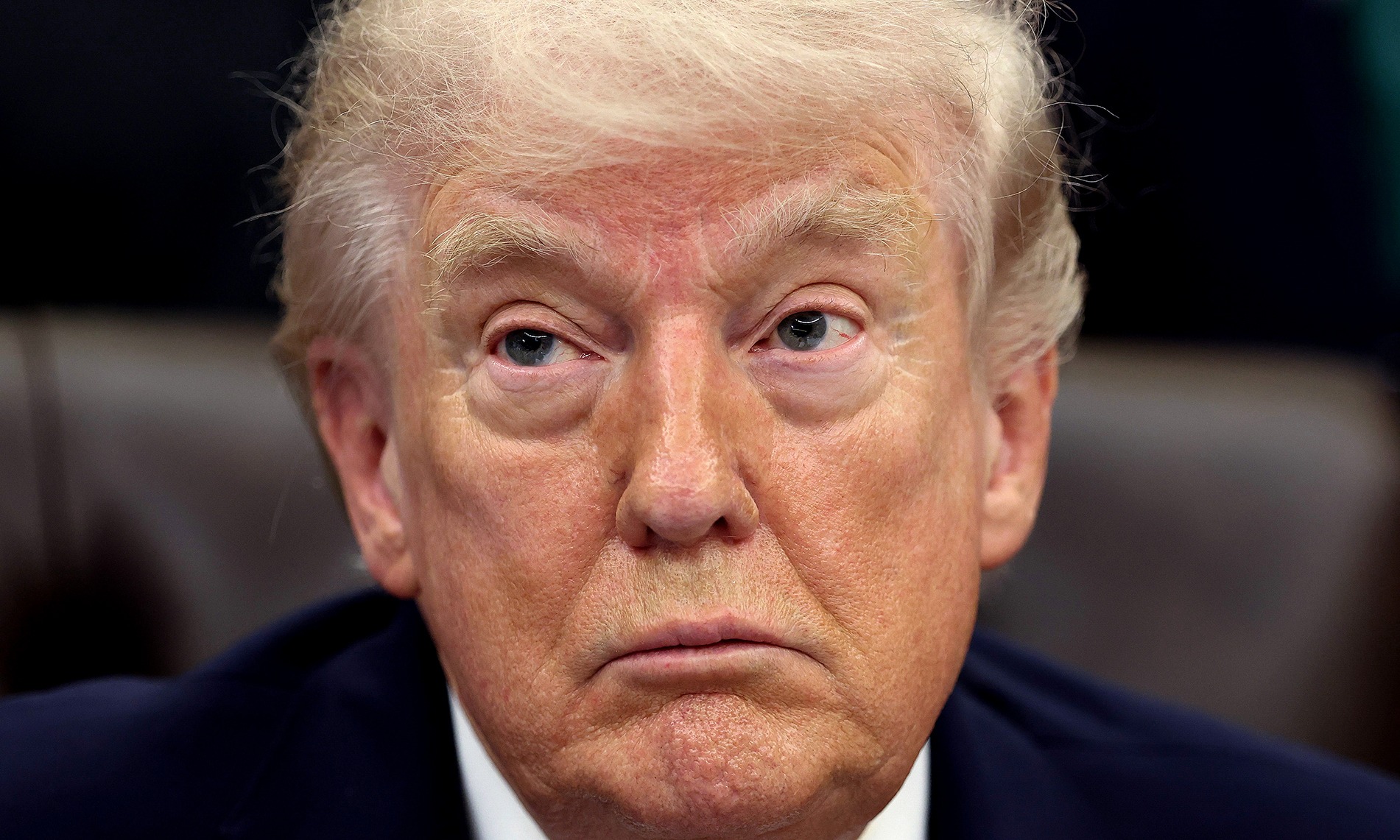
 US President Donald Trump speaks in the Oval Office after signing an executive order on 18 April 2026. (Photo: Tasos Katopodis / Getty Images)
 /file/dailymaverick/wp-content/uploads/2025/10/label-analysis-2.jpg)
There is a sense of desperation, even some panic, in the mind of Donald Trump that things are not going the way they were supposed to go. Trump believed – or was lulled into believing – the campaign against Iran would be a quick, hugely successful one. There would be an Iranian capitulation in response to US and Israeli firepower that was brought to bear. And he would lead a Republican Party to victory in the 2026 midterm poll.
But the Trump administration – and most especially the president himself – failed to (or chose not to) understand that a potent combination of a deeply held ideology and history, multiplied by geography, could withstand overwhelming conventional military power. In the current conflict, despite the devastating aerial assault, those other force multipliers have helped Iran gain an interim strategic victory out of a tactical defeat. The fighting is now a key element of the landscape of the US midterm elections in November.
In explaining this misstep in American strategy, one theory is the too-easy success of kidnapping Nicolás Maduro, the former leader of Venezuela, with no American fatalities, contributed to the seductive idea that a highly skilled, overwhelming military force would quickly bludgeon Iran into complying with American demands. This was further reinforced by the idea the killing of an entire swathe of Iranian leadership by Israeli aerial attacks would lead a replacement Iranian leadership to bend its collective knees.
/file/attachments/orphans/GettyImages-2254192259_537695.jpg "Ousted Venezuelan President Nicolás Maduro arrives at the Wall Street heliport before his appearance in federal court in New York on 5 January 2026. (Photo: Michael Nagle / Bloomberg via Getty Images)")
Limited ceasefires
Instead, the dynamic has become very different. There has been a cycle of threats and counterthreats, fierce aerial assaults, eventual agreements for face-to-face negotiations (but now on hold), a limited ceasefire and new restrictions on ships attempting to transit the Strait of Hormuz.
The strait is a chokepoint for a fifth of all petro-energy shipments globally. East and South Asian nations in particular are especially vulnerable to this stoppage of ship movements and so Iran’s use of geography is a trump card, at least for now.
Iran’s threat to close the strait – and now weapons fired at some ships attempting the transit under a mistaken belief the Strait was once again open for traffic – is preventing most ship transits. This has led to massive price increases and threatened shortages of vital petroleum and LNG for the global economy. Most recently, use of the strait has been imperilled from an American blockade of Iranian ports and Iranian shipping – and the boarding of some ships.
Meanwhile, the Americans have been bringing more frontline troops and ships close to the zone of conflict, poised, in theory, for an assault on Kharg Island (or other nearby islands). Kharg is the departure point for 90% of all Iranian petroleum shipments.
The recent, 21-hour negotiation session in Islamabad failed to resolve differences between the two parties. Those who expected rays of sunshine and an outburst of “Kumbaya” singing were hopelessly naive.
By contrast, recall that the 2015 accord over Iran’s presumed nuclear ambitions took more than two years to achieve, given complex technical details plus conflicting goals by the two sides. Sadly, during Trump’s first administration, American participation in that accord ended in 2017. The collapse of that agreement helped set the stage for the current situation.
Reportedly, a Pakistani source involved in the discussions said there was momentum for peace talks to recommence on Wednesday, 22 April 2026, as the US expressed confidence that the talks would go ahead and a senior Iranian official said Tehran was considering joining. US Vice President JD Vance would travel to Pakistan on Tuesday for negotiations, while Iran told regional mediators it would send a delegation, media reports said. However, there were still significant hurdles and uncertainty as the end of the ceasefire approached.
This comes amid Iranian protests over the American naval blockade and capture of Iranian-flagged vessels, among other issues. In the wake of all the bombs, missiles, drones, death and destruction, Iranian suspicions about American intentions must be much stronger than a few months ago.
The Iranians have been pursuing agreement about Iranian funds being held in escrow, relief from economic and financial sanctions, their right to carry out putatively peaceful nuclear ambitions, and – now – to have a hand controlling access to the Strait of Hormuz – a narrow stretch of international waters. This last is a ratchet upward for the complexity of the conflict and negotiations.
Midterms impact
Concurrently, the US president is furious at the US’ inability to move Iran towards a renunciation of any nuclear ambitions, as well as a promise to end missile and drone launches at US facilities in the Gulf, at Israel and at America’s allies in the Gulf, along with support for Hamas in Gaza, Hezbollah in southern Lebanon and the Houthis in Yemen.
Curiously, the earlier US concern for the human rights of the Iranian people, thousands of whom were killed by the regime in January in putting down demonstrations, seems to have vanished. There is some evidence, in fact, that the aerial attacks on Iran have generated an uptick of support for the government, despite its violent crushing of numerous protests over the years.
And so now the key questions are how this conflict with Iran is affecting the Trump administration domestically and what impact it will have on US midterm elections.
As the Wall Street Journal reported over the weekend, “Trump campaigned on ending foreign wars but wagered that he could solve, with American air and naval power, a national security problem that had bedevilled seven previous presidents. Now, a ceasefire is in doubt, a critical trade route has been closed for weeks and Iran’s regime has been replaced with radical new leaders, all threatening to lengthen an operation that Trump has repeatedly said would only last six weeks – a deadline already missed since the war began Feb 28…”
Because this conflict has not ended, unlike the Maduro capture, Trump’s administration (and his political party) is now facing the domestic political and economic consequences of a military and strategic crisis largely of its own making.
/file/attachments/orphans/GettyImages-2214104428_621825.jpg "US President Donald Trump speaks to reporters outside the West Wing of the White House on 8 May, 2025 in Washington, DC. (Photo: Anna Moneymaker/Getty Images)")
The Washington Post noted on Monday: “Republicans already faced daunting odds before the war began; the president’s party often loses ground in midterm elections. Now, the cost of gas – clear to consumers and slow to recalibrate – threatens to make that even more challenging… And midterms tend to be referendums on the White House.”
As a visible sign of inflation, petrol prices in America – as elsewhere – have shot up just as the spring and – soon enough – the summer vacation travel season begins. While America is a major exporter of it, the petrol price is largely determined by the global market forces, not domestic ones.
The key economic question of “affordability”, or inflation, is troubling a growing number of citizens and potential voters, influencing many American feelings towards the Trump administration and Republican congressional candidates generally. Further, there is the sense, even among many of the president’s supporters, that his promises to keep the country out of endless wars has now been overturned by the current hostilities.
More personally, there are growing concerns that Trump’s internal impulse control – per those wild, apocalyptic threats about “bombing Iran back to those stone ages” or destroying its civilisation – has evaporated as he tweets through the night. Then, too, there have been the president’s extraordinary – and not in a good way – social media images like the one depicting him as Jesus Christ (set among soldiers, flags and a glowing orb).
Then, too, there has been the snit fight he and Vice-President JD Vance (a Catholic convert, just by the way) have picked with Pope Leo XIV over the latter’s supposed (mis)understandings of theology or the theory of the “just war”. None of this rhetorical excess is endearing the president to voters. A growing number of Republican candidates for the House or Senate may try to minimise their relationship with the president in their election or re-election campaigns in this year’s midterm elections.
/file/attachments/orphans/GettyImages-2272041510_201714.jpg "Pope Leo presides over a mass in Luanda’s suburb of Kilamba, Angola, on 19 April 2026. (Photo: Simone Risoluti - Vatican Media via Vatican Pool / Getty Images)")
/file/attachments/orphans/GettyImages-2271377061_921517.jpg "US Vice-President JD Vance takes part in a ‘fireside chat’ during a Turning Points USA event at the University of Georgia on 14 April 2026. (Photo: Chip Somodevilla / Getty Images)")
Of course, Trump (or any future successor) is not on this year’s midterm ballot – but what is up for grabs is control of either or both houses of Congress. Current polling points to Democrats gaining control of the House of Representatives (where members are elected for two-year terms). They are now just a very small number of seats away from control.
It is even possible they can win sufficient Senate seats (one-third of the Senate is up for election or re-election) to control that body as well, although given some of the long-time incumbent Republicans seeking re-election, that may be a hard ask.
But if they win either house, Democrats will be able to convene hearings on administration decisions, to demand testimony by administration officials and to subpoena embarrassing documents. Most especially, these would focus on the Iran conflict Trump has led the nation into, and how and why the administration has now found itself in this mess. Democrats would also be able to thwart legislation favoured by Trump.
Distant hope for Israel, Lebanon deal
Meanwhile, last Friday, in Washington, the Israeli and Lebanese governments actually held their first face-to-face meeting in many years. This comes in the wake of an Israeli military assault in the southern part of Lebanon (and some devastating attacks on Beirut neighbourhoods) against Hezbollah, forcing about a million people to flee north of the Litani River, even as Hezbollah continued to fire some rockets at northern Israel.
The Israelis hope they can manoeuvre the Lebanese government into disarming Hezbollah, although the Lebanese military is unlikely to have the strength to carry out such a mission. The Lebanese hope they can push the Israelis into vacating the southern reaches of their country. In the meantime, their ceasefire has several days left, although it remains a distant hope that either will achieve their respective goals.
/file/attachments/orphans/GettyImages-22539702551_989802.jpg "Israeli Prime Minister Benjamin Netanyahu holds a press conference with US President Donald Trump at Mar-a-Lago in Florida on 29 December 2025, following a bilateral meeting to discuss regional security in the Middle East as well as the US-Israel partnership. (Photo: Joe Raedle / Getty Images)")
Importantly for American domestic politics, Israeli military action against Iran and Lebanon, following its massively destructive efforts in Gaza, have been collapsing support for Israel among many Americans and American politicians.
Restraints on American support for that nation are becoming a bellwether in various primary elections to select candidates for the House and Senate – most especially among Democrats, but also with some Republicans in vulnerable seats as “America Firsters” like broadcaster Tucker Carlson have come out against the US-Israeli alignment.
While the outcome of conflict with Iran is obviously crucial for the circumstances of the nations of the Middle East, and more broadly for all those nations dependent on petroleum imports, it is going to have important repercussions on American political life. It is increasingly likely there will be more pressure brought to bear on the Trump administration to dig itself out of this mess by its emboldened political opponents, both from his MAGA supporters and from increasingly fired-up Democrats. DM