
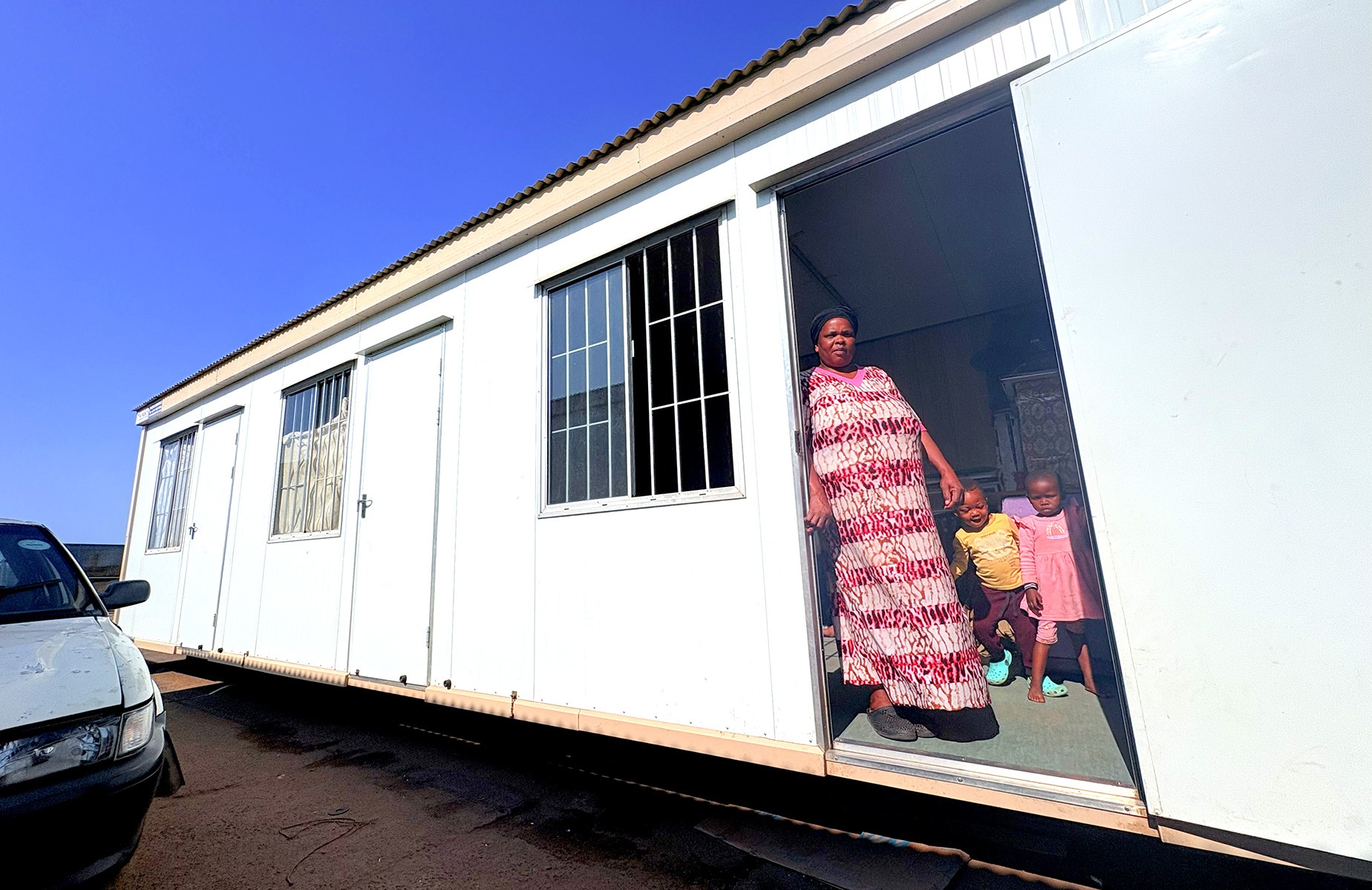
 Ziphi Nduli moved out of her home and agreed to having it dismantled so that the city could repair the storm water system that drains the area, including Toyota South Africa’s Prospecton Road factory. She was waiting for a new metal-and-wood home, but she didn’t think it would be as robust
as her previous one. She says families are made to feel as though this is favour to them.
(Photo: Leonie Joubert)
Ziphi Nduli moved out of her home and agreed to having it dismantled so that the city could repair the storm water system that drains the area, including Toyota South Africa’s Prospecton Road factory. She was waiting for a new metal-and-wood home, but she didn’t think it would be as robust
as her previous one. She says families are made to feel as though this is favour to them.
(Photo: Leonie Joubert)
Putting up a shack is common sense: wooden planks for the frame; some well-placed nails; doors and windows, obviously; clad it with metal sheets or whatever’s on hand.
Jomo Sakhile looks puzzled when he’s asked about this. It’s not rocket science, his face seems to say, gesturing to the corrugated metal roof and wall panels of his new home. These still gleam like an unpolished mirror. The pine planks smell faintly of resin.
His previous home was destroyed by fire two months before, shortly before dawn in early July 2025. Sakhile and his family – his mother and brother – had to stay at a friend’s place for about a month, but once the disaster response kicked in and the City delivered emergency materials, he got to rebuilding. They had a new home within days.
The trick, the lean 29-year-old says, is that you don’t want to make the structure too sturdy.
“It’s dangerous if you make it strong. Sometimes, when the shack is burning and you can’t find the key, you have to knock the wall off.”
Loose planks pop off easily. There are enough chilling memories from around here, stories of others who haven’t been able to get out in time.
Luck and elevation protected the Sakhile family from the April 2022 floods. This now infamous event swallowed up homes, up to their roofs in places, in lower-lying parts of the Dakota informal settlement in Isipingo, south Durban. Their suffering didn’t make the news. What did, though, was the Toyota factory, a stone’s throw from here, which shut down production for four months following the event.
The land outside the Sakhiles’ front door is still surprisingly roomy. Many neighbours haven’t rebuilt yet after the fire.
It wasn’t like this on the morning of the blaze.
“Fire!” he heard his mother shout in the dark. “There’s fire!”
Sakhile dashed outside to check. It still seemed some distance away.
“I told them don’t panic,” he recalls. They grabbed the essentials: identity documents, a few clothes.
/file/attachments/orphans/3cIMG_1847_596726.jpg "Two months after the fire, many families hadn’t rebuilt yet. Rubble and charred stumps are testimony to all that was lost.
<br>(Photo: Leonie Joubert)
<br>")
(Photo: Leonie Joubert)
After that, they didn’t know what to take. It was bedlam outside. Fear. Confusion. People jostling in the tiny alley between the shacks that pressed in on all sides. People were trying to lug stuff up the hill to dump it safely on the beach.
Fire engines arrived but couldn’t tame the thing. The flames eventually arrived at the Sakhile home. They saw their house burn.
“It was scary. At least no one was hurt.”
Floods and fires like these are headline grabbers. But there’s another kind of unnatural disaster that stalks here, invisibly: extreme heat. Not long before Sakhile and his family lost their home to the inferno, he took part in a study that drew contours to this stealthy killer. A summer’s worth of temperature and humidity readings in homes like this show just how hellish it can be to live in a shack made from materials better suited to a working oven.
South Africa’s human settlements policy aims to build back better following disasters like this. But the people of the Dakota informal settlement know first hand: it’s more complicated than simply handing out more materials to make the same flimsy, uninsulated homes that are intended to be temporary, yet are anything but that.
Hot, hotter, hellish
Spring is here, and its a T-shirt-and-flipflops kind of day. Thokozile Cebekhulu is lit dimly by sunlight edging in through her bedroom window. There’s a bare bulb overhead, not far from where a digital sensor sat earlier in the year, logging the temperature and humidity from a roof beam every half-hour.
/file/attachments/orphans/5IMG_1366_819794.jpg "Thokozile Cebekhulu’s home is sturdier than some, and made from more insulating bricks and asbestos. But on the hottest days it isn’t much more forgiving than the metal-and-wood ones.
<br>(Photo: Leonie Joubert)
<br>")
(Photo: Leonie Joubert)
Sakhile had one in his home, too.
About 19 families took part in the study, which ran from early December 2024 until June 2025. They recorded a daily voice dairy to capture how they’d experienced conditions.
This data was then compared with weather data captured at the nearest meteorological station, Ballito, about 70km up the coast.
Researchers at the University of Cape Town (UCT) are still crunching the numbers for a study that’s part of the multicountry, pan-African Palm-Trees project, run by Climate Adaptation and Resilience (CLARE), although a preliminary scan shows just how much hotter conditions are inside these homes, compared with what local weather stations will record.
The fourth day of January 2025 turned out to be the hottest that summer. Where the Ballito met station measured a top temperature of 34.5°C at lunchtime, Cebekhulu’s bedroom got to 39.8°C just after noon, and Sakhile’s maxed out at 45.2°C. Across the summer, the Dakota homes were close to 10°C hotter than conditions recorded at Ballito. But it was the humidity that made things feel even worse. While Ballito’s weather might have felt like a great day for the beach, for many, for someone in Dakota, it could have amounted to medical emergency.
/file/attachments/orphans/StoryArkDMRedAlert1DakotaSIDEBARFINAL-3_851187.jpg)
Durban’s notoriously muggy climate meant that high water vapour in the air pushed Ballito’s discomfort index – the how-does-it-feel temperature – up to 48.6°C. But conditions in Cebekhulu’s bedroom would have felt as though it was 53°C; Sakhile’s, 56°C. This isn’t just unbearable. It’s potentially life threatening.
/file/attachments/orphans/StoryArkDMRedAlert1DakotaSIDEBARFINAL-1_287637.jpg "(Source: Leonie Joubert)
<br>(Data: Dr Ross Blamey, Climate Adaptation and Resilience, (CLARE) University of Cape Town and e Thekwini Municipality)")
(Data: Dr Ross Blamey, Climate Adaptation and Resilience, (CLARE) University of Cape Town and e Thekwini Municipality)
[Red Alert will expand on the health implications of this kind of heat in a future article.]
Cebekhulu’s home is a little misleading. It’s made of materials that are more sturdy and insulating than Sakhile’s. The walls are bricks and cement. Part of the roof: thickish asbestos sheets. The wooden beams look solid as pillars.
And yet during the previous summer, the digital sensor showed that the temperature inside her home wasn’t much more forgiving than Sakhile’s.
“There was a difference between the hottest homes and the coolest homes,” explains Laura Washington, director of the gender-focused civil society organisation Project Empower, which has worked with the Dakota community for years and did this data capture for UCT’s CLARE crew. “But we found on hot days the temperatures were extreme for everybody. They were still all hot.”
There are pros and cons to each of the materials typically used for informal homes like these, they found. Bricks and cement are first prize, but expensive. They’re risky, too: if you don’t own the land, or the structure, why sink good money into it if you may be forced out? Wood insulates, but can harbour disease-causing moulds; it rots; it burns easily. Metal lets in the cold and the heat as if it were an open door; it stays mould-free; but damp dissolves it to rust. Asbestos has been off the cards since it was banned in 2008. Tarpaulins cast shade, but the air becomes stiflingly humid under their cover.
Suggestions of tech solutions like heat-reflective paint and living, green roofs are as out of reach as something from science fiction in a community where homes don’t have working taps or toilets. Tree planting to give the original and best air conditioning – the cooling effect of plant life breathing – is the most obvious solution. But as many residents say, if there is a patch of open land next to your house, you’re more likely to put up another shelter, which you can rent out. Tree shade can’t earn anyone a passive income.
Building back better?
Ziphi Nduli (57) isn’t so sure about her new house: when it’ll be finished, or how long it’ll last. Her previous home was made of boards, planks and asbestos. The new one will be like Sakhile’s – planks and metal sheets – and she didn’t have any say in this.
“The new homes are fine. The problem is the corrugated iron, because we are close to the sea, which may cause rust,” Nduli says through a translator. “The house I had previously was stronger because it was built of boards.”
She didn’t lose her previous home in the recent fire, though.
/file/attachments/orphans/6IMG_1603_897696.jpg "Ziphi Nduli moved out of her home and agreed to having it dismantled so that the city could repair the storm water system that drains the area, including Toyota South Africa’s Prospecton Road factory. She was waiting for a new metal-and-wood home, but she didn’t think it would be as robust
<br>as her previous one. She says families are made to feel as though this is favour to them.
<br>(Photo: Leonie Joubert)
<br>")
as her previous one. She says families are made to feel as though this is favour to them.
(Photo: Leonie Joubert)
After the 2022 floods, the stormwater system drainage around Toyota’s Prospecton Road factory needed an urgent overhaul. The multinational had run up a R4.5-billion repair bill on the plant, and suffered R2-billion in lost business while it was offline.
Stormwater repairs began soon after the flood, but then things got more complicated. In late 2025, Toyota’s insurer, Tokio Marine & Nichido Fire Insurance, began legal proceedings to sue the eThekwini Municipality, Transnet and the KwaZulu-Natal (KZN) Department of Transport for R6.5-billion, claiming negligence to maintain infrastructure.
Things also got messy for some Dakota families. Many in the lower-lying areas had already suffered serious flood damage to their homes. But they were living just a city block from the factory and directly above the drainage infrastructure that needed repairing.
The solution: move the families for a spell, put them up in temporary container housing set up in a nearby parking lot, dismantle their homes, repair the drains, put up brand-new shacks made of metal and planks.
This is the home that Nduli was waiting for when Daily Maverick visited her in September 2025, and she had no idea how much longer she’d have to live in the stark, curtain-less container room, from where she ran a small creche.
It’s not immediately clear which government bodies are responsible for various aspects of the stormwater upgrade, the new homes or the temporary housing for those in transit. Daily Maverick asked the eThekwini Municipality and Toyota South Africa for clarity: how much the various upgrades and repairs are costing, who is footing the bill for which parts of it, and whether Toyota South Africa has contributed to their neighbour’s post-flood recovery.
Both the municipality and Toyota South Africa were cagey, erroneously using sub judice principles relating to the civil suit to avoid responding.
When it comes to replacing informal homes after events linked with extreme weather, the KZN human settlements department gets its mandate from the national department of human settlements, the Disaster Management Act of 2002 and the National Disaster Management Framework. The provincial department’s 2023 disaster management policy, and a recent revision, state that it must give families temporary building material. It doesn’t specify what materials, but offers corrugated sheets and poles as examples. Materials must be enough to support shelters of 9m² to 30m², not cost more than R12,000, and should be able to last about five years. The municipality has to buy and distribute materials, and claim the cost back from the national department.
Materials must be fire-rated to South African Bureau of Standards-approved quality, but there’s no mention that they must be suited to hold back the dangers of extreme heat. There’s also no stipulation about including insulation as a must-have, or suggestions on how to build shade or other cooling technologies such as heat-reflective paint.
Extreme heat is often regarded as a silent killer, because it doesn’t have the attention-grabbing scenes of floods or fires. Media often headline them with beach-day suggestions. Deaths hide behind mortality data that show heart or kidney failure, respiratory distress, or even deaths of despair.
Now heat events are being recognised as the clear and present danger that they already are, according to a study released last month by the Academy of Science of South Africa which shows why it has emerged as a “defining climate-related health challenge for the SADC region”.
For a city like eThekwini, and communities like Dakota, the recommendation to gear up for extreme heat events, according to University of KwaZulu-Natal occupational and environmental health expert Professor Rajen Naidoo, is threefold: think in terms of shelter, water and rest.
[The Red Alert series will investigate what shelter, water and rest mean in different informal work and living contexts, against the backdrop of the health threats linked with extreme heat.]
Crushed
For the Shezi family, it wasn’t a case of lightning striking twice, but three times. First, the 2022 floods destroyed the home they’d lived in for roughly 15 years. Like refugees, they camped out in a nearby hall for several months along with so many neighbours, until they’d rebuilt. This second house was dismantled when the drain repair work happened.
Lufuno Shezi, the Project Empower community worker who helped lead the indoor temperature monitoring for the CLARE researchers, is pragmatic when she remembers how she, her daughter, two brothers – one who is disabled – and her father had to decamp in temporary accommodation again until their metal-and-wood home was done.
/file/attachments/orphans/7IMG_1363_610769.jpg "Lufuno Shezi shows where the digital sensor was installed in Thokozile Cebekhulu bedroom. Shezi, a long-time Dakota resident who helped lead the temperature monitoring research, lost her home twice to weather events, and once to the city’s stormwater upgrades.
<br>(Photo: Leonie Joubert)
<br>
<br>")
(Photo: Leonie Joubert)
When the third strike hit, it wasn’t the fire. It came from the least-likely threat in an informal settlement that so desperately needs more trees for shade.
Last month, on the first Friday of March, Durbanites received a level four weather alert. A powerful storm was inbound.
“It was extremely windy,” Shezi recalls.
The next evening, she and her family were pottering around when they heard someone at their door.
“There was a man passing, he saw that the tree is about to fall,” she says. The tree in question: a mostly useless conifer that stood tall, cast little shade and was better suited for Christmas decorations.
There was a cracking sound coming from its roots.
“The tree,” the passer-by said, “it’s going to fall anytime!”
Within a minute of them getting outside, the tree began to topple. There was little they could do but watch it come crashing down.
“It fell right on top of the roof and destroyed all of the house,” Shezi says.
Just seven months earlier, the 26-year old sat in her bedroom with Daily Maverick to explain the work and the community she knows so well.
Now that bedroom had been crushed like a tin can.
“We just have one room left. We’ve contacted disaster management and human settlements but until this day they haven’t arrived with materials to help us.” DM
Leonie Joubert is on a mobile journalism project investigating how the climate crisis is unfolding on our doorstep, in our lifetime. Story Ark – tales from southern Africa’s climate tipping points is an award-winning collaboration with the Stellenbosch University School for Climate Studies and the Henry Nxumalo Foundation.