



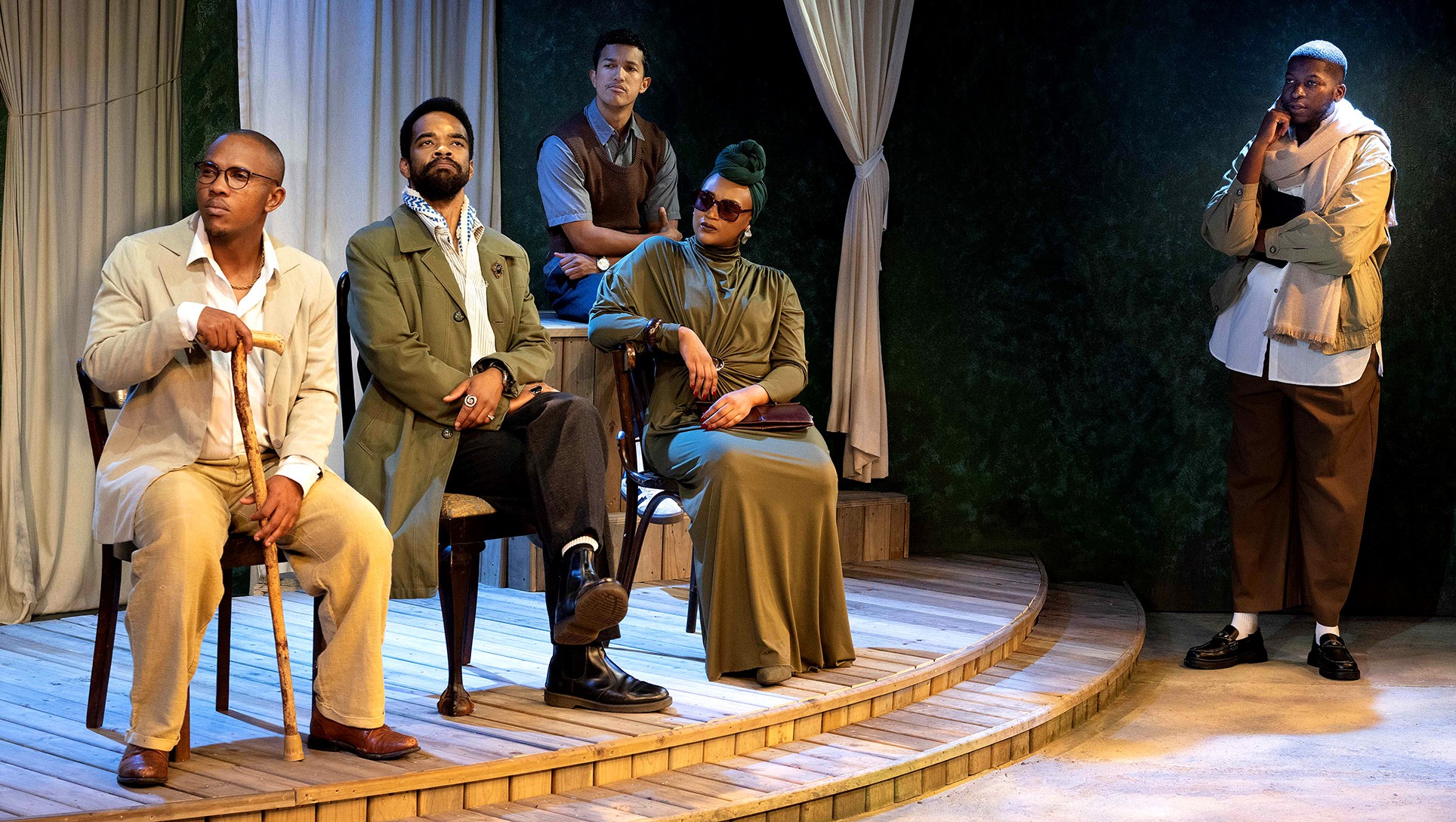
 Lwanda Sindaphi, Carlo Daniels, Awethu Hleli, Lyle October and Nirel Sithole. (Photo: Fiona MacPherson)
 Can theatre change the world? It’s unlikely. But this has not — for millennia — prevented playwrights from dabbling in prose, poetry and dialogue that sets out in hope of doing so.
In Stupid Fucking Bird, US playwright Aaron Posner’s marvellously meta retelling of Chekhov’s The Seagull, a young, idealistic, wannabe playwright named Con (a riff on the original Russian play’s Konstantin) imagines he can, with his writing, change theatre itself.
He possesses all the earnest high-mindedness, will and conviction of an artist utterly convinced that he’s capable of creating something important enough that it will not only challenge the conventions of the established entertainment he loathes (he calls Cirque du Soleil “the handjob of theatre”, for example), but that he can with his angsty, cerebral and frankly self-indulgent writing, make a difference, maybe change the world.
He’s up against a lot.
For one thing, there is his mother, a viper named Emma, who is a celebrated actor who has carved a name for herself by starring in precisely the kinds of commercial productions Con detests.
Played by the marvellous Awethu Hleli, she is the quintessential diva — self-important and infatuated with her own importance, believes that her opinions alone are what matters, cares little that she’s widely disliked and makes minimal effort as a mother. Emma’s only real loyalty is to herself, and she takes her son’s quest to be a writer as both an embarrassment and a personal affront.
When Con stages a hideously self-aware monologue performed by an aspiring actor named Nina, with whom he’s in love, Emma makes little effort to disguise the fact that she finds his writing — and his aspirations — infuriating, petulant, even vulgar.
Adding insult to injury is the fact that Con’s mother has taken as her lover a famed, almost cult-status author, Trigorin.
This rather self-important novelist is at times Emma’s lapdog and in other moments a bit of a windbag who loves nothing better than to blow smoke up his own backside, prattling on about the significance of great art. He is also something of a Lothario, eager for the attentions of a much younger lover, someone who can stroke his ego and make him feel young and virile, too. And, of course, who should fall for his charms other than Nina, the focus of Con’s ill-fated affections.
/file/attachments/orphans/AwethuHleliLwandaSindaphiNirelSitholeCarloDanielsandTamzinDaniels_FionaMacPherson_530485.jpg "Awethu Hleli, Lwanda Sindaphi, Nirel Sithole, Carlo Daniels and Tamzin Daniels in Stupid Fucking Bird. (Photo: Fiona MacPherson)")
A dire love quadrangle
And thus a rather dire (and, for the purposes of Posner’s play, hilarious) love quadrangle is set in motion. Like the formula for a complicated but sappy soap opera, Con loves Nina, Nina desires Trigorin, Trigorin cheats on Emma with Nina, Emma scorns Con, and Con fudges an attempt to kill himself.
Orbiting this central drama are Con’s friends Mash and Dev, who inhabit substantively different rungs on the social hierarchy. Mash is in unrequited love with Con and is permanently grumpy as a result. And Dev, a happy-go-lucky fool who takes delight in the simpler things, loves Mash.
It’s the terrible odds against any of this turning out well that, at the start of the second act, prompts someone to pronounce God “a fucker”, accusing Him of looking down at the mess He’s made on Earth, “munching on celestial popcorn”.
But — and herein lies the rub of the play — perhaps Con’s biggest foe is not God nor fate, but his own human nature, his anxieties and fears, his inability to move on from Nina, his ongoing sense of existing in his mother’s shadow, his self-loathing and self-doubt, his constant need to change the world… It’s his relentless existential angst, basically, that undermines his true potential, cuts him down at the knees.
As Con, Nirel Sithole perfectly captures the fine line between tragic victim and ironic underdog. There’s a ridiculousness to his character; his infuriating earnestness and self-pitying sense of impending doom are almost an invitation to slap some sense into him, remove the chip from his shoulder.
At the same time, he’s only human, full of needs and longings and desires. Like so many tragic figures, his curse is being human.
The play covers a lot of ground, despite pulling off the trick of appearing quite simple.
It’s disguised as a straightforward soap opera: there’s that crazy love quadrangle and a few bitter rivalries, a seagull that’s shot, and a metaphoric seagull (Nina) who gets beaten and broken by the choices she makes in life.
Spinning through all of this is life itself, and its eternal mysteries. Which complicates the drama, and gives flight to Posner’s idea of transforming melodrama into meta-drama, dragging the audience into the fray, and becoming a version of The Seagull in which the subtext is spoken out loud, as if to suggest that contemporary audiences, so used to having everything spelled out for them, need to have the meaning of this particular stupid fucking play explained to them, too.
And thus the stage is set for a thought-provoking play that grapples with the infuriatingly unstable substance of life: it’s about all the things we cannot control — how others feel about us, who loves us back, and whether or not we are sufficiently talented to achieve our dreams.
It is a play about a play, and it is a play in which the characters are aware that they’re in a play. They’re aware, too, of the audience, and they have questions for us.
/file/attachments/orphans/TamzinDanielsLwandaSindaphiNolufefeNtshuntsheNirelSitholeLyleOctoberCarloDanielsandAwethuHleli_FionaMacPherson_234640.jpg "The cast of Stupid Fucking Bird. (Photo: Fiona MacPherson)")
An infinite loop
Kieran McGregor’s set suggests a kind of theatre stage not unlike one you might imagine David Lynch designing for a play within a play within a play, one that’s perhaps set to an infinite loop. The design is a constant reminder that we are also witnessing a kind of living, breathing palimpsest, the two plays written more than a century apart, in conversation with one another, across time.
In a sense, this production contracts the passage of 130 years between Chekhov’s The Seagull and this “right here, right now” contemporary retelling of that Russian classic by an American which has then been transposed into a South African context and performed by actors whose diverse local accents help underscore the beautiful variety of human beings who make up our complex, convoluted society.
We, the audience, are not only watching a play, but in a sense also witnessing the actors reflect on themselves, on their practice, and on the characters they’re playing.
It’s a play that’s bound to another play, and that repeatedly interrupts itself, stops to question the reasons why any of what’s happening is happening, and that has the actors interrogate their roles.
As with Rosencrantz and Guildenstern Are Dead, Tom Stoppard’s great absurdist tragicomedy, there’s a kind of unavoidable fatalism at the heart of the play. The fates of Posner’s characters are largely predetermined by the plot of Chekhov’s play, so we’re there to find out how this updated cast mitigates against whatever outcomes have been handed down.
Not only are we witnessing, but we’re also encouraged to participate in the play, even have our opinions measured and commented upon in real time by the actors.
Which can, of course, have consequences; on the night I watched it, for example, the audience took the opportunity to participate a little too far, got too involved and overly vocal.
And perhaps that’s part of the experience: to kind of demonstrate just how much people want to have their say, take ownership, even dictate how the play will be experienced by the rest of the audience. In a sense, having audience members constantly offering their opinions proves that they’ve been sucked into the world of the play, that they care enough to try to change the world.
Such violations of theatre’s imaginary fourth wall are — to use the terminology of the play itself — ways of “fucking with the audience” and quite possibly part of Stupid Fucking Bird’s success.
/file/attachments/orphans/LwandaSindaphiCarloDanielsAwethuHleliLyleOctoberandNirelSitholeinStupidFuckingBird_FionaMacPherson_964041.jpg "Lwanda Sindaphi, Carlo Daniels, Awethu Hleli, Lyle October and Nirel Sithole in Stupid Fucking Bird. (Photo: Fiona MacPherson)")
The eternal question
It is not simply the self-reflexive nature of the play, nor the cockiness of messing with Chekhov, but the questions it raises about the very notion of theatre, its self-importance as a form within the broader context of entertainment. It reasserts that eternal question: Can theatre change the world?
The play gives the audience the illusion of exercising some control over what’s happening on stage.
At the very beginning, proceedings are kicked off by the announcement that the play will begin when someone says, “Start the fucking play!” It’s a prompt for the audience to not only giggle at the erasure of the fourth wall, but to straight-up swear back at the cast and give them the go-ahead to start.
Which is momentarily empowering, I guess.
Of course, the fun touch of letting the audience get involved from the start is turned on its head by the end of the play, when Con, having repeatedly warned us that he intends to off himself, dares the audience to “stop the fucking play”.
Which is precisely where my heart broke.
Because, by this juncture, the audience no longer has the stomach — nor the power — to intervene.
As in life, by the time the play is steamrolling its way towards its climax, the course of the action and the consequences for the actors have been decided.
This is the nature of narrative — its outcomes are pre-determined. And it is this fact that distinguishes theatre from life.
For the audience, it’s a lesson: while the actors on stage are not at liberty to interfere with what’s been written and rehearsed, in life we have the means to alter destiny.
The tragedy, too often, is that — like some stupid fucking bird — we fail to make the required course corrections.
The play itself represents the great irony of being human, the way we allow ourselves, our human nature, to get in the way of happiness.
It’s right there in the title: if you’ve ever observed a seagull snatching food from a person on the beach, you’ll realise there’s nothing stupid about these birds at all. They are highly resourceful, full of guile and cunning. Like humans, they’re messy and noisy and frequently misunderstood — and although they are alive and free, can so easily be destroyed by even the tiniest folly. DM
Stupid Fucking Bird is playing at the Baxter Studio in Cape Town until 2 May.