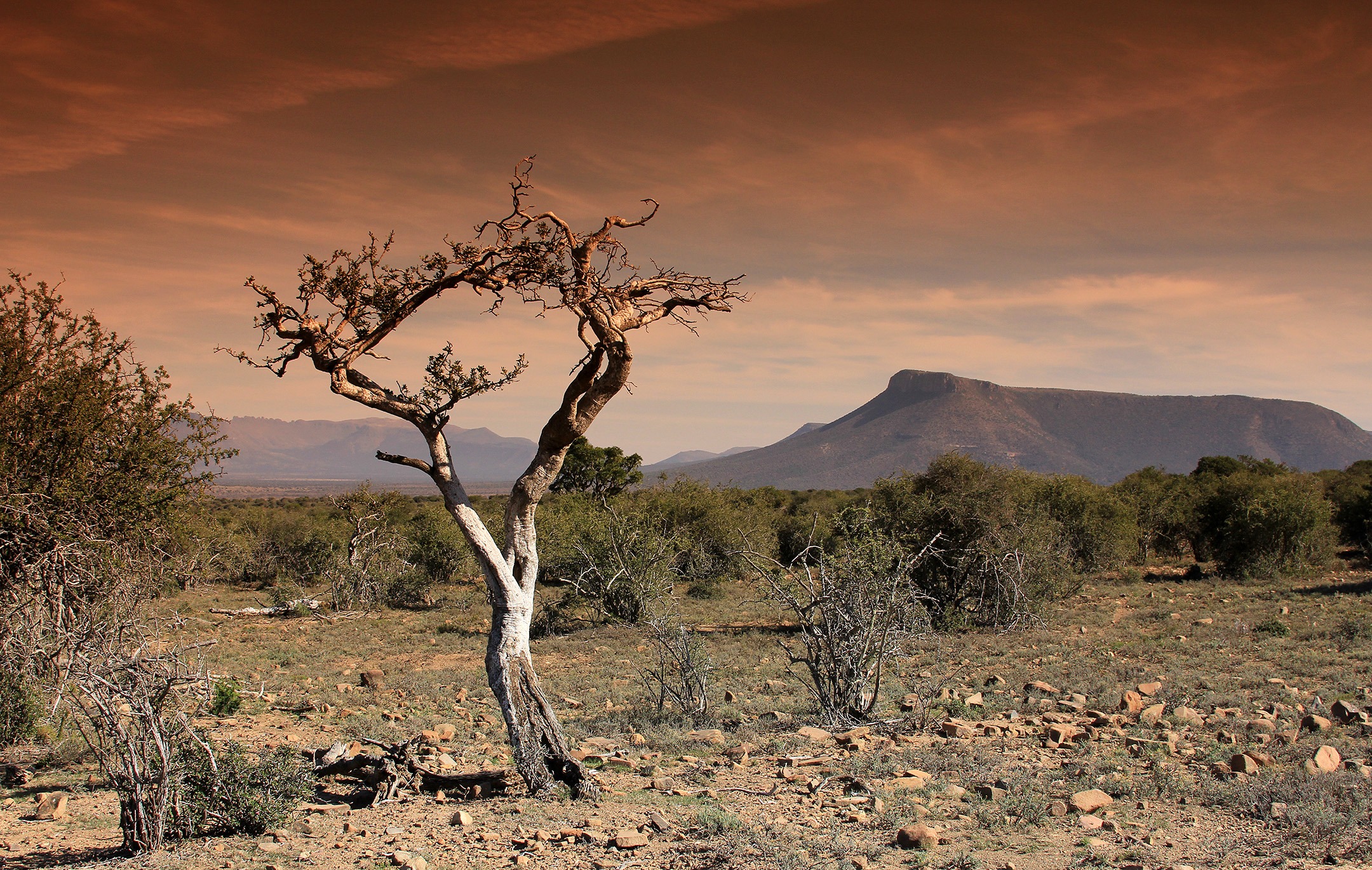
 This is not degraded land in need of trees, but a functioning, ancient and living Kalahari ecosystem. (Photo: Chris Marais courtesy of Conservation International)
 According to global datasets guiding restoration projects, vast areas of protected savanna qualify as “degraded” because they lack dense forest canopy. By that logic, places like the Kruger National Park can be misclassified as degraded land suitable for tree restoration.
Yet, Kruger is one of the best-protected and most studied savanna ecosystems on Earth. To classify such thriving ecosystems as degraded is absurd, says Ghanaian ecologist Mohammed Armani. He warns that the mistake reflects a deeper bias: that trees are the default measure of ecological health, now embedded in policy and finance.
Reforestation, he argues, is not a universal solution. “Trees can help, but only in the right places, the right species, for the right reasons, and alongside deep cuts in fossil fuel emissions”.
/file/attachments/orphans/DrMohammedArmani_220740.jpg "Ecologist Mohammed Armani speaks at the 14th Oppenheimer Research Conference 2025. (Photo: Supplied)")
Armani co-authored a 2024 Nature Communications paper re-examining global reforestation potential. The study was motivated by concerns raised by the Future Ecosystems for Africa (FEFA) programme at Wits University, which was co-created with Oppenheimer Generations Research and Conservation.
These same concerns form the bedrock of the newly published Africa’s Nature Transition: A Roadmap for People, Nature and Climate, a landmark strategy co-produced by FEFA and Conservation International that uses Armani’s research and that of other African scientists to outline how the continent can realistically deliver 1.6 gigatonnes of carbon dioxide equivalent (CO₂e) mitigation per year – roughly equivalent to taking 350 million gas-powered cars off the road. The Africa Roadmap incorporates ecological realities, social safeguards and African-specific data to demonstrate how Africa’s climate mitigation potential can be of benefit to nature and to people in the long-term.
When forest thinking misfires
Global maps have long disagreed on where trees should be planted. Critics highlight three main flaws: vague definitions of “forest” that include savannas and grasslands; reliance on low-resolution data; and weak safeguards against ecological harm.
The consequences are significant. Expanding tree cover into fire-driven or herbivore-dominated systems can reduce biodiversity. Misclassifying cropland threatens food security. Ignoring land reflectivity – the albedo effect – can even worsen warming. Thus the revised maps reduce the land available for afforestation by 92%: only 195 million hectares remain suitable for delivering lasting climate, biodiversity and social benefits.
“The African Roadmap highlights that there are still myriad opportunities to both store carbon and restore ecosystem functioning in these excluded ‘non-forest’ lands,” says Sally Archibald, Armani’s collaborator and co-author. “The updated afforestation maps are a good news story for people needing to graze cattle, harvest fuelwood or run ecotourism businesses, and the African roadmap is packed with ideas of how this can be done in a climate-friendly way.”
None of this diminishes the importance of reforestation where forests have been genuinely cleared. Forests store carbon, regulate rainfall and support immense biodiversity. From the Amazon to Indonesia and west Africa, restoration remains critical. “We cannot lose sight of that,” Armani says.
The problem arises when forest logic is applied indiscriminately. In the search for planting space, savannas are often labelled “empty” because they lack canopy cover. In reality, they are ancient, stable systems shaped by fire, herbivores and rainfall. Planting trees there does not restore nature – it replaces it.
The science of the savanna
Savannas cover roughly half of Africa and are not degraded forests but distinct ecosystems.
“Savannas are not degraded forests; they are ancient systems with their own integrity,” Armani says.
Their productivity lies in grass, not trees. Fire and grazing maintain this balance, supporting species such as wildebeest, zebra, impala, giraffe and cattle.
/file/attachments/orphans/wildebeesinsunset2_939579.jpg "Savannas support unique biodiversity. (Photo: Jonathan Irish courtesy of Conservation International)
<br>")
Carbon storage is also different. Forests store carbon above ground, while savannas store much of it in soils and roots. “You can’t just say more trees equals more carbon,” Armani says. This is a warning explicitly echoed in the new African Roadmap, which states that preventing afforestation in non-forest ecosystems is essential because altering tree cover in these carbon-rich grasslands can result in severe soil organic carbon losses.
This has implications for carbon markets. A strong focus on forest carbon risks sidelining soil carbon approaches, which can support biodiversity and livelihoods. For example, Rewild Capital is developing soil carbon projects for landowners that integrate fire and wildlife management to improve soil carbon storage while sustaining wildlife-based enterprises.
Savannas also support unique biodiversity – lions, cheetahs, wild dogs and specialised birdlife. Many would disappear if these systems were converted to forest.
“We need to recognise that savannas are not broken landscapes,” Armani says.
Policy trap
The misclassification of savannas is rooted in climate policy and finance.
Following the Paris Agreement, reforestation emerged as a major “natural climate solution”. Large-scale initiatives such as the Bonn Challenge and AFR100 set ambitious targets, creating demand for land. Open savannas were quickly drawn into these maps.
Global datasets often simplify landscapes into forest or degraded forest, ignoring whether an area was ever forest. Some maps even identify systems such as the Serengeti or Kruger as restoration targets.
Financial incentives reinforce this. Carbon credits from tree planting can be sold, and larger projects generate more revenue. “The money follows the carbon, not the ecology,” Armani says.
This frustration is shared by conservation leaders across the continent. “For too long, global climate policy and finance have treated Africa as an afterthought,” notes Jimmiel Mandima, Conservation International’s chief field officer in Africa. “Economic growth doesn’t have to come at a high carbon cost – we can drive climate action while also lifting people out of poverty.”
/file/attachments/orphans/maninveld_973660.jpg "The prospect of a prosperous Africa is based on inclusive growth and sustainable development, say the authors of the African Roadmap. (Photo Charlie Shoemaker courtesy of Conservation International)<br>")
People and the savanna
Savannas are also lived landscapes.
In northern Ghana, communities depend on shea harvesting. Across the Sahel, herders rely on seasonal grazing. In southern Africa, savannas provide fuelwood, food and materials.
To label these landscapes as degraded overlooks the people who manage them. Nature already underpins an estimated 62% of Africa’s GDP, with about 70% of communities in sub-Saharan Africa relying on forests and woodlands for economic security. “They are co-creators of these ecosystems,” Armani says.
Fire is one example. Long used by communities to manage grazing, it is now recognised as essential to maintaining savanna systems.
Tree-planting schemes that ignore this can cause harm – restricting access to land, reducing grazing or introducing species that deplete water. Communities are not opposed to trees, Armani notes, but to where and how they are planted.
A colonial legacy
The bias towards forests has historical roots. Colonial forestry systems prioritised dense canopy and timber, treating open landscapes as unproductive. This thinking persisted into development planning and science, where forests became the benchmark for ecological value.
“Savannas have always been seen as somehow lesser,” Armani says.
The consequences are well documented. Fire suppression policies in east Africa led to bush encroachment and biodiversity loss.
“What works in a European forest does not fit the African savanna,” Armani says.
Armani is not arguing against reforestation, but for precision. The African Roadmap aligns with this, establishing a localised “protect, manage and restore” framework that balances global climate goals with local development priorities, ensuring that interventions are tailored to where people actually live and work.
“We must plant trees where trees belong.”
This means:
- Protecting intact savannas;
- Restoring forests only where they historically existed;
- Supporting community-led approaches; and
- Recognising soil and grassland carbon.
“Do no harm should be our baseline,” he says.
Unavoidable trade-offs
The revised global analysis identifies 195 million hectares suitable for reforestation, with potential to remove about 2,225 teragrams of CO₂ annually over three decades – about 5% of global fossil fuel emissions. That remains the single-largest natural carbon removal option, though nearly 98 million people live within those areas. To help policymakers navigate these complex trade-offs, the study maps eight scenarios reflecting different priorities such as social safeguards, biodiversity and water quality.
But trade-offs are unavoidable. Only 15 million hectares meet most ecological and social criteria, and just 0.5 million meet all of them. Most viable areas lie near existing forests, where regeneration is more likely to succeed.
By narrowing the focus, the research offers a more realistic path forward.
“Planting them wisely matters even more than planting them widely,” Armani says.
He adds: “Africa’s savannas are not empty lands waiting for trees. They are ancient, living systems. If we lose them, we lose not just wildlife, but cultures, livelihoods and resilience.” DM
This story was produced with the support of the independent research engagement agency, Jive Media Africa.