




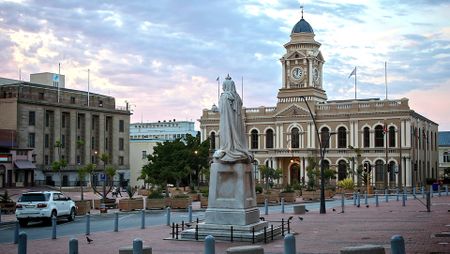
 The Nelson Mandela Bay City Hall. (Photo: Rute Martins) / Wikipedia)
 Nelson Mandela Bay is once again at risk of losing National Treasury grant funding after missing a March deadline to submit key governance documents, with a final cut-off set for 30 April.
The National Treasury has warned it may suspend transfers of the money if the municipality continues to fall short on financial management and compliance obligations, including its failure to adequately address persistent unauthorised, irregular, fruitless and wasteful expenditure.
An urgent special council meeting was called for Wednesday after senior officials, including an intervention team operating under section 154 of the Constitution and the acting chief operations officer, spent the weekend preparing outstanding submissions.
However, at a municipal public accounts committee (MPAC) meeting on Monday, also attended by Speaker Eugene Johnson and Chief Whip Wandisile Jikeka, members refused to allow the documents to be sent directly to the council without first being considered by the committee.
It was therefore resolved that the city request a deadline extension from the National Treasury and postpone the council meeting to next week, to allow MPAC to convene on Thursday to deliberate on the documents.
The call followed a visit by National Treasury officials to the city on 15 April for a meeting with acting City Manager Lonwabo Ngoqo, Mayor Babalwa Lobishe, Johnson, Jikeka, the mayoral committee, the executive committee and the disciplinary board, among others.
At the meeting, the National Treasury reiterated its warning that it may invoke section 216(2) of the Constitution, which empowers the Treasury to stop the transfer of funds to an organ of state that commits serious or persistent material breaches of financial management measures.
Accountability and transparency
This constitutional provision is used to enforce accountability and transparency in government finances.
On Tuesday, MPAC chair Luxolo Namette said, “Treasury conceded that the problem is with management and its failure of implementing consequence management, which MPAC has been calling for. We have even written to the office of the acting city manager in some instances, but Ngoqo’s office just won’t act.”
/file/attachments/orphans/LuxoloNamette_935105.jpg "MPAC chair Luxolo Namette (Photo: Andisa Bonani)")
He said the municipality was also criticised for its failure to spend grants allocated for service delivery projects, and highlighted a breakdown in communication within the metro: “The city received the letter from the Treasury in December and, as MPAC, we only got to learn about it in last week’s meeting, where the threat to withhold the funds was verbalised.
“We won’t take this lightly; we will raise this issue at council so that whoever dropped the ball is held responsible.”
Asked whether the council was expected to adopt the recently prepared documents required by Treasury without following due process, Namette said: “I just came out of a meeting with the speaker, chief whip and MPAC members where we decided that the meeting be postponed to allow MPAC to convene on Thursday, where the documents to Treasury will be tabled before they are taken to council for approval. The council meeting will be rescheduled for next week.”
Persistent failure
Slides from a presentation conducted by Treasury officials last week indicate that grant funding for the city will be withheld due to the persistent failure to reduce the unauthorised, irregular, fruitless and wasteful expenditure (UIFWE) by at least 75%. The failure to implement consequence management in terms of the Municipal Finance Management Act (MFMA) and the financial misconduct regulations is another factor.
The National Treasury director-general, Dr Duncan Pieterse, wrote to Ngoqo on 8 December 2025, requesting the progress reports of 10 action plan documents to be submitted by the end of March and the end of October.
/file/dailymaverick/wp-content/uploads/2025/11/Damien-Pieterse_4202.jpg "Treasury Director-General Duncan Pieterse. (Photo: Phando Jikelo / Parliament of SA)")
Despite these clear directives, the city defaulted on its submissions and failed to provide any explanation to the National Treasury.
The metro’s grant funding was initially at risk of being withheld when Pieterse warned Ngoqo that the Treasury intended to stop transferring funds to municipalities that commit serious or persistent material breaches of the measures established in terms of section 216(1) of the Constitution.
“This step is necessitated by the municipality’s persistent failure to address UIFWE as required in terms of section 32 of the MFMA. Additionally, the municipality has failed to implement consequence management as required under Chapter 15 of the MFMA, read with the Municipal Regulations on Financial Misconduct Procedures and Criminal Proceedings.”
Duncan referred to a letter sent to the city on 11 November 2025, alerting the city of the intention to stop the funds.
The Treasury’s deputy director-general for intergovernmental relations, Ogalaletseng Gaarekwe, notified Ngoqo about the move to withhold the equitable share due to the failure to address the UIFWE.
In its submission, the municipality noted that MPAC had made recommendations to write off R1.5-billion in UIFWE.
Despite the initial threat to freeze the money, the Treasury eventually transferred the December equitable share tranche — amounting to R546-million — to the metro on 9 December 2025.
Duncan indicated that while reference has been made to forensic investigations, the city failed to address matters relating to investigations by the Disciplinary Board as required in terms of Chapter 15 of the MFMA, read with the financial misconduct regulations.
“There is still persistent non-compliance with section 32 and Chapter 15 of the MFMA, read together with the Financial Misconduct Regulations. Therefore, the National Treasury hereby notifies you of its intention to stop the transfer of funds in line with section 216 (2) of the Constitution, read with section 38 of the MFMA, until the requirements outlined are met,” he told Ngoqo.
Section 38 (2) (a) of the MFMA allows a municipality to submit written representations within seven days to the National Treasury regarding the proposed halting of funds.
The progress reports required by the Treasury, none of which has been submitted, include:
- An updated council-approved UIFWE prevention and reduction strategy;
- An updated and council-approved UIFWE policy;
- An action plan with monthly activities to process historical UIFWE;
- A copy of the reviewed MPAC terms of reference;
- A copy of the policy for UIFWE documentation;
- An amendment of the terms of reference for the Disciplinary Board;
- An action plan to address the backlog in the financial misconduct investigation;
- A reviewed and adopted consequence management policy;
- A copy of the reviewed UIFWE preventative controls; and
- A copy of the internal audit action plan.
In December 2024, the Treasury requested municipalities across South Africa to develop an action plan, setting out a procedure to process the UIFWE balance up to 30 June 2024 by the end of August 2025.
Postponement of council meeting
Johnson confirmed the postponement of the council meeting, stating the council would ensure that it did not miss the 30 April deadline.
“We postponed because MPAC members wanted to scrutinise some of the documents, especially the ones that have to do with policy and the UIFWE. So we decided to allow for this process to take place, then bring the documents to council next week.”
ACDP councillor Lance Grootboom said, “We strongly condemn the last-minute attempt to force critical UIFWE-related documents through council after months of delay, despite clear directives and deadlines from National Treasury.
"Treasury’s letter dated 8 December 2025 made it clear that the municipality was already facing serious compliance concerns. Treasury required specific governance and compliance documents, several of which clearly required council approval or formal resolution.”
/file/attachments/orphans/LanceGrootboom_133737.jpg "ACDP councillor Lance Grootboom raised concerns about the non-disclosure of the Treasury letter. (Photo: Deon Ferreira)")
Grootboom said addressing the Treasury’s concerns at the last minute raised serious concerns about neglect of duty, governance failure and possible misconduct.
“The facts before us are that these matters were not tabled properly and timeously before MPAC and council. Instead, after missed deadlines and after National Treasury engagement, the documents were only emailed through to MPAC and councillors on 21 April at 08.56, with a council meeting then called for 22 April 2026,” he stated.
“This is unacceptable. The ACDP wishes to state clearly that proper council process was not followed. Committees that should have played a central role in shaping and interrogating these amendments, including budget and treasury and MPAC, were not given a proper opportunity to make input.”
Grootboom said if Ngoqo, Lobishe, Chief Financial Officer Jackson Ngcelwane and other officials were aware of the Treasury correspondence, they must be held accountable. DM