




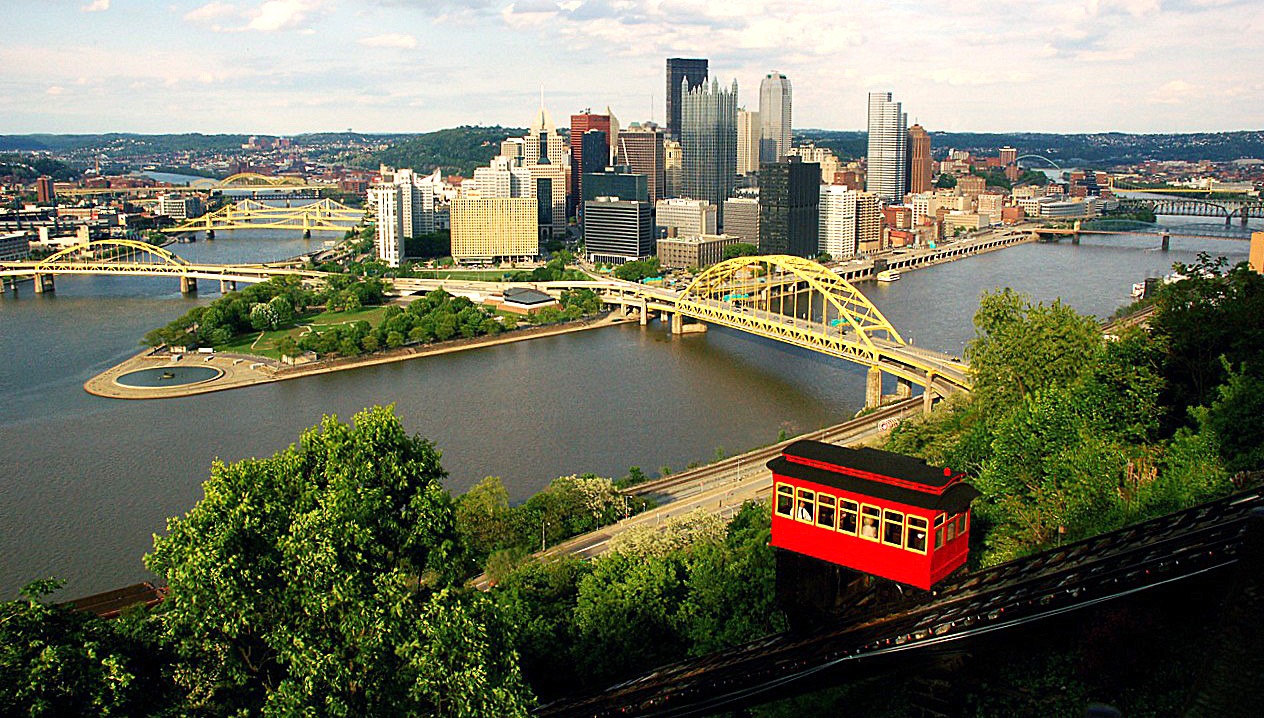
 Pittsburgh, Pennsylvania, is a picturesque city located at the confluence of the Ohio, Monongahela and Allegheny Rivers. (Photo: Derek Cashman / Creative Commons)
Scythian archers dipped their arrowheads into cadavers, hoping to give their enemies tetanus. In 1346, Mongol warriors laying siege to a Genoese trading outpost in Crimea catapulted the bodies of plague victims over its fortified wall.
During World War 2, Unit 731 of the Imperial Japanese Army rubbed anthrax spores on to the feathers of living birds, then dropped them, cooing and fluttering, on to Chinese cities.
In other words, long before concepts like “virus” and “bacteria” entered our worldview, humans observed chains of infection, such as nurses coming down with smallpox after washing sheets. This, in turn, ignited dreams of weaponised disease.
Pull up to a bar or casino on an Indian Reservation in the American West today, and you’ll hear in no uncertain terms: the whites gave our ancestors smallpox-infested blankets. Indigenous oral histories include tales of bizarre gifts of unwashed bedding or paper scraps that ended up seeding devastating epidemics.
Indigenous population crash
Academic historians find such narratives hard to research, but there’s no question about the broader context: the Indigenous population of the Americas declined by more than 90% in the four centuries after Columbus arrived in 1492, mostly because of Native people’s lack of prior immunity to smallpox, measles and influenza.
Like many governments, the US has been guilty of war crimes. For example, the only reason the Lakota, Cheyenne, and Kiowa ever agreed to abandon their ancestral plains for dusty, crowded reservations was that the US military deliberately hunted the bison, their traditional food source, to near extinction.
But as a general rule, contagious diseases were seldom the first choice of generals or war strategists, since they had a nasty habit of spiralling back on their promulgators, as when, in 1781, Indigenous traders who had contracted smallpox from British settlers spread it right back to white employees of the Hudson’s Bay Company.
There is, however, one well-documented example from colonial history of smallpox blankets being handed to Native Americans. This incident is so notorious, in fact, that it regularly makes it on to lists of the top five instances of germ warfare in human history.
Pontiac’s War
/file/attachments/orphans/pontiac_998112.jpg "<br>An artist’s rendition of Pontiac, a Lenape leader who organised a coalition of Indigenous American nations to rise up against British rule in 1763. (Photo: Glen Retief)")
An artist’s rendition of Pontiac, a Lenape leader who organised a coalition of Indigenous American nations to rise up against British rule in 1763. (Photo: Glen Retief)
In 1763, a coalition of Lenape, Shawnee, Wyandot, and Seneca armies laid siege to Fort Pitt, in today’s Pittsburgh. They were trying to stop British encroachment in Western Pennsylvania, as part of an uprising known today as Pontiac’s War.
On 24 June, two Lenape diplomats, Turtleheart and Mamaltee, met two leaders from the garrison. One was Simeon Ecuyer, a Swiss mercenary in service to the British army, and also the commanding officer at the fort. The other was William Trent, an Indian trader who acted as Ecuyer’s right-hand man.
At this meeting, Turtleheart and Mamaltee tried to persuade Ecuyer to abandon Fort Pitt, promising safe passage and peaceful coexistence with the British if they would only respect Native American lands.
Ecuyer declined the offer, but at the end of the meeting, he and Trent handed over what they told Turtleheart and Mamaltee were gifts of goodwill. The latter included two dirty blankets and one handkerchief from the smallpox ward in the fort, all wrapped together in a clean sheet to avoid infecting the British.
/file/attachments/orphans/dioramawithtamaquabackdrop_709132.jpg "A diorama of Fort Pitt in the 1765, with a quote in the background from Tamaqua, a pro-British Lenape leader.
<br>(Photo: Glen Retief)")
(Photo: Glen Retief)
Trent documented this incident in his diary, stating chillingly, “I hope it will have the desired effect.” Later, he submitted an invoice to Ecuyer, on behalf of his own trading firm, requesting reimbursement for the infected blankets and handkerchief. Ecuyer signed off on this purchase.
A month after this, in July, the commander of the British forces in North America, Jeffrey Amherst, exchanged letters with yet another Swiss mercenary, Henry Bouquet. Bouquet was leading a force tasked with relieving Fort Pitt, and Amherst, hearing of the smallpox outbreak within the citadel, wrote, “Could it not be contrived to Send the Small Pox among those Disaffected Tribes of Indians?”
But Amherst’s suggestion was superfluous; the deed had already been done. Given that smallpox outbreaks were already locally commonplace at that time, it is difficult to know whether any of the ones that followed were as a result of the blanket handover. But smallpox can be transmitted in this way, and the intentions of the British military officers were clear.
Fort Pitt Museum
/file/attachments/orphans/fortpittmuseum_752987.jpg "<br>The Fort Pitt Museum, located at the confluence of Ohio, Monongahela, and Allegheny Rivers.
<br>(Photo: Tony Webster / Creative Commons)")
The Fort Pitt Museum, located at the confluence of Ohio, Monongahela, and Allegheny Rivers.
(Photo: Tony Webster / Creative Commons)
I wanted to learn more, so I emailed Mike Burke, assistant director of the Fort Pitt Museum, requesting an interview to coincide with a business trip I needed to make to Pittsburgh.
“Sorry, but I’ll be out of town,” Burke said. “But you’ll find everything you need on the second floor, under the exhibit for Pontiac’s War.”
So I arrived at Fort Pitt on a bright autumn morning: elderly ladies walking their dogs in the nearby city park; the old bronze cannon with its American flag pinned to it, shining in the sun.
/file/attachments/orphans/dioramafortpitt_699183.jpg "A diorama of Pitt and surrounding houses in 1765.
<br>(Photo: Glen Retief)")
(Photo: Glen Retief)
In the museum itself, I started on the ground floor, at a diorama of both the fort and what was then the tiny village of Pittsburgh. A different world! No steel mills or bridges, no trendy food districts or immigrants’ onion-dome churches. No suburbs or highways, stretching halfway to the Ohio border. Just the confluence of the Ohio, Monongahela, and Allegheny Rivers and a dozen wooden houses.
/file/attachments/orphans/tamaquaandhisquote_206131.jpg "A sculpture of Tamaqua, a Lenape leader who advocated as early as 1751 for a British fort in the area of today’s Pittsburgh.
<br>(Photo: Glen Retief)")
(Photo: Glen Retief)
The ground floor also showcased a giant quote from Tamaqua, a Lenape chief who in 1751 told George Croghan, a trader popular among Indigenous people in the area: “The French want to cheat us out of our country, but we will stop them; and Brothers the English, you must help us. We expect that you will build a strong house on the River Ohio.”
The display was, of course, technically accurate. Indigenous nations like the Lenape were internally divided between supporters of the two colonial powers vying at the time for control of North America.
Misleading display
But Tamaqua’s opinion, in 1751, was also decidedly a minority one. Fourteen years earlier, the Lenape had been cheated out of their ancestral homeland along the Delaware River by the British in a blatantly fraudulent land deal. As a result, almost all Lenape at the time were pro-French; in fact, Pontiac’s rebellion was partly aimed at creating space for the French, who had just been defeated in the Seven Years’ War, to return to Montreal.
So giving this quote such prominence seemed both misleading and self-serving on the part of contemporary Anglo-Americans.
/file/attachments/orphans/pontiacquote_630564.jpg "A quote from Pontiac, the revolutionary Lenape leader, explaining his decision to lead an anti-British uprising in 1763. (Photo: Glen Retief)")
Upstairs, initially, things got better. To my relief, in its vast displays of regional history, the museum made a conspicuous effort at ideological balance. I read panels about the original inhabitants of the area; about European colonists’ lack of interest in peaceful coexistence with Native Americans; about the different perspectives on the great Seven Years’ War — Native, British, and French.
It was clear from, for example, the museum’s discussion of the hurtful myths of “vanished peoples” that contemporary Indigenous people had helped shape this content.
I turned a corner and entered the room dedicated to “Pontiac’s War.” Like the rest of the exhibits, this one was rich and educational. A sketch of a fierce-looking Pontiac in Lenape war dress accompanied a quote about the need to expel the British from Native lands. Maps traced the attacks associated with the uprising.
‘Germ Warfare’ display
/file/attachments/orphans/germwarfaredisplay_575079.jpg "The display at the Fort Pitt Museum regarding the incident on 24 June 1763, when the Fort Pitt commanders handed over smallpox-infected blankets to Lenape diplomats. (Photo: Glen Retief)")
But then, in the far left corner, at last I found a tiny section labelled “Germ Warfare.” It contained three short sentences summarising both the Trent-Ecuyer action and the Amherst-Bouquet exchange of letters.
Here, neither Turtleheart nor Mamaltee got a mention; they became mere “Indians,” as in Trent “gave Indians two blankets…” The display stated, accurately enough, that the “tactic had no immediate effect on the siege, but Indians would later suffer smallpox outbreaks.”
To repeat, this was one of the top five landmark incidents of germ warfare in all of human history. It was commemorated at its site of perpetration… like this? A side note. Almost an afterthought.
Later, I emailed the museum’s media office for comment. One, two, three days went by. Then: “Thanks for reaching out. [Mike Burke] said that, as you pointed out, the incident is highlighted in [a section] which was designed and installed more than a decade ago.
“While we regularly update sections of the museum and the exhibition, this is a topic that we intend to research further in the future and expand upon the information currently cited.
“As you mentioned, we work very closely with Native American tribes who once dwelled in Western Pa. and will work to incorporate their perspective on the incident before expanding that section.”
That was it, then. An exclusion, an erasure, like the inattention to Metacom’s throne or the clueless soldiers living on the grounds of a cultural genocide.
But also: a correction and an expansion. Let no one say that asking questions doesn’t change anything.
Pontiac, Turtleheart, and Mamaltee would probably be startled by the radical transformation of this place, from primitive frontier fort to glittering modern metropolis.
I like to think the three of them would also be gratified about this promised elaboration of the historical record.
But on the morning of my visit, as I returned to my own parked car over on Liberty Avenue, it wasn’t the rebels’ words or thoughts that haunted me. Rather, it was those of Tamaqua, the pro-British chief who called for the fort’s construction.
What would he have made of Trent and Ecuyer handing over those blankets? Of forests felled for skyscrapers? Of nineteenth-century steel mills, now turned into shopping malls or art museums?
I remembered him in his museum portrait, hoop dangling from his ear, pushing his dugout canoe into a river. There, like all of us, he would have had to paddle upstream, across rapids and cross-currents, to an unknown, confusing future. DM
Glen Retief’s The Jack Bank: A Memoir of a South African Childhood, won a Lambda Literary Award. He teaches creative nonfiction at Susquehanna University and recently spent a year in South Africa as a Fulbright Scholar.
Comments
Scroll down to load comments...