




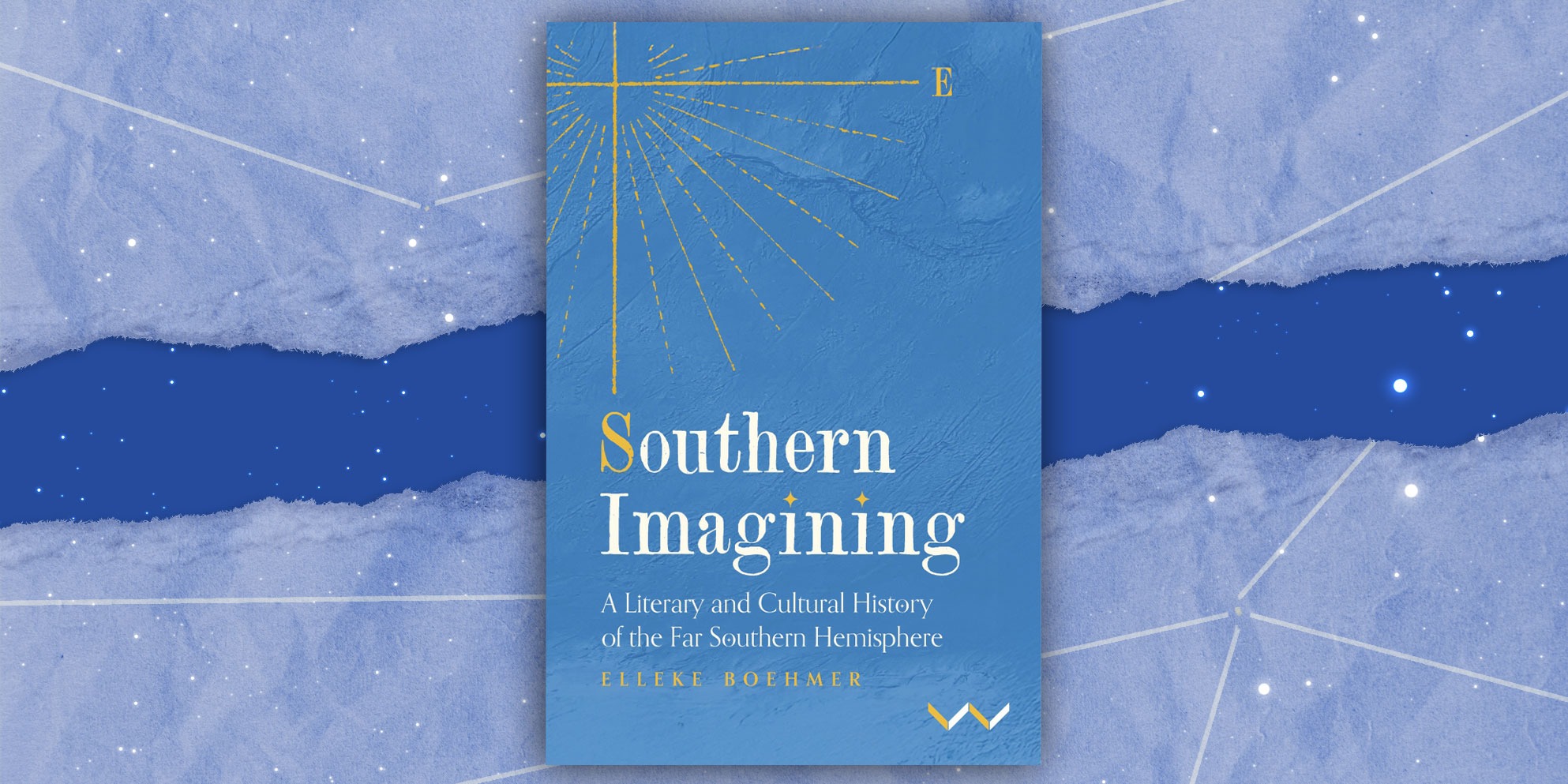
 Illustrative Image: Southern Imagining by Elleke Boehmer. (Publisher: Wits University Press) | (By Daniella lee Ming Yesca)
 Elleke Boehmer has cooked up an aromatic southern stew of artistic life and perspective in her enchanting new book Southern Imagining: A Literary and Cultural History of the Far Southern Hemisphere.
Like a good potjiekos – a product of southern culture – Boehmer has slowly and artfully layered a succulent range of literary, historical and scientific ingredients into a simmering pot to produce a masterpiece of cultural cuisine shot through with magical prose.
“The South is the far,” she writes in her preface. “The underside and the upside-down... It is the ‘bottom’ of our planet. Its verso.
“And yet, not. It depends on where you are looking from. Here, or there. To the north, the south of the world is contrary. The southern skies are upside down. But to southerners, the south is plainly here and the right way up. It is itself. In its place.”
This sets the tone: Boehmer explores the historical and cultural landscape of the south through a southern lens while also examining the prism through which northern writers and travellers viewed what was long regarded as – from their vantage point – “the limits of the known world”.
Humanity has an inherent northern bias.
This is not surprising: 90% of the world’s human population lives north of the equator, a demographic consequence of geography. The northern hemisphere is 40% land, and 60% ocean.
The southern hemisphere by contrast, is about 80% marine, with land only accounting for 20% of its territory, and this includes Antarctica – which is uninhabited when it comes to census surveys.
The northern hemisphere is “land rich” while the south is “sea rich”. It is also “star rich”, affording superior views of the Milky Way as the Earth’s tilt brings the shimmering array directly overhead.
“Human beings are, by nature, apophenic, seeing shapes within randomness... All cultures have projected designs into stars in this entoptic way,” Boehmer writes. Astrology, for example, is an outgrowth of this search for patterns amid this canopy of chaos.
Parallel outlines
“Yet what is especially striking about pre-modern observation in the south is that stargazers appear to have identified similar shapes, including in the Milky Way, reading meaning in both light clusters and the dark spaces between them. While cultures worldwide have arranged the stars into patterns, the truly remarkable thing here is that peoples from Patagonia through to the Karoo to Australasia drew outlines in parallel.”
And Boehmer observes how southern peoples tracked, in an unusual way, faunal features in the spoor of the sky.
“... their environments featured creatures from the same species, particularly the flightless birds – the emu, the ostrich and the rhea. They drew the emu/ostrich shape into the dark spaces within the Milky Way, finding the birds’ behaviours of mating and egg-laying mirrored in the galaxy’s shift from forward-leaning to vertical between the months of March and July.”
I find this arresting: looking between the stars in the voids above to discern the earthly patterns of birds that could never be spotted in the sky. And the plumage of these birds is generally dull, so it makes sense, especially for hunter/gatherer societies, to trace their shape in the dark.
Turning to the sea, Boehmer notes that the south’s marine richness and remoteness from a northern standpoint made it a natural draw for exploitation by the whaling and sealing industries – a point that was not lost on Herman Melville, the author of Moby Dick.
“Though the animals occur throughout the planet’s waters, the higher proportion of ocean in the southern hemisphere, and the low population density of humans, not least on the sub-Antarctic islands, always gave whaling an austral focus, as Melville was aware,” Boehmer writes.
“This insight lead him to become probably the first Anglophone author to bring into the open how the seemingly boundless and relatively unpeopled reaches of the Southern Ocean were being used as mass killing fields, the industrial-scale slaughter and rendering conveniently veiled from the eyes of competitor nations and controlling tax officials.”
This treatment of the far south as an “exploitable outside” has had, Boehmer notes, “far-reaching environmental consequences”.
“In response, Southern Imagining invites a more interconnected understanding of southern spaces, a view of the external from the inside,” she writes.
Global South
This work has some unavoidable links to the geopolitical concept of the “Global South”, but the stage and focus are different. It also invites comparisons to Edward Said’s influential writings on Orientalism as a tool wielded to impose European hegemony on the East and the cultural construct of the “other”.
But while acknowledging Said’s influence on one level, Boehmer maintains that the southern terrain she navigates “... is too amorphous and dispersed to operate as a discourse in the way of Orientalism. Its scatteredness does not conform to the singular idea of an opposite to a Western norm.”
Indeed, Boehmer explores an astonishing range of writers, artists, travellers and scientists, bringing forth the diversity, complexity and scatteredness of the far south. These scatterlings include Zakes Mda, Olive Schreiner, Samuel Taylor Coleridge, Mxolisi Nyezwa, Herman Melville, Yatjiki Vicki Cullinan, Charles Darwin, Fabián Martínez Siccardi and many more.
The south’s unique floral offerings also bloom on these pages. Boehmer plucks this green shoot of insight from the writings of the late South African writer and academic Zoë Wicomb.
In You Can’t Get Lost in Cape Town, the heroine Frieda Shenton reminds her daughter that the protea belongs to the veld – placing the plant where it belongs beyond its appropriation as an emblem of Afrikaner nationalism.
This brings to this reviewer’s mind the conflicting images of the south's rich fauna – most of the planet’s wild elephants, rhinos and lions are now found south of the equator – held by the rural poor who have to share space with such dangerous wildlife and the romantic view of such animals in northern eyes, where their portrayal has been appropriated by the likes of Disney.
Brimming potjie pot
There are many more morsels to be found in this brimming potjie pot. I have just spooned up a handful of tasters here and highly recommend to readers who are tempted by this offering to tuck in.
Boehmer is a novelist and academic, a Professor of World Literature in English at Oxford and Extraordinary Professor of English at the University of Pretoria, and this book is a work of serious scholarship. But it is accessible to a wide and literate audience, not least because Boehmer is a wordsmith of note.
Hailing from Canadian province of Nova Scotia, this northerner is now a southern transplant, and Boehmer has helped give me added perspective on this shift in terrain. My passion for the outdoors, notably fly fishing, has imbued me with a deep and abiding connection to the rhythm and ritual of the seasons. And I have grown accustomed to the southern rhyme.
Boehmer has drawn my attention to something I only noticed in a vague sort of way – how austral light is “blue-blue-white, almost incandescent”. I write these words over a sundowner on my stoep as this blue-blue-white encases the green of my garden, the sun perched at a jaunty angle as it treks west before it will make its abrupt descent.
For me, north is now the there, and I am here.
One of the traits this Nova Scotian has picked up by settling in the south is that I am now a passionate potjie chef. And I now realise that a good potjie offers a taste of the south. DM