




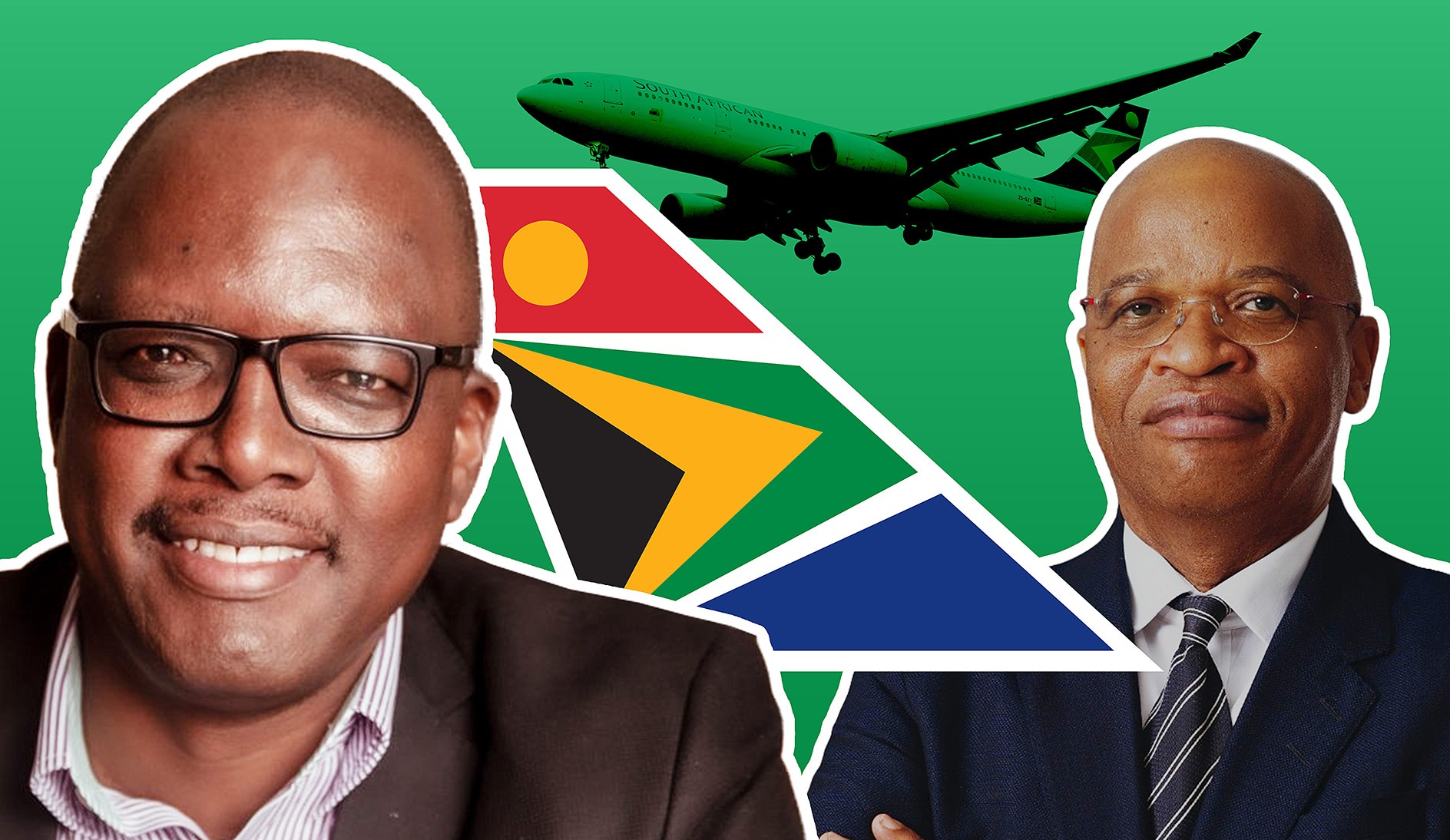
 Illustrative image: SAA CEO Matshela Seshibe. (Photo: Facebook/ Daybreak Farms) | SAA Logo. (Graphic: Wikipedia) | SAA plane (Photo: iStock) | Outgoing SAA CEO Prof John Lamola. (Photo: Facebook / SAA)
 “I have resigned for personal reasons following months of contemplation and discussions with both the Minister and the Board. I believe I have played my part in resuscitating the national carrier post the business rescue, Covid and Ukraine War. It is time for new and steady hands to take the airline to the next level.”
That is the reason the outgoing CEO of the South African Airways (SAA) group, Professor John Lamola, gave for his resignation in a carefully crafted 1,356-word statement written in response to Daily Maverick’s recent reporting on the airline.
He has overseen a remarkable turnaround in the national carrier’s fortunes, and the team that he led – including departed CFO Lindsay Olitzki, who, according to Lamola, “reached SAA’s mandatory retirement age in October 2025, and we requested that she stay on for an additional five months” – deserves all the credit for saving SAA from the brink of bankruptcy.
Pointed rebuttal
“I reiterate the attainment of a net profit of R155 million, whilst stating that during 2024-25, the airline was in a phase of consolidating its restart momentum amid working capital pressures occasioned by the non-conclusion of the planned Takatso equity injection,” Lamola asserted.
“Using EBITDA in isolation to judge an airline’s success or otherwise is analytically unsound and inconsistent with industry practice.”
That final remark serves as a pointed rebuttal to Daily Maverick, which had scrutinised the airline’s integrated reports alongside its financial statements to cut through the corporate jargon and challenge the official narrative.
And that heavily publicised R155-million net profit is entirely reliant on the R1.153-billion sale of a pair of Heathrow landing and departure slots.
Without the sale of this critical asset, the group would have recorded a massive net loss. And the fact remains that the Auditor-General (AG) issued a disclaimer of opinion because they could not verify SAA’s revenues, maintenance costs, or operating costs.
Crucially, the AG warned that the reported airline Ebitda (which Lamola rightly refers to as operating profit) loss of R443-million was probably inaccurate, stating: “I could not determine the actual achievement, but I estimated it to be materially less than reported.”
We’re in the endgame now
On the subject of the R1-billion in SAA shares that the state is now saddled with, Lamola was detailed:
“In the February 2023 Budget speech, SAA was allocated R1 billion. These funds were received in April 2023, hence they were reported in the FY24 (2023 March-April 2024) AFS [annual financial statement].
“Contrary to [aviation journalist] Guy Leitch’s and Lindsey Schutter[s]’s wild claims, this was not ‘a bailout’. The shareholder [the state] was effectively reimbursing SAA for the business rescue liabilities it had covered. The note in the FY25 AFS regarding the shares issued to the shareholder to legally regularise this transfer of funds is not a ruse or a sneaky concealment of a bailout.
“I state categorically that since exiting business rescue and restarting in 2021, SAA has never received any operational support from the fiscus. Its emergence as an airline and growth have been funded internally, reflecting disciplined and innovative financial management.”
The sale of the pair of Heathrow landing and departure slots was also explained with care and specificity:
“We had to pursue a range of options to raise funds for this company, which had a poor credit rating as it was emerging from near-bankruptcy. An innovative opportunity, borne out of a superior understanding of the economics of aviation infrastructure, directed management to convert one pair of unused landing and departure slots at London Heathrow airport into liquid cash. Historically, SAA has had three of these slots. One was sold in 2012. There is still one remaining, which will be used when SAA resumes London operations. The price received for the slot is stated in rand equivalents in the FY2024/25 AFS under the relevant line, as a significant portion of the R1,153 million.”
Coming in for a landing
Lamola is fundamentally correct that the airline has been navigating severe external turbulence since its rebirth. The much-delayed Takatso transaction dragged on for three years before formally collapsing in March 2024. This left SAA without an expected R1-billion in working capital, triggering a severe financial crunch.
Where the defence banks a little too sharply is his framing of the AG’s findings. Lamola insists (read above) that the financial statements, as audited by the AG and signed off by the directors, “are an accurate and true reflection of SAA’s finances”. He dismisses critics as being desperate to sketch a crisis out of mere “typographical errors” in the integrated report.
This is a misrepresentation of the audit outcome.

The AG did not sign off on the financials as an accurate reflection; they issued a Disclaimer of Opinion. This means the state of SAA’s accounting records was so poor that the auditor could not obtain enough evidence to verify the numbers. The AG flagged systemic internal control deficiencies, unverified technical services revenue stated at R333-million, and unverified maintenance costs stated at R896-million.
Lamola also pointed out that management had to endure seven back-to-back audits to clear historical backlogs, leaving them little time to address findings. While true, the AG did note that management “did not implement proper record-keeping in a timely manner”.
Even SAA’s own Audit Risk and Governance Committee expressed deep concern over this disclaimer outcome and the lack of progress in addressing previous audit findings.
Ultimately, Lamola’s parting shot offers a realistic view of the national carrier he leaves behind. He acknowledges that while the resuscitation of SAA is an “undeniable success story,” it remains a “project under reconstruction”.
The operations and the brand have indeed been saved from the scrap heap, and Lamola’s captaincy during a precarious restart deserves acknowledgement. But as he hands over the controls, the turbulence of deep-rooted financial governance issues remains very much on the radar. DM