



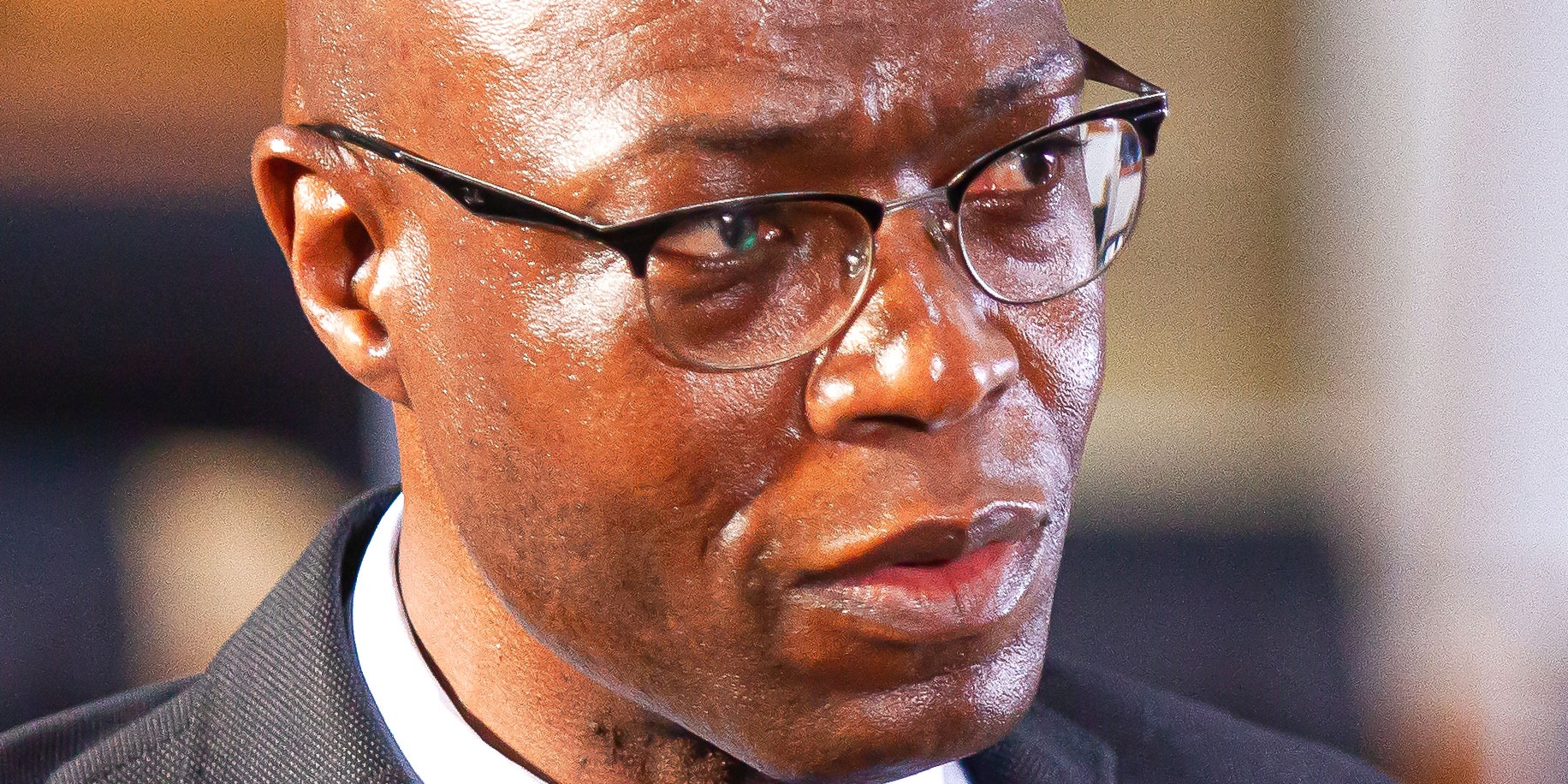
 Former Eskom acting CEO Matshela Koko testifies at the Zondo Commission in Johannesburg on 19 May 2021. (Photo: Gallo Images / Papi Morake)
Should the National Prosecuting Authority be allowed to conclude settlement agreements with companies accused of corruption instead of taking them to trial? This is the question being asked by former Eskom executive Matshela Koko, who is challenging a R2.5-billion “punitive reparations” agreement between the NPA and Swedish-Swiss technology company Asea Brown Boveri (ABB).
Koko was acting CEO at Eskom between December 2016 and May 2017 when he was placed on special leave. Before that, he held the position of Group Executive: Generation and Technology.
/file/dailymaverick/wp-content/uploads/2024/08/ED_467287.jpg "Kusile Power Station in eMalahleni. (Photo: Gallo Images / Daily Maverick / Felix Dlangamandla)")
The legal battle stems from the Kusile Power Station’s “Control and Instruments” contract, for which ABB’s South African subsidiary was contracted. ABB admitted to the US Department of Justice that it had paid bribes to “a high-ranking official at South Africa’s state-owned energy company” to attain the contract.
The settlement formed part of a cross-continental anti-corruption deal negotiated in 2022 with the United States, Italy and Germany, the NPA said.
In a statement at the time, the NPA said: “This agreement was reached in line with Section 64(e) of the Prevention of Organised Crime Act. It is reflective of the NPA’s two-pronged strategy to deal with corruption through prosecuting perpetrators and recovering the stolen money.”
“South Africa is getting the bulk of the settlement amount due to the nature of the crimes and the negative impact on South Africa and its people,” it said in a December 2022 statement. As part of the agreement, the company agreed to cooperate with local authorities in the prosecution of criminal cases linked to the contract. Some staff also agreed to serve as witnesses.
ABB also agreed to pay R1.56-billion to Eskom to settle an overpayment dispute.

However, in papers before the high court sitting in Johannesburg, Koko says the company should not have been granted immunity from prosecution.
He notes that the bribery allegations are directly linked to him and the NPA’s previous attempts to prosecute him for corruption in a R2.2-billion tender.
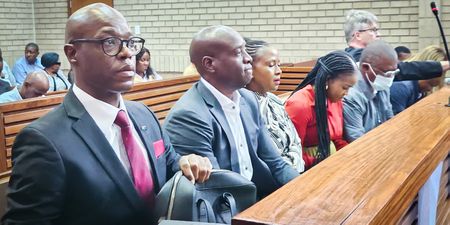
Koko was arrested in October 2022 and charged alongside his wife, Mosima Koko and his step-daughters, Koketso Aren and Thato Choma.
Former SA Local Government Association chief executive Thabo Mokwena, Eskom Project Director at Kusile, Hlupheka Sithole, lawyers Johannes Coetzee and Watson Seswai, as well as business owner Lese’tsa Johannes Mutchinya, were among the accused.
In November 2023, the case was struck from the Middelburg Regional Court due to “unreasonable delays” from the NPA. It is yet to be re-enrolled.
‘Selective prosecution’
In his affidavit before the high court, Koko argues that the alternative dispute resolution agreement “infringes on the rule of law and the Constitution”.
“Guaranteed immunity from criminal prosecution is not provided in South African law. The constitutional obligation of the NPA is to ‘prosecute those offences that threaten or infringe the rights of citizens’,” he says.
Koko also cites the equality clause in the Constitution, saying it “precludes selective prosecution”.
“I submit that the alternative dispute resolution and cooperation agreement with ABB South Africa is meant to sanitise ABB South Africa to possibly avoid a court … endorsing ABB South Africa on the register of criminal offenders under section 28 of the Prevention and Combating of Corrupt Activities Act. This would be devastating for ABB globally.”
Koko adds that the NPA “shows contempt” for him and his co-accused.
“It is not respectful of the Constitution. It is unlawful. All are equal before the law,” he says.
Koko also argues that ABB has admitted wrongdoing by agreeing to the contents of a “statement of facts” document, linked to the agreement.
“The criminal conduct of the ABB officers ought to be imputed to the company. ABB South Africa cannot escape criminal prosecution”.
Koko also argues that the decision on whether to prosecute should be made under judicial oversight, following a guilty plea.
During his Middelburg court appearances and in these court papers, Koko maintains that he is innocent of wrongdoing. He says that there is no direct evidence of bribery, but does acknowledge that ABB overcharged Eskom, inflating prices by between 864% and 1,045%.
Koko alleges that ABB staffers “framed” him, while the company “sanitised” its staff after the deal.
“I had no operational responsibility for the Kusile project, directly or indirectly. ABB faced an existential threat because of its corrupt activities at the Kusile project. They were looking for a way out – a deal with the USA DOJ and the NPA,” he argues.
‘Discretion to prosecute’
The NPA has defended the agreement in court papers, saying that ABB had voluntarily informed it of the corruption after an internal integrity unit investigation revealed it. The company also provided evidence which the NPA said it was not aware of at the time.
In heads of argument before the court, the NPA says Koko’s insistence that it prosecute ABB SA is “unprecedented in South African law”.
“It is a claim that, as far as we have been able to establish, is also unprecedented elsewhere. An accused person is not entitled to insist that an alleged co-offender also be prosecuted, and is also not entitled to object to the prosecution’s decision to see an alleged co-offender as a State witness,” the NPA says.
The NPA also says it has “discretion as to whether to prosecute”, which is supported by the NPA Act and prosecution policy. The NPA says it considered public interest and policy when making the decision. It also considered whether there was a reasonable prospect of success.
“In any event, there is no prospect of a successful prosecution of ABB SA in South Africa. ABB SA has been prosecuted, convicted and sentenced in the USA for the same acts and omissions as those in respect of which Mr Koko insists that they must now be prosecuted in South Africa.
“It cannot be prosecuted in South Africa, because the prosecution would be in breach of the double jeopardy provision in section 35 (3)(m) of the Constitution: every accused person has the right to a fair trial, which includes the right ‘not to be tried for an offence in respect of an act or omission for which that person has previously been either acquitted or convicted’.”
The NPA argues further that if the court were to accept Koko’s position, both he and ABB SA would “go scot-free”.
“If Mr Koko is correct, then he will also be able to go scot-free, because the NPA will not be able to hold ABB SA to its undertakings in the [alternative dispute resolution agreement] to co-operate and assist in the prosecution, and to provide the evidence which is collected, which the NPA needs for the prosecution of Mr Koko and others.”
The NPA indicates that it “intends to resume” the prosecution of Koko and his co-accused, although it does not provide a timeline. The NPA has called on the court to dismiss the case and wants the court to order Koko to pay the legal costs for “abusive” litigation practices.
‘Irrelevant and vexatious’
ABB SA has also opposed Koko’s case, saying his court papers are “replete with irrelevant and vexatious matters”. The company has asked the court to strike out parts of Koko’s affidavits. The company’s lawyer, ABB SA lawyer Dierdré Mary Jane Simaan, has also set out the background to the agreement and plea deal.
In February 2017, ABB received confidential whistleblower reports that implicated ABB employees in corrupt dealings, which kicked off an internal probe. The company says the investigation involved the processing of 8.2 terabytes of data, 20.9 million documents and “approximately 50 in-person interviews with ABB employees in South Africa, the United States of America, Germany, Italy and the United Arab Emirates”.
In June 2018, after the SIU began investigating losses at Eskom, the company confirmed its willingness to cooperate with the authorities. It also made similar voluntary disclosures in the US, Switzerland and Germany.
Simaan says the company considered the legality of the agreement before signing it. It believes the agreement is in line with the NPA’s restorative justice approach.
“ABB South Africa viewed, and still views, the ADR agreement as being in line with an exercise of prosecutorial discretion,” she said.
“I further note that in terms of section 331 of the Criminal Procedure Act, a corporate [sic] cannot be imprisoned. Instead, the primary consequence for a corporation found guilty of an offence is a fine. The ADR agreement effectively places the State in a better position than it would have been had ABB South Africa been successfully convicted through a protracted court process,” said Simaan.
She said that such a prosecution would have been “subject to the defence of double jeopardy given that ABB South Africa entered into the US plea agreement for the same offences”.
The case is set down for two days of argument on 20 and 21 April. DM
Comments
Scroll down to load comments...