
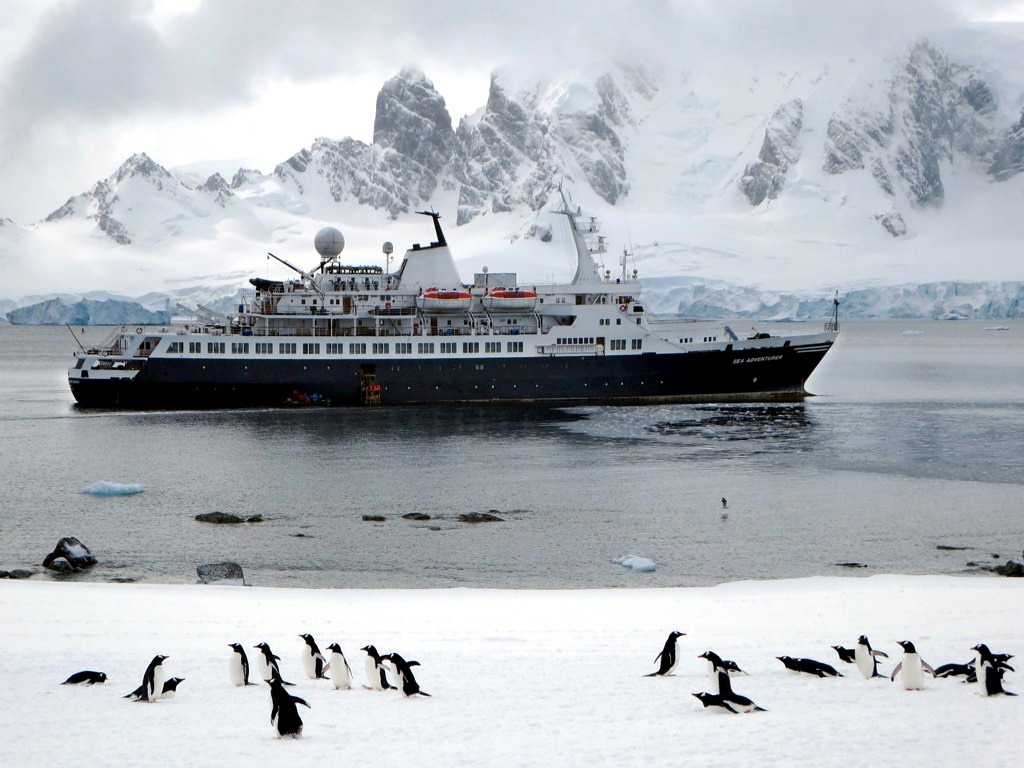
 The Sea Adventurer cruise ship in Antarctica. (Photo: David Stanley / Wikimedia Commons)
 Emperor penguins are being driven towards extinction by climate change. And into that crisis, a second pressure is rapidly increasing: tourists.
In a report released this month, the International Union for Conservation of Nature (IUCN) moved the emperor penguin onto its Red List as endangered, warning that populations could halve by the 2080s as Antarctic sea ice continues to disappear.
The danger is simple: these birds breed on sea ice, and when it breaks too early, their chicks die.
At the same time, tens of thousands of tourists are travelling to Antarctica each year – many drawn by the chance to see emperor penguins. Getting there requires long-haul flights, fuel-intensive cruise ships and, in some cases, helicopter and fixed-wing transfers into remote breeding colonies.
/file/attachments/orphans/gentootourism3_325243.jpg "Tourists among penguins in Antarctica. (Photo: Supplied)")
In a research paper titled “A fragile encounter: The paradox of touring emperor penguin colonies in a changing Antarctic” published in the journal Biological Conservation, lead author Allyson Kristan of Duke University and her co-authors describe this as a growing contradiction: a climate-vulnerable species being visited, involving activities that generate disturbance and emissions, which threaten their habitat.
In an interview with Maverick Earth, Kristan outlined her concern: “It’s very clear that emperor penguins are declining because of climate change. But at the same time, people are generating huge amounts of emissions just to see them before they go extinct. That’s a paradox.”
A species built on stability
Few species are as tightly bound to environmental conditions as the emperor penguin. They rely on stable “fast ice” for breeding, moulting and access to feeding grounds.
/file/attachments/orphans/Adele_152301.jpg "Young Adélie penguins are adorable and a magnet for Antarctic tourists. (Photo: Don Pinnock)")
Kristan and her co-authors note that emperor penguins depend on this for nearly every stage of their life cycle, making them exceptionally vulnerable to environmental change. Timing is everything. If the ice forms too late or breaks too early, entire reproductive cycles collapse.
Recent data suggest the system is no longer behaving as it once did. In their paper, the authors point to a string of record-low sea ice years – well outside expected natural variability – as evidence of a deeper structural shift in the Antarctic system.
The IUCN, drawing on satellite data, reports that about 10% of the global population has already been lost in less than a decade, equivalent to more than 20,000 adult birds. In some regions, breeding failure has been near total. The emperors are being outpaced by environmental change.
The arrival of a second pressure
Overlaying this environmental instability is a rapidly expanding human presence. According to the Fragile Encounter paper, Antarctic tourism has surged in recent years, with more than 117,000 visitors recorded in the 2024/25 season – a sharp increase on pre-pandemic levels. What was once a remote, logistically difficult destination is now part of a global circuit.
For many visitors, wildlife is the primary drawcard, and emperor penguins are among the most sought-after encounters. But reaching them is hugely carbon-intensive.
Kristan and her colleagues cite research showing that a single Antarctic trip can generate several tonnes of CO₂ per person transported, combining flights and cruise travel. Additional excursions – such as helicopter visits to colonies such as Snow Hill – add further emissions, along with noise and physical disturbance.
These emissions are small in global terms, but symbolically potent: carbon burned to witness the victims of carbon overload.
/file/attachments/orphans/Screenshot2026-04-02at103838AM_683068.jpg "(Source: Allyson Kristan et al)")
The paper situates this within the broader phenomenon of “last-chance tourism” – the urge to see places and species before they disappear. None of this is driving the species’ decline at a global scale. But it’s not inconsequential either.
“What we’re really asking,” Kristan says, “is why are we adding additional disturbance and pollution to a species and habitat that’s already under so much pressure? It isn’t worth the risk.”
Disturbance of a finely tuned system
As Kristan’s research outlines, humans are extremely disruptive. Adults and chicks rely on sound to navigate dense breeding groups. Aircraft noise – particularly from helicopters – disrupts this acoustic landscape. Previous studies cited in the paper show that penguins exposed to such disturbances show increased stress responses, vigilance and behavioural changes.
The paper also highlights the cumulative nature of tourism: multiple groups of visitors rotating through colonies, extended periods of presence and prolonged exposure during critical breeding windows. “It can be very disturbing,” Kristan says. “We don’t know all the long-term impacts, but we do know there are acute and potentially chronic effects.”
/file/attachments/orphans/DSC_0017_525927.jpg "Younger emperors are incurably curious but at great risk from crumbling ice and tourist incursions. (Photo: Don Pinnock)")
In a system where survival in an extreme environment such as Antarctica depends on tight energy budgets and precise timing, those effects are not insignificant.
A system struggling to regulate itself
Managing these pressures is complicated by governance. As Fragile Encounter makes clear, Antarctic tourism operates within a disjointed regulatory system, combining international law under the Antarctic Treaty, national permitting and largely voluntary industry guidelines. Enforcement is inconsistent, and oversight is often limited.
In our interview, Kristan pointed to practices such as “forum shopping”, where operators seek permits from countries with less-stringent requirements, as a key weakness. “Compliance exists,” she says. “But there’s no real international enforcement structure.”
Efforts to strengthen protections – including proposals within the Antarctic Treaty system to designate emperor penguins as an Antarctic Specially Protected Species – have repeatedly stalled, despite strong scientific support.
The bigger picture remains unchanged
The underlying driver of decline remains undeniable. In its Red List assessment, the IUCN identifies human-induced climate change – specifically the loss and instability of sea ice – as the dominant threat to emperor penguins. Without rapid reductions in greenhouse gas emissions, populations are expected to decline steeply throughout this century.
Kristan’s paper builds on this conclusion, pointing to additional pressures, including disturbance and pollution from human activity.
In our interview, she added another concern: the expansion of krill fisheries.
“They’re using massive, industrial supertrawlers to steal krill from the mouths of Antarctic penguins, whales and seals for absolutely needless products. It has the potential to devastate the entire Southern Ocean food web.
“It’s largely Norwegian- and Chinese-flagged ships, but also South Korean, Chilean and Ukrainian. Krill is being used as an omega-3 supplement for people as an alternative to fish oil, although algae or flaxseed oils are just as good without the environmental destruction.”
Krill, she says, have a pigment in them that makes their skin pink, so krill is also caught to be fed to farmed salmon in aquaculture to make them look pink and healthy instead of the otherwise sickly grey colour. Some of the krill catch is ground up and used in pet food.”
Not a spectacle
Emperor penguins are still there – still breeding, still enduring. But the conditions that sustained them are slipping away. The ice is thinner. The seasons are less predictable. The margin for survival narrower each year.
“They’re not a spectacle,” Kristan says, “they’re in crisis because of climate change, and mass tourism is part of the problem.” DM