



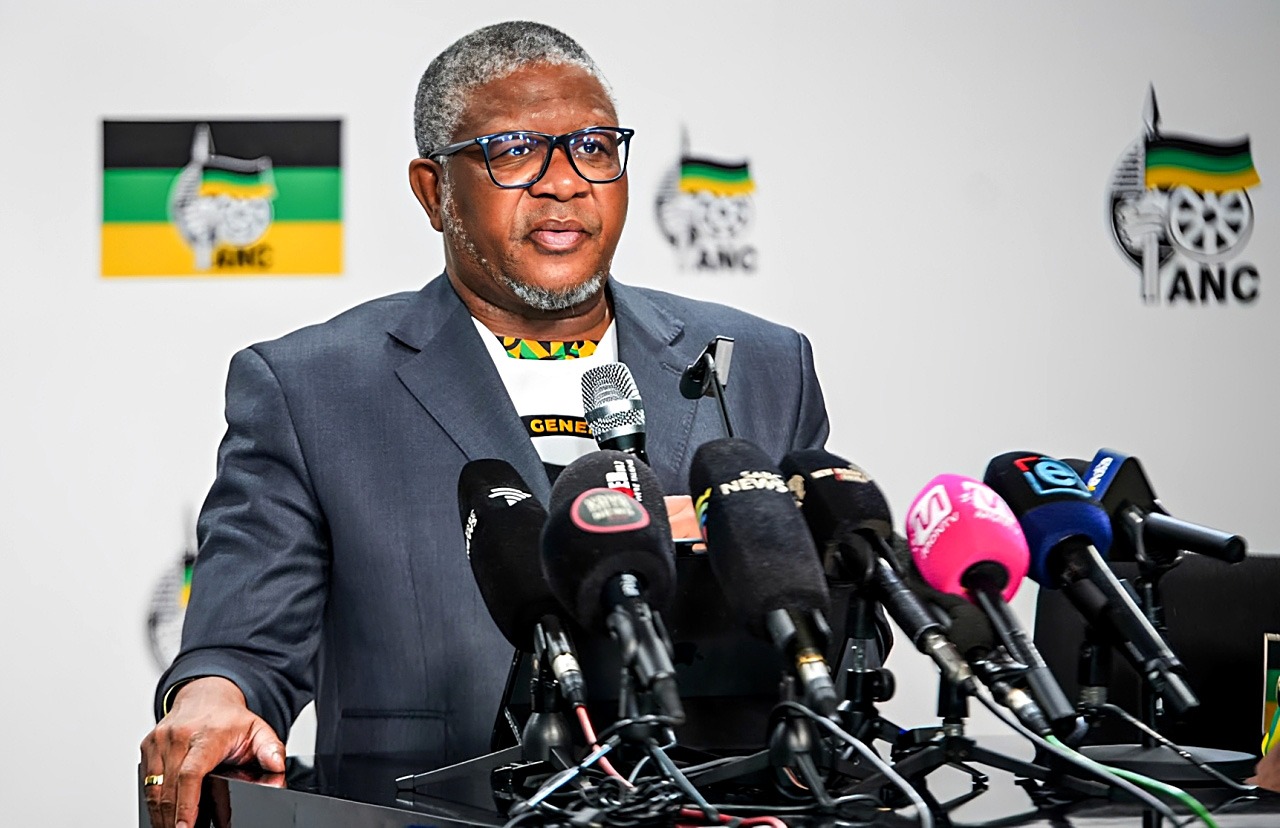
 On Monday, 20 April 2026, ANC national officials, including secretary-general Fikile Mbalula, briefed the media at Luthuli House on the party’s Local Government Action Plan. (Photo: ANC Gauteng / Facebook)
 The ANC will formally launch its campaign only in July, once a date is set for the local government poll – the DA began its campaign in Joburg six months ago and used its Congress in April as a national launch.
The party will open its mayoral candidate selection process beyond its own membership and invite public input – particularly in Johannesburg – a sharp break with its past, the party said in its first major briefing on its local government election strategy.
Party secretary-general Fikile Mbalula said the ANC was looking for “the best of the best” and would not limit itself to internal candidates.
“We are not confining ourselves to elected leadership… If the people say, among those interviewed, this is the person we believe can be mayor, that will be it,” Mbalula said on Monday.
The party outlined a multi-stage vetting process, including interviews, background checks and assessments of governance capability, before candidates are shortlisted for metros and secondary cities. The party’s head of elections, former president Kgalema Motlanthe, will be in charge of the process already under way.
An outside candidate for Joburg?
Mbalula said the ANC could not afford to run a campaign for as long as the DA’s, but it’s clear that Zille’s energetic social media campaign will see the ANC respond.
“We will be intensifying, in the coming weeks, engagement with the public… Who do you want to become the mayor of Joburg on the ANC platform?”
This week, the party will launch a show-and-tell campaign to display progress in the city, which is run by an ANC-EFF-PA and other small parties.
Soft launch
Asked why the ANC’s campaign was not visible, party deputy secretary-general Nomvula Mokonyane said it was in a “soft launch” phase where each by-election allowed it to test its strategy.
“As an incumbent, you don’t start a campaign – you are already in a campaign because you are in charge.”
“A campaign is not an event… it is what we are going to do to account to our people,” said Mbalula.
Coalitions: Necessary but unstable
The party will campaign for outright majorities, but acknowledged the realities of coalition politics – pointing to its cooperation with the Economic Freedom Fighters in Gauteng after other parties declined to back the budget.
The ANC is not polling with a majority, according to four major polls released recently. It was knocked down to 40% in the 2024 national election, and the trend line is that it will drop further in the local poll.
“That is the nature of coalition politics – you work with those who are prepared to govern,” said Mbalula.
At the same time, he highlighted instability in hung councils, citing Johannesburg’s revolving door of mayors as a cautionary example. Only three of the eight metros are run by majority governments – two by the ANC and one by the DA.
“There’s no single party that comes and governs alone… coalition governments have created instability,” said Mbalula.
Strategy: Defend base, expand reach
The ANC said by-election results showed it was still competitive, having defended most of its strongholds while conceding a few wards to opposition parties, including the IFP and MK.
But the party is cautious about overreading those results.
“We don’t want to use by-elections as a metric… but we have defended our base,” said Mbalula.
“We are not waiting for coalition governments… We are working for an outright majority.”
SACP members must choose
Meanwhile, the ANC has confirmed an ultimatum to SA Communist Party (SACP) members in government on a party ticket: they will have to choose a single political home in the next 10 days.
This is because the SACP has decided that it will contest the local elections on its own. Mbalula said this did not signal the end of the Tripartite Alliance, but that those in government had to choose.
Senior leaders affected by the decision are: Minister of Science, Technology and Innovation Blade Nzimande, Minister of Mineral and Petroleum Resources Gwede Mantashe, Higher Education Minister Buti Manamela, Deputy Minister of Finance David Masondo and Deputy Minister of Police Polly Boshielo.
Mbalula said these leaders could not be in government by day and campaign for the SACP by night.
/file/dailymaverick/wp-content/uploads/2024/04/ED_490914.jpg "Minister of Higher Education, Science and Technology Blade Nzimande is an SACP member who could be affected by the party’s decision to contest elections independently of the ANC. (Photo: Gallo Images / Luba Lesolle)")
Action plan progress
The ANC also released an update on its Local Government Action Plan, announced by President Cyril Ramaphosa during a “roll call” with the party’s councillors from across the country in September 2025. The party said its turnaround plan for municipalities was working and highlighted the following progress in the seven months since:
1. Turnaround of failing municipalities
Eight priority municipalities have structured turnaround plans, with six already stabilised and core services (water, electricity, sanitation, roads) refocused.
2. Rapid-response “War Rooms”
Service Delivery War Rooms in all nine provinces, resolved 320+ high-priority incidents. Knysna’s “Day Zero” risk was averted with 122 emergency water points.
3. Electricity: Cutting load reduction
Load reduction eliminated in Northern Cape and Western Cape, with 140+ feeders restored and 380,000+ smart meters installed (190,000 in high-risk areas).
4. Roads and transport recovery
- 3,200km of national roads rehabilitated
- 5,800km of provincial roads upgraded
- 12,000km+ of local roads improved
- Rail: 31 corridors restored, 68 stations upgraded, adding ~450,000 daily trips
5. Water and sanitation gains
- 420+ boreholes drilled/refurbished
- 67 treatment works upgraded
- 1,200km of reticulation repaired
- ~2.8 million households with improved access
6. Crisis intervention (including Joburg)
National intervention stabilised Johannesburg’s water system through leak repairs, pressure management and coordination — avoiding collapse and restoring supply reliability.
7. Revenue recovery through smart tech
- 15,000 smart meters installed in the Enoch Mgijima municipality
- R36m revenue boost in one month
- 71 municipalities in Eskom debt relief
- R55.3bn total relief package
8. Metro reform tied to funding
A R54bn reform programme over six years, with metros required to meet eight minimum conditions by 30 June 2026 or risk losing grant funding.
9. Governance and audit improvements
180+ compliance interventions (including Section 139), with improved audit outcomes in municipalities such as Mbombela, Mamusa and Bela-Bela.
10. Local economic development push
R18bn+ investment pipeline unlocked and 6,500+ small enterprises supported, repositioning local economic development as a growth driver. DM
*The audit is a summary of an ANC presentation using AI. An editor checked the original document against the summary for accuracy.