




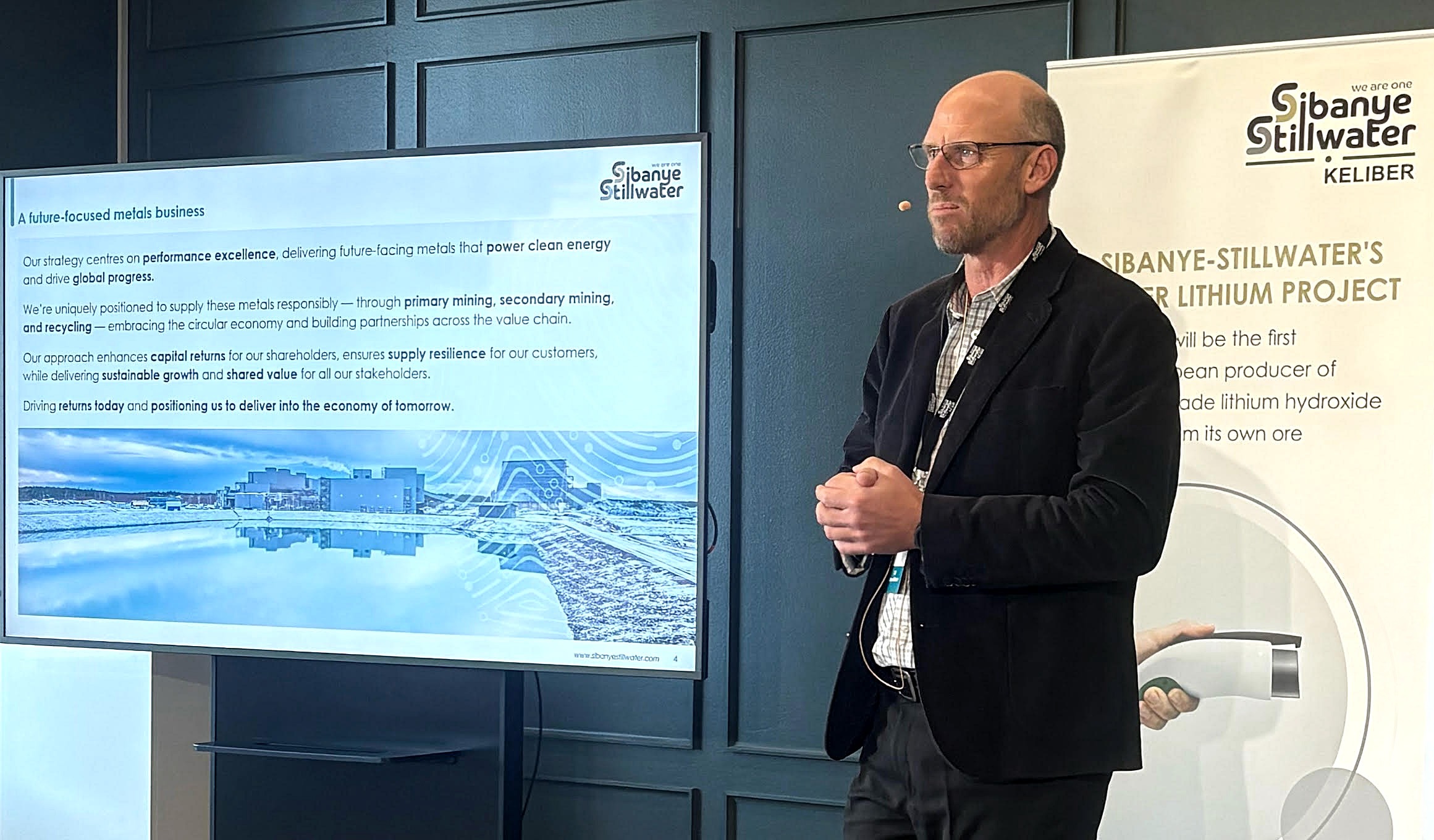
 Sibanye-Stillwater CEO Richard Stewart at a capital markets presentation in Helsinki, Finland, on 20 April 2026. (Photo: Ed Stoddard)
More than 10,000km from the Witwatersrand gold reefs where it was spawned, Sibanye-Stillwater is swimming in the currents of new commodity markets that it hopes will boost its revenue and dividend flows in the long run.
The company’s Keliber lithium project in Finland, which just went into production after three years of construction at a cost of more than €780-million, is Europe’s first domestic source of battery-grade lithium hydroxide – a critical component of the batteries needed for electric vehicles and battery energy storage systems.
Sibanye, a spin-off from Gold Fields that began life over a decade ago as a gold producer focused on deep-level, conventional South African mines, has aggressively diversified its asset profile both geographically and geologically.
And this has lead to an interesting strategic confluence. In the US, the company’s Stillwater operation is the only producer of platinum group metals (PGMs), used mostly for emissions-capping catalytic converters in internal combustion engines.
This places it in the heart of the massive market for internal combustion engine vehicles in the US, where the bakkies are big and cultural resistance to battery electric vehicles has been significant.
At its Finnish lithium project, it has the only operation in Europe that mines and refines the metal in a region where battery electric vehicles are fast gaining market share against a very different and greener cultural backdrop.
This also plugs into the EU’s scramble to secure supplies of critical minerals, and Keliber has been designated an EU Strategic Project under the Critical Raw Materials Act. This aims to “ensure EU a secure and sustainable supply of critical raw materials, enabling Europe to meet its 2030 climate and digital objectives”.
And that status down the road could also lead to EU support and subsidies – an astonishing twist on history’s grand stage for a South African gold producer.
China has 70% of the world’s refining capacity for lithium, and the Strait of Hormuz has dramatically underscored the importance of geography to commodity markets and supply.
At a capital markets presentation on Monday, 20 April 2026, in the Finnish capital Helsinki before a visit to the mine site on Tuesday, Sibanye CEO Richard Stewart pointedly said the company “did take a view on geographies with battery metals”.
In Europe, the battery electric vehicle share of the auto market continues to gain traction. In the first quarter of 2026, new battery electric vehicle registrations soared 30% to nearly 560,000 units, according to trade association E-Mobility Europe and research firm New AutoMotive. One key catalyst was the surging price of oil in March in the wake of the Iran War.
/file/attachments/orphans/unnamed1_103838.jpg "Lithium-bearing rock from the first blast at Sibanye-Stillwater's Keliber lithium operation in Finland. (Photo: Ed Stoddard)")
Most PGM producers have watched the growth of battery electric vehicles – which don’t require PGMs – with a sense of alarm and dread, while hoping for hybrids to gain more favour as such vehicles require more PGMs than internal combustion engine vehicles.
Sibanye is in a different boat as it has exposure to both battery electric vehicles and internal combustion engine vehicles.
But Stewart said that Sibanye did not see this as a hedging of bets.
“It was never about a hedge. We have not seen it as one or the other. We think both technologies are going to exist for a long time. Battery electric vehicles and internal combustion engine vehicles are going to be around for the long term, so we don’t see it as a trade-off,” he said.
Indeed, forecasts of the end of internal combustion engines vehicles are proving to be premature.
In December last year, the European Commission announced that it was effectively lifting the scheduled ban on the sale of internal combustion engines vehicles from 2035 – partly under pressure from countries such as Germany, which have huge auto industries. In its place, the EU is aiming for significant reductions from new cars in the CO₂ emissions linked to climate change.
With or without a ban, one of the consequences of the Iran War could be the acceleration of the demise of internal combustion engines vehicles.
Shortages seen
But beyond the automotive sector, both PGMs and lithium have many other industrial uses and forecast demand points to supply deficits that will underpin prices – and producer profits.
“Global lithium demand could exceed 13 million tonnes by 2050 under an accelerated energy transition, more than double base case projections,” energy consultancy Wood Mackenzie said in its latest Energy Transition Outlook for Lithium.
“Without significant new investment, supply deficits could emerge as early as 2028. Even under the Wood Mackenzie’s base case scenario, existing supply projects are unlikely to meet demand beyond the mid-2030s, highlighting the need for sustained investment across the value chain,” it said.
Looming shortages are also seen for PGMs after decades of under-investment in SA in response to depressed prices, policy uncertainty and past eruptions of labour and social unrest. PGMs have a wide range of industrial and medical uses and are crucial on the green energy front for the production of hydrogen fuel cells.
Having exposure to both is probably no bad thing in an era when “critical minerals” are all the rage. And having Europe’s only fully integrated lithium project may prove to be a strategic masterstroke that flows from a confluence of geology and geography. DM
Disclosure: Ed Stoddard is a guest of Sibanye-Stillwater in Finland.
Comments
Scroll down to load comments...