




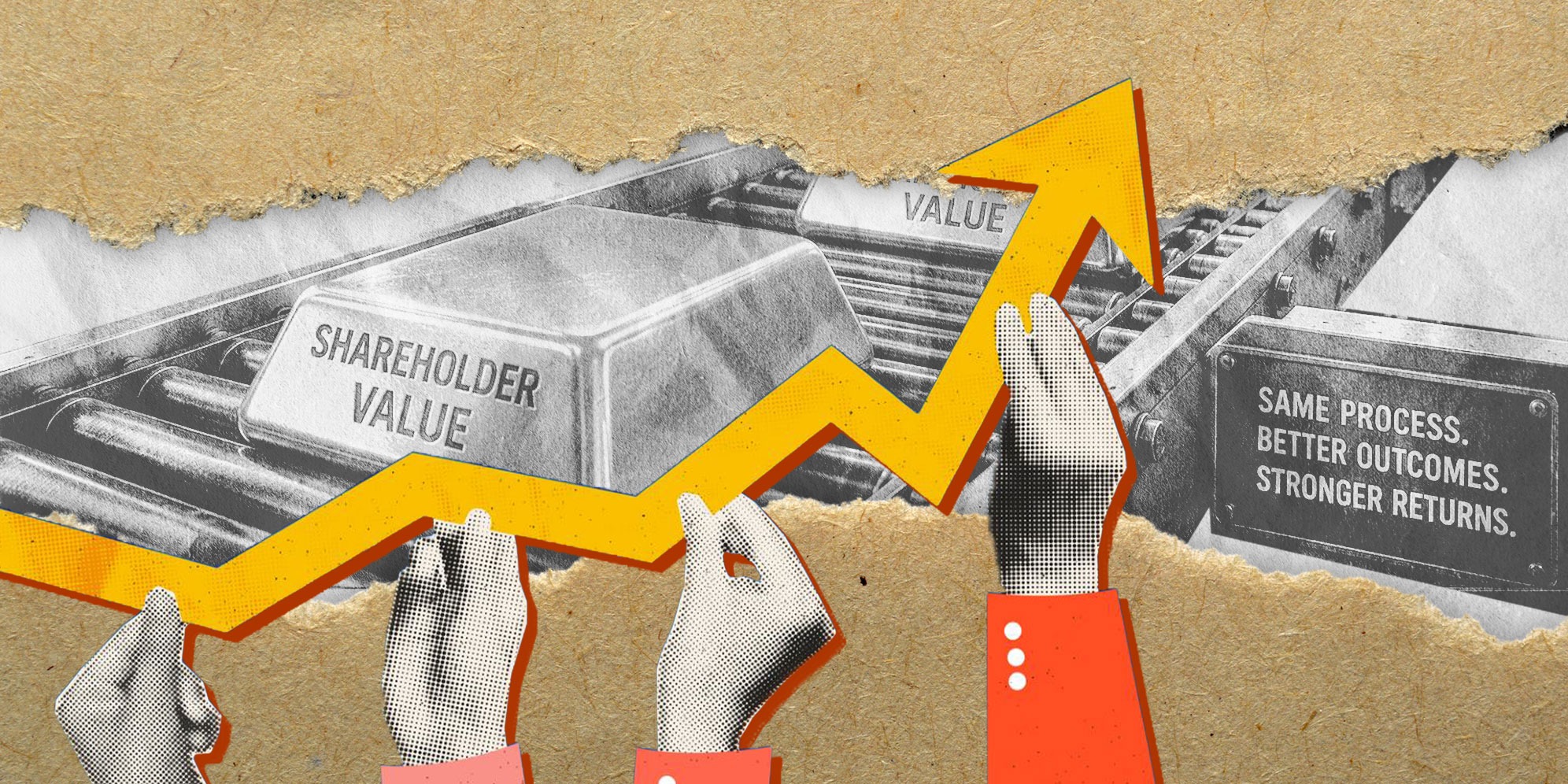
 Illustration: Gold bars on conveyer belt. (Image: ChatGPT) | Hands holding up arrows. (Image: Freepik / Vecteezy) | (By Daniella Lee Ming Yesca)
 When investing in shares, investors are entrusting their money to a management team. That team will act as stewards of the capital, making decisions that will determine whether those investors build wealth or watch it get destroyed. Naturally, investors will care a lot about those outcomes.
This means that a big part of the decision to invest in a company must be the management team itself. No matter how good the underlying assets are, a weak or ill-disciplined team can ruin investment returns.
One of the ways to assess the capabilities of a management team is to consider how consistent their strategic execution has been. Importantly, the tighter the mandate, the easier it is to judge whether the executives have done a good job or not.
Listed companies with loose “spray and pray” investment mandates tend to build exposure across multiple sectors and businesses. Local investors aren’t fans of this strategy anymore, which is why investment holding companies that take this approach tend to trade at a significant discount to the underlying net asset value (NAV) per share.
Aligned interests
Investors are able to build their own diversified portfolios by owning shares in multiple companies. This means that management teams who stay in their lane and execute a predictable strategy to a high standard are usually rewarded in the form of a better valuation on the shares. As executives are always remunerated partially in cash and partially in shares, this creates alignment between investors and executives – in theory, at least.
Conversely, strategic surprises are unwelcome, whether they take the form of unexpected acquisitions or weird allocations of capital. Just ask Mr Price, with a share price that is still in the toilet in the aftermath of the NKD deal announcement. As I said, the alignment of management teams with shareholders is sometimes theoretical at best.
Consistent execution won’t beat the market every year, as high valuations can create lofty expectations that suffer sharp sell-offs when the macroeconomic picture deteriorates. This is why high-quality stocks can easily have a flat year, or even a year in the red. But over the long term, which is the appropriate time horizon when investing in shares, the trajectory will usually be positive when a company is getting the basics right.
In the past week on the JSE, we saw updates from two companies that easily fall into the category of consistent strategic execution. We begin with PSG Financial Services, a wonderful example of the kind of growth trajectory that you can still find on the JSE.
It is growing how fast?
PSG Financial Services isn’t a start-up. Not by a long shot. This is a highly entrenched wealth, asset management and insurance business that has a distribution network across the country. And, might I add, we are talking about a country with a weak savings culture and close to zero real GDP growth.
Despite the obvious macro challenges, PSG Financial Services just grew its recurring headline earnings per share (Heps) by 34% for the year ended February 2026. Now, before you point out that the JSE has had the year of its life, I must note that performance fees contributed only 12.5 cents out of 135 cents of recurring Heps. This is very useful disclosure for investors, so kudos to the company for including this level of detail.
Return on equity – a key metric in financial services in particular – increased from 26.6% to 31.7%. This means that for every rand of equity on the balance sheet, the company is generating a return that is more than double what some of the local banks are achieving. And remember, those banks are taking credit risk to generate their earnings.
PSG Financial Services isn’t without risk of course, but it has one of the strongest balance sheets in the country. This is evidenced by its investment grade credit rating, the happy outcome of no fewer than five credit rating upgrades over the past decade.
The segmental numbers are just as impressive as the group story. The smallest segment, PSG Insure, also had the lowest growth rate – a casual 22% increase in headline earnings. Yes, the lowest growth rate is at a level that most companies in South Africa can only dream of! PSG Asset Management was at the top of the pile with a 59% increase, while PSG Wealth (which contributes more than half of group earnings) anchored the performance with an excellent 25% growth rate.
The share price is up 56% in the past year. It’s not hard to see why.
A clever strategy in European property
Sirius Real Estate is a great example of a smart strategy in a difficult market. Europe isn’t exactly a hotbed of growth, so property companies need to be very careful in how they participate in this market.
Most JSE-listed funds have historically taken the route of pursuing growth in Poland, with other markets such as Spain and Portugal attracting a lot of recent attention. But at Sirius, they aren’t involved in any of those usual choices.
Instead, Sirius has built a business in Germany and the UK, which are grey and dreary markets compared to the sunshine along the Med. But “boring” can be good for your money, especially when a management team knows how to identify pockets of growth.
This is where the consistent execution comes in. Sirius has a reputation for two things, both of which are being done well.
The first is that it is very good at finding assets that would benefit from some active management, which means putting in the effort to increase occupancies and improve rental yields. This is the buy-low, sell-high approach to property. It requires a specific skill set and a hands-on management team.
The second is that it is playing the defence theme in Europe, which means buying properties (especially in Germany) that would appeal to tenants in the defence industry. The political landscape has changed completely since the Trump administration returned to the White House, forcing Europe to invest in defence and pull its weight. Germany is one of the lead countries in this regard, with Sirius happily on the receiving end of that trend.
How does that work in practice? Germany encourages defence spending and companies respond by ramping up production and R&D. These services need space, which is where Sirius comes in. Demand for space means higher rentals, which in turn creates happy investors.
In the year ended March 2026, Sirius achieved like-for-like rent growth of 6.4%. This is its 12th consecutive year of like-for-like growth in excess of 5% – not bad at all when measured in hard currency. Together with strong acquisitions and a few disposals at decent prices, it looks like Sirius had a good year. We will have to wait for the release of final results to know for sure.
Unlike PSG, the Sirius share price is flat over 12 months. The dividend has been ticking over in the background though, with investors being patient for the European growth story to come through in earnest. To its absolute credit, the Sirius management team have followed a consistent path, without being tempted to take more risk in an effort to boost the share price. That’s a good sign for investors. DM
Comments
Scroll down to load comments...