




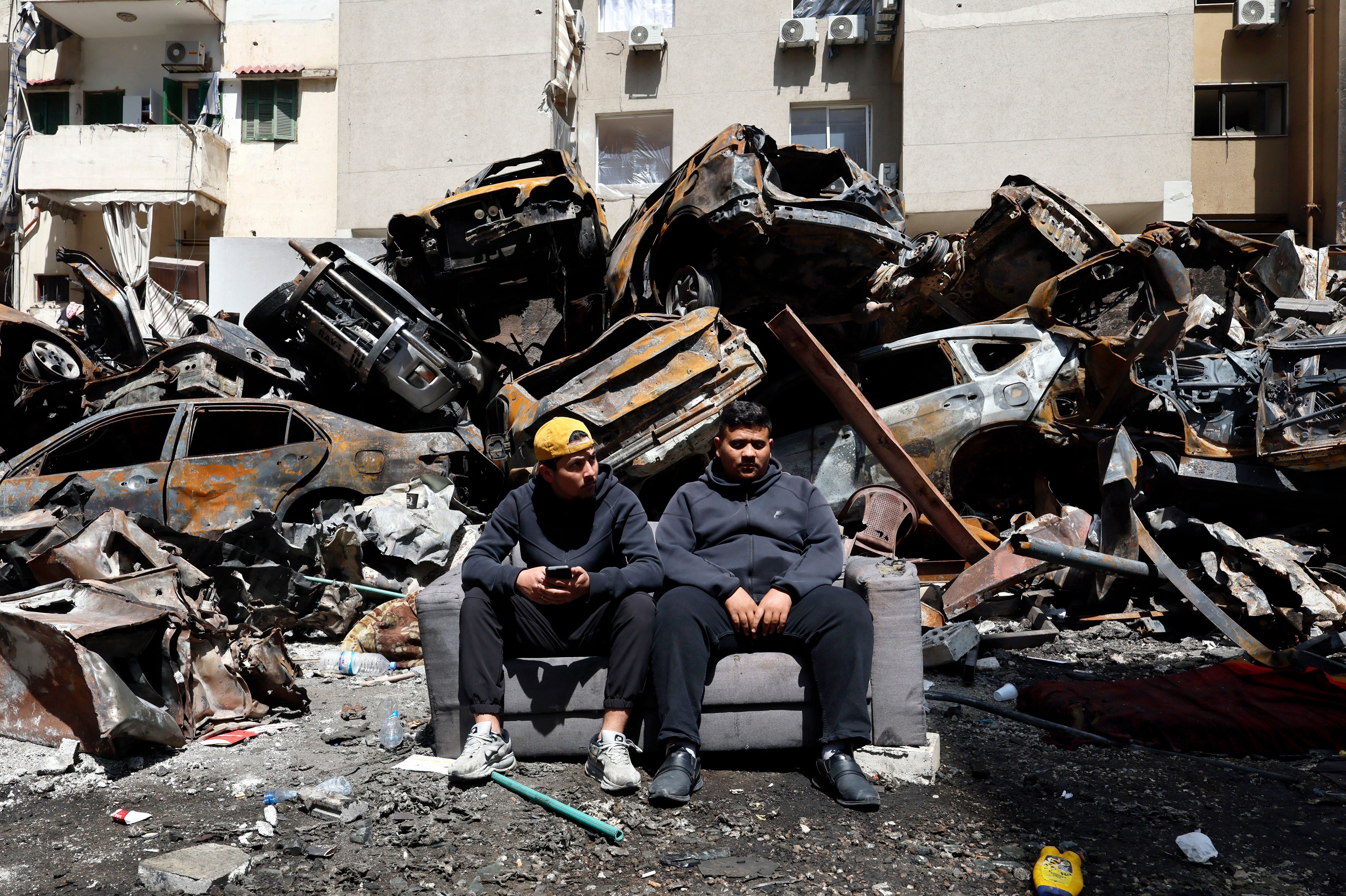
 People sit among the wreckage of cars in Corniche el Mazraa, one of the areas hit during a massive wave of Israeli air strikes in Beirut, Lebanon, on 8 April 2026. According to the Lebanese Ministry of Public Health, Israeli attacks across Lebanon have killed at least 2,055 people and injured more than 6,588 others since the start of renewed hostilities between Israel and Hezbollah on 2 March 2026. (Photo: Wael Hamzeh / EPA)
 In the dark shadow of the US and Israel’s war on Iran, another war on Lebanon has killed and wounded thousands of civilians, displaced tens of thousands and destroyed the country’s civilian infrastructure, hindering the evacuation of the wounded and disrupting the delivery of food and medical supplies.
On Friday, a 10-day ceasefire was announced, with both Lebanese and Israeli leaders calling it an historic opportunity, while questions remain about whether it will last.
Israeli attacks have killed more than 2,000 people since the beginning of March and wounded a further 6,500, Lebanon’s Public Health Emergency Operation Center reported on 12 April. They included more than 130 children, 102 women and 57 medical workers, as of 7 April.
Human Rights Watch reported that more than 100 Israeli strikes across Lebanon in less than an hour on 8 April, including in densely populated neighbourhoods in Beirut, killed more than 300 people and damaged the last main bridge linking southern Lebanon with the rest of the country.
“Israeli strikes making bridge crossings over the Litani River unusable threaten to sever tens of thousands of people in southern Lebanon from access to humanitarian aid, food and healthcare,” it said.
/file/attachments/2990/13852581_588564.jpg "Smoke and flames rise after an Israeli strike targeting the Qasmiya Bridge near Tyre in southern Lebanon on 22 March 2026. The bridge is a key crossing point over the Litani River connecting southern Lebanon to the north. (Photo: Stringer / EPA)")
The normally circumspect International Committee of the Red Cross (ICRC) released a statement the same day saying it was outraged by the “deadly strikes in heavily populated areas”. On 12 and 13 April, two further separate Israeli strikes near its personnel and offices killed a paramedic and damaged an ICRC facility.
The Center for Civilians in Conflict, an NGO based in Washington, DC, condemned the targeting and killing of medical workers in Lebanon. “Medical personnel, facilities and transport are explicitly protected under international humanitarian law, and any attacks against them are unlawful.”
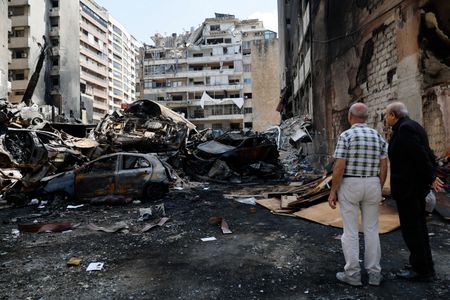
The extensive attacks occurred as the US and Iran were negotiating a possible end to the war, with the Iranians stating that any permanent ceasefire would have to include Lebanon, a belief echoed by the Pakistanis hosting the talks, but denied by the Israelis and the Americans, CNBC reported.
Towards the end of last year, the UN Office for the High Commissioner for Human Rights reported that a year after the ceasefire between Lebanon and Israel was agreed, “we continue to witness increasing attacks by the Israeli military resulting in the killing of civilians and destruction of civilian objects in Lebanon, coupled with alarming threats of a wider, intensified offensive”.
The extensive destruction of civilian infrastructure appears to be part of Israel’s Dahiya Doctrine, which aims to put severe pressure on the civilian population in an effort to weaken support for any resistance.
International condemnation
Israel’s attacks resulted in condemnation from a number of diplomatic capitals. Israel summoned Italy’s ambassador on 12 April in rebuke after Italian Foreign Minister Antonio Tajani condemned its “unacceptable attacks” on civilians in Lebanon during a visit to Beirut, The Times of Israel reported.
The UN also condemned the strikes, calling them a “dangerous escalation”, and highlighted the significant civilian casualties and displacement. France described them as “unacceptable”; British officials expressed deep concern over the “escalating attacks”; and the EU condemned them.
Australian Prime Minister Anthony Albanese called for the ceasefire to apply to Lebanon, stating that many Australians were worried about the impact on the region. Regional countries including Qatar, Egypt, Pakistan and Turkey condemned the strikes, calling them a “flagrant violation” of Lebanese sovereignty, Al Jazeera reported.
/file/attachments/2990/197957_693410.jpg "A man sits on rubble in a desolated area of west Beirut on 8 August 1982. Lebanon has been scarred by two full-scale Israeli invasions and several limited but violent military operations since then, which have resulted in the Jewish state’s continued occupation of 8% of Lebanese territory. (Photo: EPA)")
Hezbollah, a proxy of Iran that has been armed and financed by it for decades, has been the main target of Israeli attacks. The organisation has carried out numerous attacks on northern Israel, destroying homes and killing a number of Israelis. Israel said the attacks on Lebanon were for defensive and security purposes.
However, Hezbollah only came into being as a defensive response to Israel’s deadly invasion of Lebanon in 1982, when up to 20,000 people, mostly civilians, were killed and tens of thousands more injured. The group didn’t exist before that invasion.
Hezbollah’s war of attrition on Israel’s self-declared security zone, established in southern Lebanon, forced the withdrawal of the Israel Defense Forces (IDF) in 2000 because although the IDF was militarily superior, the constant losses and attacks by the Shia militia proved to be too high a cost in the end for Tel Aviv.
Israel had invaded Lebanon a number of times before Hezbollah’s establishment, mainly in response to guerrilla attacks on northern Israel by the Palestine Liberation Organisation, which was based in Lebanon.
But there had been no attacks on Israel for many months before Israel’s 1982 invasion and the excuse given for the invasion was the attempted assassination of Israel’s ambassador to the UK, Shlomo Argov.
Analysts believe that Israel had also been looking for an excuse to enable regime change in Lebanon by helping to install Christian Phalangist leader Amin Gemayel.
Long-term strategy
Regime change has been part of Israeli Prime Minister Benjamin Netanyahu’s plan since the mid-1990s when a document, titled A Clean Break: A New Strategy for Securing the Realm, was formulated for him by Washington neoconservatives associated with the erstwhile “Project for a New American Century”, which supported the invasion of Iraq on trumped-up accusations of possessing weapons of mass destruction.
The Clean Break strategy outlined the overthrowing of a number of Middle East governments by force and influence – overtly or covertly – including Iran, Iraq, Libya, Lebanon, Syria, Somalia and Sudan. This is the reason for fears that Israel’s latest attacks in southern Lebanon may be a precursor for a new land grab and a permanent “security” presence.
Critics also point out that the US props up its own “regimes and proxies” in the region, including Israel, to the tune of $3.8-billion annually. The US also supports – militarily, economically and politically – repressive, unelected Sunni monarchies in the region.
/file/attachments/2990/13901869_684129.jpg "People inspect the wreckage of cars in Corniche el Mazraa, one of the areas hit during a massive wave of Israeli air strikes in Beirut, Lebanon, on 8 April 2026. (Photo: Wael Hamzeh / EPA)")
The latest Israeli attacks on Lebanon helped to undermine peace talks between Tehran and Washington, and the US put pressure on Israel to take part in peace talks with Lebanon after the global outcry.
However, Israel’s chief negotiator, its ambassador to the US Yechiel Leiter, is a right-wing hardliner living in an Israeli settlement in the illegally occupied Palestinian West Bank, Al Jazeera reported. According to Israeli media reports, Leiter was involved with the Jewish Defense League in his youth, a US-based, far-right, pro-Israel group that was classified by US authorities as a terrorist organisation.
Al Jazeera further reported that the Jewish Defense League supports the annexation of the occupied West Bank and the dismantling of the Palestinian Authority. It has been linked to several violent attacks on US soil. This has raised doubts about the success of the talks between Israel and Lebanon which began last week.
Lebanon’s priority is a permanent ceasefire. It argues that there can be no negotiations under fire. Israel’s priority is the disarmament of Hezbollah, which the Lebanese forces would struggle to do because of Hezbollah’s military superiority, and any escalation between the two could ignite a civil war in Lebanon. DM
This story first appeared in our weekly DM168 newspaper, available countrywide for R35.
/file/attachments/2991/DM-17042026001CPTJHB_115125.jpg)
Comments
Scroll down to load comments...