




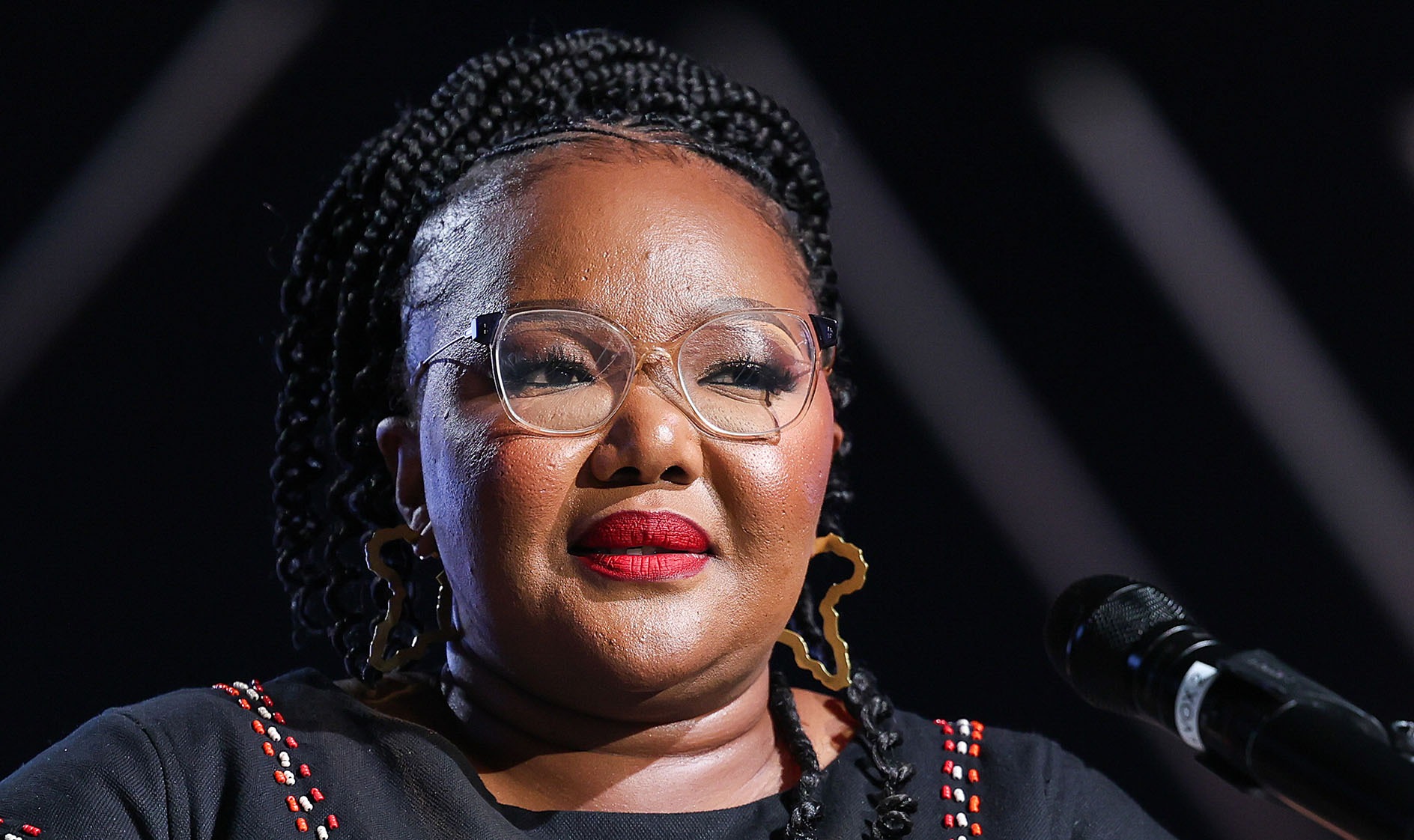
 Minister of Basic Education Siviwe Gwarube. A new draft history curriculum shifts from Eurocentric narratives to a multidisciplinary focus on Africa’s rich history and contributions. (Photo: Gallo Images / Luba Lesolle)
South African history classrooms could be set for a sweeping transformation following the publication of a new draft History Curriculum and Assessment Policy Statement (Caps) by the Department of Basic Education (DBE).
Grounded in an “African-centred” approach and influenced by the United Nations Educational, Scientific and Cultural Organization (Unesco) General History of Africa, the draft curriculum moves away from Eurocentric narratives to view global events from the vantage point of Africa.
The framework notes that this overhaul is not a narrowly focused patriotic history or a “settling of scores” against colonialism. Instead, it relies on a multidisciplinary approach to reconstruct the real course of events, helping a new generation of learners discover Africa’s deep, knowable past and its undeniable interconnectedness with the rest of the world.
From local roots to lost empires
For the youngest learners, history is a detective story that starts with personal heritage. In Grade 4, students begin by exploring their own individual histories, local community maps, and family clan names to answer the fundamental question: “Who am I?”
Students spend Grade 5 unearthing monumental innovations like how the controlled use of fire and the early smelting of metals completely revolutionised society.
The primary phase culminates in Grade 6 with students embarking on a journey into ancient global and African history.
Students track early human migrations and Stone Age innovations that began on the continent. The curriculum then bridges to the Fertile Crescent to study the birth of the first cities and the earliest written laws, before moving to ancient Egypt to examine its architectural and medical advancements. The year ends with the Kingdom of Mali, where learners explore the legendary wealth of Mansa Musa and the rise of Timbuktu as a bustling centre for global trade.
Bustling cities and stolen land
In Grade 7, the curriculum takes direct aim at the colonial myth of an “empty land” waiting to be discovered. Students will learn that long before European settlement, southern Africa was already bustling with activity and global connections. They will explore early Indian Ocean trade networks, study the sophisticated pastoral economies of the Khoekhoe and San peoples, and marvel at massive, complex precolonial African cities like Kweneng.
By Grade 8, the focus shifts to the upheavals of the 19th century. Learners will unpack the dynamic political and military shifts of the Mfecane/Difaqane and study the dramatic societal changes brought about by the European Industrial Revolution. They will bring these global shifts home by examining SA’s own minerals revolution, learning how the sudden rush for gold and diamonds completely transformed the region, accelerating aggressive land dispossession and trapping millions of people in an exploitative migrant and indentured labour system.
The journey reaches its peak in Grade 9, which interrogates the ideological machinery of modern inequality. The syllabus explores how 19th-century pseudoscience and eugenics were falsely used to justify racism. The focus then shifts locally to highlight powerful resistance movements and examines global atrocities, teaching learners about the devastating impacts of World War 2 and the Holocaust.
From sovereign empires to the TRC’s unfinished business
In the final Further Education and Training phase, the curriculum shifts toward high-level critical inquiry, beginning in Grade 10 with the total dismantling of the “dark continent” myth as learners explore the staggering wealth, advanced architecture and global connections of ancient African empires.
Moving into Grade 11, students learn about the massive global disruptions caused by European expansion and imperialism. The curriculum explores the devastating impacts of the transatlantic slave trade, the genocide of indigenous populations and the aggressive “Scramble for Africa”. However, it shifts the traditional focus from European conquerors to indigenous resistance. Students study the Haitian Revolution as the ultimate modern fight for universal human rights, while locally examining the military genius of kingdoms like the amaZulu and Bapedi in their defence of sovereignty against British forces.
Grade 12 brings students face to face with SA’s turbulent modern history. Students start by looking at how the early rushes for gold and diamonds birthed a deeply unequal, racially divided capitalist economy. The curriculum then sweeps through decades of fierce resistance, moving from the birth of early political movements to the militant youth uprisings of 1976. Students will also explore the global chess game of the Cold War, learning how the US and Soviet Union used southern Africa for their proxy wars.
To close out their schooling, students will critically dissect the 1994 transition to democracy. They are encouraged to ask tough questions about the political violence of the early 90s, the compromises made by leaders, and why the Truth and Reconciliation Commission failed to hold massive financial and legal institutions accountable for apartheid.
Support and scrutiny from stakeholders
The draft has been met with praise and caution from key stakeholders across the education sector.
The South African Democratic Teachers’ Union (Sadtu) has hailed the draft as a “progressive and timely intervention”. A long-standing advocate for decolonisation, the union argues that for too long the subject has been tethered to a Eurocentric lens that ignored African perspectives.
Beyond the change in content, Sadtu is using this window to renew its call for History to become a compulsory subject. The union argues that a mandated, African-centred history is essential for fostering national identity, social cohesion and the critical thinking skills necessary for a united SA.
For historian and author Zikhona Valela, the draft curriculum is far more comprehensive than any previous iteration in its attempt to unravel the pre-colonial, colonial and liberation eras.
Despite her overall positive sentiment, Valela noted a weakness when the draft reaches the liberation era.
“I’m not seeing enough representation of the role of women in the liberation movement, and I’m not seeing enough representation of the movements outside of the African National Congress. It’s important for us to really make greater efforts and be intentional about moving away from that ‘big man’ narrative that nationalist history often tends to focus on,” she said.
She called for an extensive look at figures like Winnie Mandela and Albertina Sisulu, but also Mamphela Ramphele of the Black Consciousness Movement and Sister Bernard Ncube at the height of the United Democratic Front, alongside the role of the LGBTQ community in shaping the Bill of Rights.
“Our education should mirror the various types of actors and groups that played a role in us being able to put together a Constitution that recognises various communities,” she said.
Valela also flagged a “colonial hangover” in the draft’s language.
“You can’t refer to legitimate royal figures as ‘chiefs’, that was a British demotion to enforce the authority of Queen Victoria. They are kings (inkosi). If decolonisation is a priority, then decolonised language must be a priority,” she said.
As Chairperson of the South African Society for History Teaching and a high school educator, Lufuno Lerato Monguni acknowledged that the shift toward “African-centredness” was long overdue.
However, Monguni voiced concerns and described the draft as “jam-packed”.
With a mandate to finish six complex topics by June for Grade 12 learners, Monguni fears that the classroom will become a site of frantic content-dumping rather than critical inquiry.
“Engagement is where learners learn the most. The facts are there, but what can we do with them? If we are forced to put everything together, it takes away from the quality of delivery,” she said.
How to have your say
The department welcomes substantive submissions on the draft’s scope, balance and historical framing. Comments must be clearly marked by Caps document and page number.
- Deadline: 19 May 2026
- Email: modipa.f@dbe.gov.za (Att: Florence Modipa)
- Physical Address: 222 Struben Street, Pretoria, 0001
Web: The full draft and comment templates for public comment are available here. DM
This story was updated to reflect an extension in the deadline for submissions on the draft curriculum from 19 April to 19 May 2026. (Updated 21 April 2026)
Comments
Scroll down to load comments...