




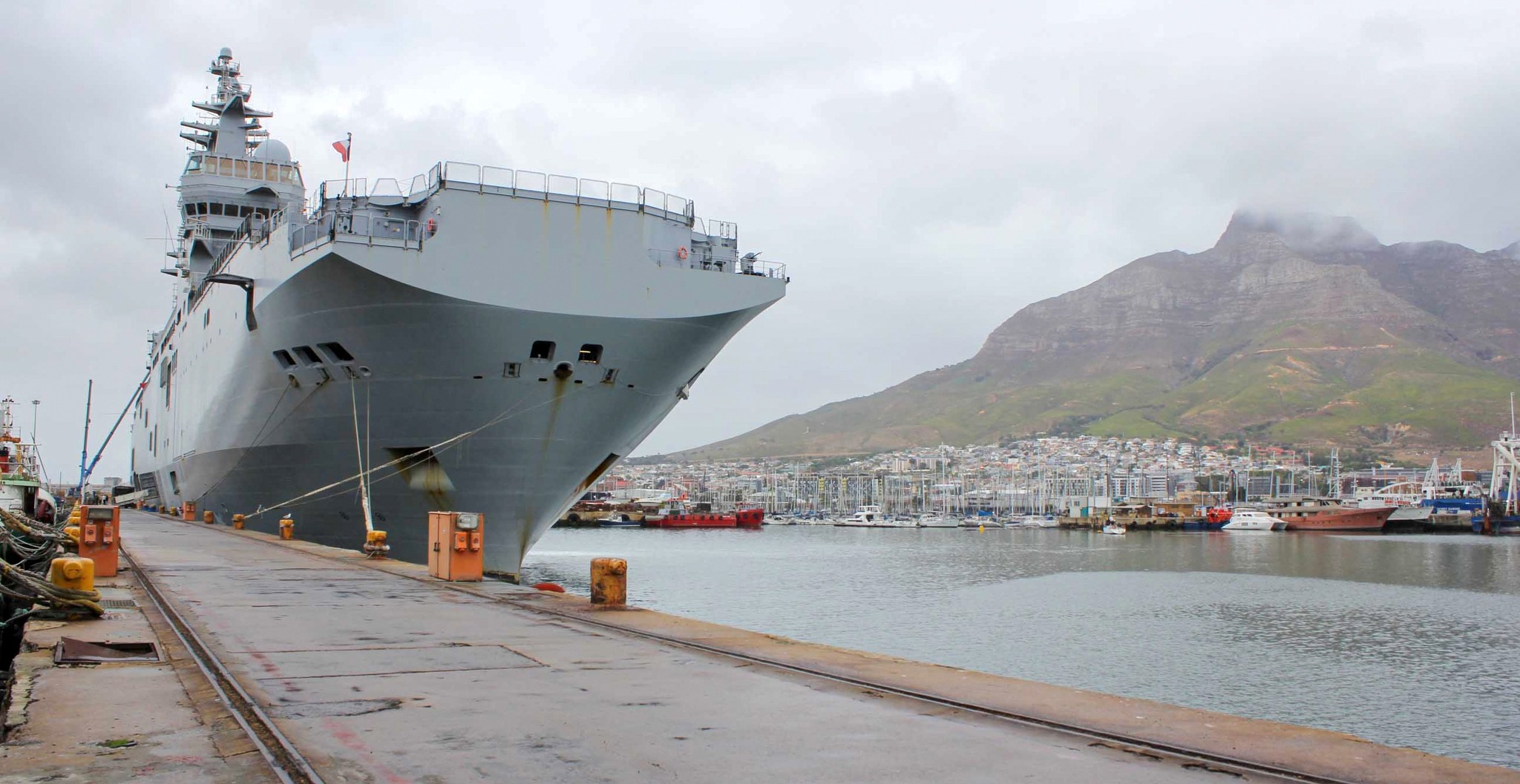
 The Mistral-class amphibious assault ship Dixmude docked at Cape Town Harbour. (Photo: SA National Defence Force / Facebook)
Among the many ships diverted via Cape Town by the war in Iran this month were the French Navy’s assault ship Dixmude and its stealth frigate Aconit. Dixmude was conspicuous in the harbour, since it resembles an aircraft carrier, although it carries many helicopters rather than fixed-wing aircraft, as well as landing craft, ground vehicles and troops.
France and South Africa turned the detour into a diplomatic and training opportunity.
The ships had left their base in Toulon in southern France in February on a five-month voyage, mainly in the Indian Ocean, intending to return via the Suez Canal. But when the US and Israel’s attack on Iran turned the northern Indian Ocean into a war zone, they were rerouted around the Cape.
Dixmude commander Captain Jocelyn Delrieu told Daily Maverick that the two ships formed a task group that was conducting the navy’s annual Jeanne d’Arc mission: training 160 midshipmen or young candidate officers who would then join the navy as full officers in July.
/file/attachments/orphans/unnamed3_761119.jpg "Captain Jocelyn Delrieu, commander of the French Navy assault ship Dixmude, on the deck of his ship in Cape Town Harbour. (Photo: Peter Fabricius)")
Sixteen were from foreign partner countries. There was no South African among them this time, although in 2012 a South African midshipman had participated in the same training mission.
But this was also an operational mission as the ships conducted exercises with partner navies: particularly the Papangue maritime exercise at the French territorial island of Reunion with 14 French partners from the region, including South Africa. The four-day exercise of almost 2,000 people simulated various crisis scenarios in which France deployed its ships as well as landing operations with soldiers on board the Dixmude.
The South African Navy had not deployed a ship but navy officers had been on board the French ship to participate in the command and control aspects of the exercise, Delrieu said.
From Cape Town, the two French ships would sail into the Atlantic to continue training and exercises with partner navies there to advance maritime security.
“And when you shift from the Indian to the Atlantic Ocean, Cape Town and South Africa is both an enduring partner and a very solid resupply or replenishment point, a support point for the task group,” he said.
“And especially for the midshipmen on board, because it is a training mission, to cross the Cape of Good Hope longitude is a thing you have to do in your sailor life.”
Delrieu said he and his officers were sharing knowledge with South African Navy officers about this maritime region in which they had a common interest.
Though the task force has a training mission, it is always ready to deploy at any moment on operations, if required. Delrieu noted that the Dixmude was a highly versatile vessel.
/file/dailymaverick/wp-content/uploads/2023/11/11386231.jpg "French Navy soldiers carry supplies to the amphibious assault ship Dixmude, when it was moored at at Tanjung Priok Harbour in Jakarta, Indonesia, in March 2023. (Photo: EPA-EFE / Bagus Indahono)")
For instance, the record shows that it deployed to the Egyptian port of El Arish from November 2023 to January 2024 to treat wounded civilians from Gaza, serving as a floating hospital with operating theatres and 70 medical staff who treated nearly 1,000 patients.
‘Shared commitment’
France’s ambassador to South Africa David Martinon said the visit of the two ships – and the earlier visit of the French frigate Nivôse to Cape Town in January – “reflects a deliberate commitment to engage, to train and to build lasting partnerships along strategic maritime routes from the Indian to the Pacific Ocean”.
He said it also shows a “shared commitment to the security of these strategic waters”.
Martinon welcomed South Africa’s willingness to implement the first navy staff talks with France, from 18 to 20 May, and resume the strategic dialogue between the two militaries in the following weeks. (It has been suspended for about 12 years.)
He said southern Africa and the Indian Ocean constituted a key strategic maritime domain.
/file/attachments/orphans/unnamed1_990886.jpg "France’s ambassador to South Africa David Martinon addresses sailors and guests aboard the French navy ship Dixmude in Cape Town Harbour. Behind him is Captain Jocelyn Delrieu, commander of the Dixmude. (Photo: Marine Durand, French Consulate-General, Cape Town)<br>")
“It is a space of opportunity and prosperity, but also of growing competition and vulnerability. Illicit trafficking, piracy risks and threats to critical maritime infrastructure directly impact sovereignty, economic stability and the security of global flows.”
And so “cooperation is not an option, it is a necessity”.
France aimed “to support the emergence of a robust, coherent and resilient maritime security architecture in the region. No ideology, no politics on the sea, but a reality to challenge all threats together as one on the sea.”
/file/attachments/orphans/unnamed2_104918.jpg "France’s ambassador to South Africa David Martinon<br>addresses sailors and guests aboard the French navy ship Dixmude in Cape Town Harbour. (Photo: Marine Durand, French Consulate-General, Cape Town)")
addresses sailors and guests aboard the French navy ship Dixmude in Cape Town Harbour. (Photo: Marine Durand, French Consulate-General, Cape Town)
Martinon said this cooperation should include not only the French and South African navies but the entire community of “sea guardians” in South Africa, all those organisations dealing with safety and security, including the Maritime Rescue Coordination Centre, the National Sea Rescue Institute (NSRI), as well as police and transport authorities in Cape Town.
French maritime medicine – and cuisine
In February, France flew two South African “sea guardians” to Reunion, the home port of the Nivôse, who then sailed with that ship back to Cape Town.
For both Lieutenant Sakhile Mbokane, a doctor in the Institute for Maritime Medicine of the SANDF’s South African Military Health Service, and NSRI regional operations manager and Class 1 coxswain Dean Wegerle, this was clearly a memorable experience.
Mbokane told Daily Maverick that he had learnt a huge amount about maritime medicine during his eight-day voyage.
“We interacted with the doctors onboard. We did a lot of medical exercises, medical evacuation. Every day there was training, basic life support, first aid, massive bleeding control, those types of emergencies. They showed me around the equipment they have which we need to procure for ourselves.”
/file/attachments/orphans/unnamed4_177190.jpg "Doctors at sea: Lieutenant Sakhile Mbokane (right) and Lieutenant-Colonel Rohan Terblanche of the Institute for Maritime Medicine of the South African Military Health Service aboard the French Navy frigate Nivôse in Cape Town Harbour in January 2026. (Photo: Marine Durand, French Consulate-General, Cape Town)")
Wegerle told NSRI News that the eye-opener for him came in blue waters, out of sight of land. NSRI crews hug the coast so they always have a headland or lighthouse to navigate by. On blue water patrol, the French crew keep old navigation skills alive.
“They use a sextant to get a fix,” he was quoted as saying. “I was taught how to use a sextant to find our position using the sun, the horizon and some stars, which was really, really cool.”
He also tasted pure French cuisine.
“Every meal is a three-course affair,” he said. “The French take their food very, very seriously.”
Mbokane’s colleague, Lieutenant-Colonel Rohan Terblanche, also a doctor with the Institute for Maritime Medicine, likewise learnt a lot on a three-week voyage with the French Navy’s icebreaker and polar patrol vessel L’Astrolabe from Durban in July 2025. It sailed southeast, about halfway to Antarctica, past the South African Prince Edward and Marion islands and then further east to participate in operations around the French archipelagos of Crozet and Kerguelen.
France’s military attaché in South Africa, Colonel Frédéric Jardin, said this voyage had also helped South Africa to monitor its southern Indian Ocean islands.
He plans to embark officials from South Africa’s Maritime Rescue Coordination Centre (MRCC) on L’Astrolabe on its next voyage in June 2026 on the same route.
He told Daily Maverick that the French Navy was taking NSRI and MRCC officers on its trips because it sometimes cooperated with these sea guardians on rescue missions.
“When some people would like to put political… or ideological issues on the sea, I work only to put peace and security on it. It is not an exercise, it is a Wish for Peace,” he added, in an apparent ironic reference to the “BRICS Plus” naval exercise Will for Peace which the South African Navy had then just conducted at Simon’s Town.
It included warships from Russia, China, the United Arab Emirates and Iran. The latter deployed the corvette IRIS Naghdi, and two big support ships, the IRIS Makran and the IRIS Shahid Mahdavi.
The exercise was controversial, since the South African Navy had apparently ignored a last-minute order from President Cyril Ramaphosa to withdraw the Iranian ships, largely, it seemed, to avoid controversy at a time when Tehran was killing hundreds of protesters. This is now the subject of a board of inquiry.
Diverging alliances
In a speech on board the frigate SAS Amatola, the chief of the South African Navy, Vice-Admiral Monde Lobese, nevertheless called Will for Peace a “resounding success”, reflecting South Africa’s commitment to peaceful maritime cooperation, particularly among partners of the Global South”.
He added that the diversity of operational experience, strategic outlooks and maritime traditions of the participating navies had enriched the learning experience of all.
But what lessons did the South African Navy learn from all these visits? They and other “sea guardians” apparently learnt useful skills from their French counterparts and South Africa usefully strengthened maritime cooperation with France in South Africa’s own backyard.
And geopolitically? Did South Africa demonstrate that it is indeed a non-aligned nation, by conducting military exercises equally with Iran, Russia, China, the UAE – and France?
Or did the exercise rather question the wisdom of helping to sharpen the naval skills of nations which are suppressing their populations or attacking their neighbours or threatening to do so?
For the three Iranian ships and presumably some of their crews, any lessons learnt were tragically short-lived. All three were sunk or destroyed barely a month later, in the first days of the brutal US and Israeli military strike on Iran, along with much of the rest of the Iranian navy. DM
Comments
Scroll down to load comments...