




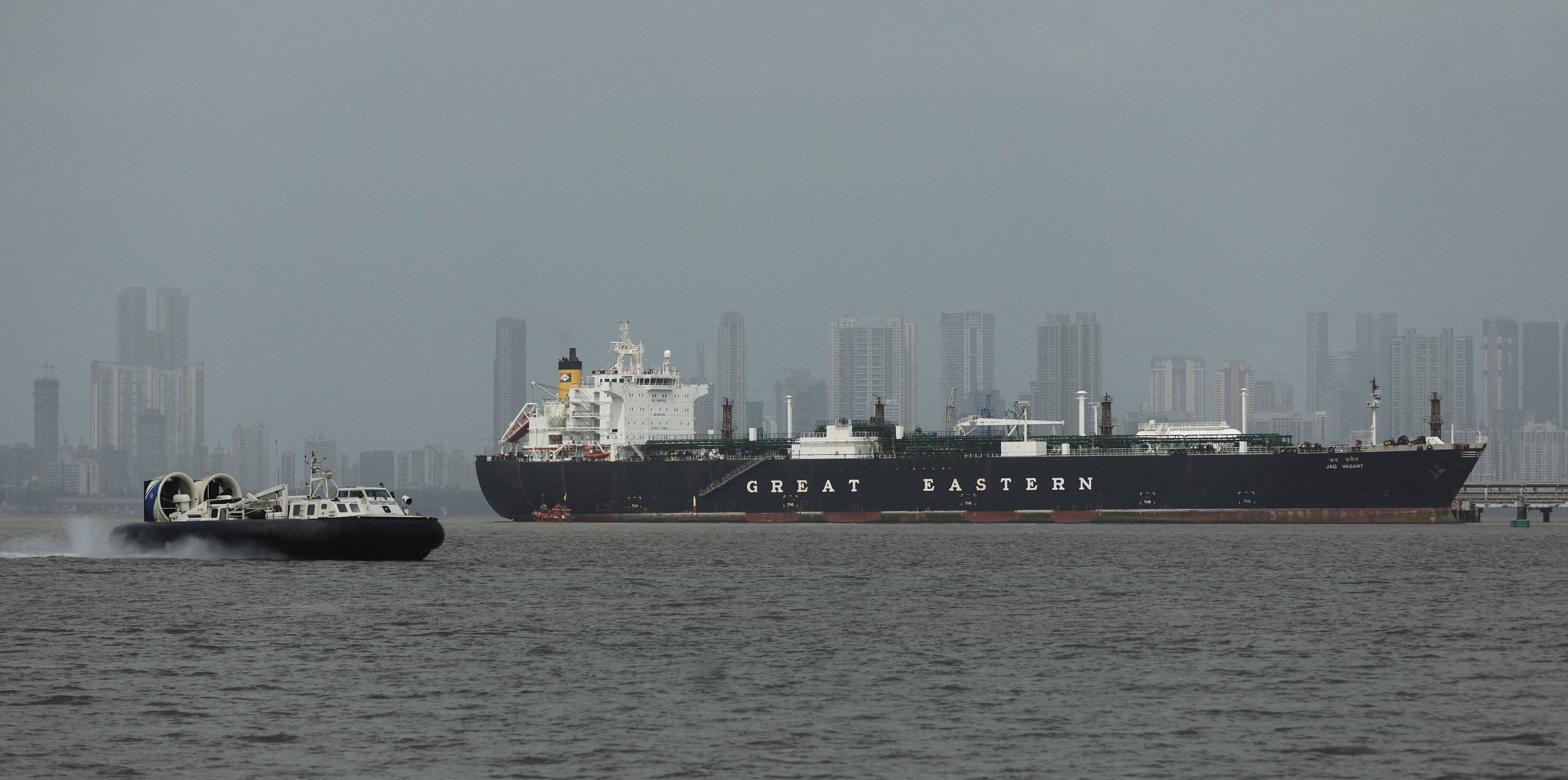
 A hovercraft moves past the Jag Vasant vessel transferring LPG at a port after transiting the Strait of Hormuz amid supply disruptions linked to the U.S-Israeli conflict with Iran, in Mumbai, India, April 1, 2026. (Photo: REUTERS/Francis) Mascarenhas
Iranian Foreign Minister Abbas Araqchi said in a post on X the Strait was open for all commercial vessels for the remainder of the US-brokered 10-day truce between Israeli forces and Iran-backed Hezbollah agreed on Thursday between Israel and Lebanon.
In line with the ceasefire in Lebanon, the passage for all commercial vessels through Strait of Hormuz is declared completely open for the remaining period of ceasefire, on the coordinated route as already announced by Ports and Maritime Organisation of the Islamic Rep. of Iran.
— Seyed Abbas Araghchi (@araghchi) April 17, 2026
A senior Iranian official told Reuters that transit would be through designated lanes that Iran deemed safe for navigation and would exclude naval vessels.
The US-Israeli conflict with Iran, which started on 28 February, has killed thousands of people and destabilised the Middle East. The conflict also effectively closed the Strait of Hormuz, through which a fifth of the world’s oil and liquefied natural gas usually transits, threatening the worst oil shock in history.
Oil prices tumble, stocks jump
Oil prices fell by 11%, extending earlier losses, following Araqchi’s post. Stocks around the world, which had already been trading around record highs, jumped further on the news.
Major shipping companies reacted more cautiously, signalling it may take more time for traffic through the chokepoint to return to normal levels, which was about 130 ships a day prior to the war.
German shipping company Hapag-Lloyd said it would refrain from passing through the Strait while it assessed the announcement and the Norwegian Shipowners’ Association said several factors needed to be clarified, including the possible presence of sea mines.
The International Monetary Fund this week lowered its forecasts for global growth and warned the global economy risked tipping into recession if the conflict was prolonged, mainly due to the impact from the closure of the strait.
US blockade remains in place
Shortly after Araqchi’s statement, Trump posted on Truth Social: “IRAN HAS JUST ANNOUNCED THAT THE STRAIT OF IRAN IS FULLY OPEN AND READY FOR PASSAGE.”
However, Trump said the US military blockade of ships sailing through the Strait to Iranian ports – announced after talks with Iran last weekend in the Pakistani capital Islamabad ended without agreement – remained in place.
He said that the blockade would remain in full force until “our transaction with Iran is 100% complete”, which he said should happen very quickly given that most points were already negotiated.
Trump had said on Thursday that talks could happen as soon as this weekend, although that was looking increasingly unlikely by Friday afternoon, given the logistics of assembling officials in Islamabad, where the talks are expected to take place.
Despite Trump’s optimism, Iranian sources told Reuters on Friday that some “gaps remained to be resolved” before reaching a preliminary deal and senior clerics leading Friday prayers struck a defiant tone.
In a sermon in Tehran, cleric Ahmad Khatami said: “Our people do not negotiate while being humiliated,” while in the central city of Isfahan, the imam said: “We did not accept the terms proposed by the other party.”
In Islamabad, troops were seen along routes leading into the capital on Friday, but roads were still open and the government had not issued orders for businesses to shut down, as they did prior to the last meeting.
Backdoor diplomacy progress
A Pakistani source involved in mediating between the US and Iran said on Friday there was progress in backdoor diplomacy and that an upcoming meeting between the two sides could result in the signing of a memorandum of understanding, followed by a comprehensive deal within 60 days.
“Both sides are agreeing in principle. And technical bits come later,” the source said on condition of anonymity.
A senior Iranian official told Reuters there had been an agreement on unfreezing billions of dollars in Iranian assets, as part of the accord to reopen the Strait, without giving a timeline.
One of the key sticking points has been over Tehran’s nuclear ambitions, with the US proposing at last weekend’s talks a 20-year suspension of all Iranian nuclear activity. Tehran suggested a halt of three to five years, according to people familiar with the proposals.
Iran has demanded international sanctions on it be lifted and Washington has pressed for any highly enriched uranium to be removed from Iran. Two Iranian sources have said there were signs of a compromise on the HEU stockpile, with Tehran considering shipping part of it out of the country.
Trump repeated his Thursday comment that the U.S. would get all the “nuclear dust”, referring to Iran’s highly enriched uranium which he says was obliterated by U.S. bombers last June.
Earlier on Friday, Iran’s state media outlet Mizan disputed that, highlighting ongoing differences.
No negotiation regarding the “transfer of Iran’s highly enriched uranium to America had ever taken place, and naturally there is no agreement on this matter either”, it said, citing sources.
Lebanon ceasefire goes into effect
The US-backed ceasefire agreed between Israel and Lebanon to end the fighting between Israel and Hezbollah appeared to be largely holding on Friday, despite some Lebanese Army reports of violations by Israel.
/file/attachments/orphans/13889390_223602.jpg "Rescuers search for survivors in the Fatima al-Zahraa complex in Sidon, Lebanon 08 April 2026. Several people were killed in the strike including Hezbollah-affiliated Sheikh Sadiq Al-Nabilsi. Israel launched a large scale attack on multiple locations across Lebanon, with many hitting central Beirut one day after the United States and Iran agreed to a ceasefire to end hostilities between the two countries. (Photo: EPA/STRINGER)")
The conflict in Lebanon was reignited on 2 March when Hezbollah opened fire on northern Israel in support of Tehran, prompting an Israeli offensive that authorities say has killed more than 2,000 people.
There was no immediate comment from the Israeli military on the reported ceasefire violations on Friday. DM
(By Humeyra Pamuk, Saad Sayeed and Aziz Taher; Reporting by Reuters bureaus; Writing by Martin Petty and Sharon Singleton; Editing by Raju Gopalakrishnan and Alex Richardson)
Comments
Scroll down to load comments...