




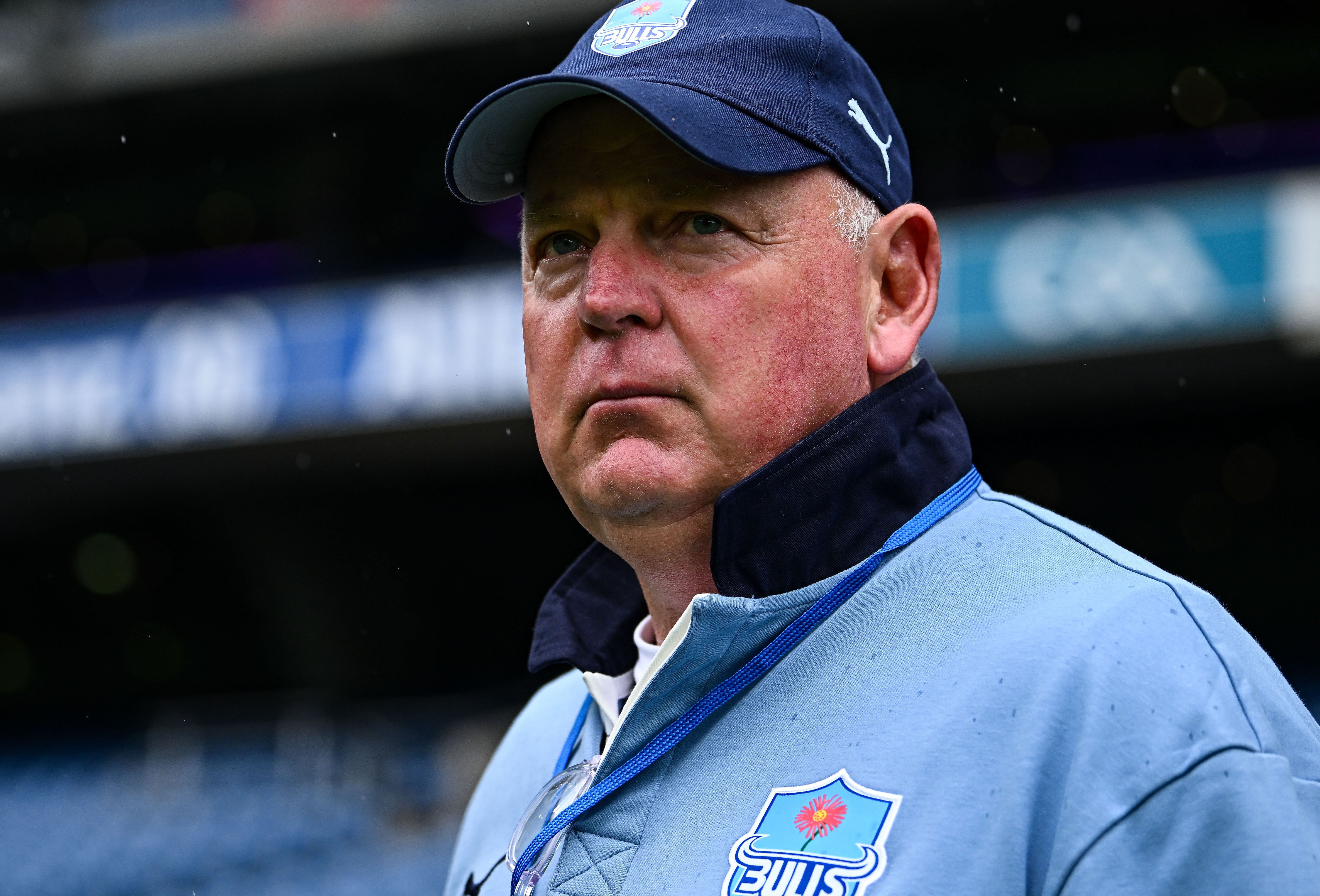
 Former Vodacom Bulls head coach Jake White before the United Rugby Championship final match between Leinster and Vodacom Bulls at Croke Park on June 14, 2025 in Dublin Ireland. (Photo: Seb Daly/Gallo Images)
The recent fallout between Selborne College on the one side and rugby director Derek Page and former Springbok coach and Bulls mentor Jake White on the other should be placed at the centre of a much larger conversation: the rapid professionalisation of schoolboy rugby in South Africa and how much is too much to ensure competitiveness.
At the start of the season, Selborne College, a school in the Eastern Cape brought on White – who famously led the Springboks to World Cup victory in 2007 – and Page to serve as the school’s rugby consultant and director of rugby respectively.
The pair had been tasked with using their professional expertise to rebuild the school’s rugby programme, with assurance of autonomy and institutional backing.
However, in an email that White sent to Selborne Foundation Trust chairman Andrew Reeves, White claims that never materialised.
“After some reflection I think it would be better for me to step away from the Selborne project. I have felt that the headmaster is not totally committed to the changes needed or expected,” White’s letter read. “Through my experience as a teacher, it’s a futile project unless the headmaster backs it 100%.”
As a result, White and Page detached themselves from the school, further citing a difficult working relationship with the headmaster, Andrew Dewar.
Apparently, Dewar would prioritise other sports over rugby and ultimately White felt his position was thus futile.
In response to Rugby365com’s enquiry regarding his fallout with White and Page, Dewar, among other things, stated: “Academics are important. Principals of schools want the institution to be a success and a centre of excellence. People need to understand; we are not a rugby institute.”
Selborne’s appointment of highly elite coaches with the assumption of significantly boosting their rugby programme is not an isolated case.
Rather it reflects the undeniable professionalisation of schoolboy rugby which has evolved into a high-stakes, multimillion-rand ecosystem.
Schools are no longer simply appointing teachers who coach; they are recruiting specialists, such as White, who have an established network equipped to build competitive squads and high-performance tactical expertise.
Millions invested to create high-performance units
At the centre of it all is money. Schoolboy rugby has become a major investment area, with schools pumping millions into their rugby programmes to remain competitive and more recently for emerging challengers to close the gap to traditional powerhouses.
According to figures compiled by Rapport, top rugby schools are today spending an average of around R6-million annually on their first team programmes, with some allocating as much as R10-million towards bursaries to attract top talent, starting as early as under-14 level.
Additionally, coaching salaries at elite institutions can exceed R1-million.
These budgets cover far more than match-day expenses. They fund national travel schedules, strength-and-conditioning programmes and video analysis.
Jeppe High School for Boys, for example, recently unveiled refurbished rugby locker rooms as well as plans to build what looks like a state-of-the-art high performance centre. This appearance of a professional set-up is likely to attract expert coaches in the field and young rugby talent alike.
Affies’ (Afrikaanse Hoër Seunskool in Pretoria) first team coach, Ruan Jacobs, told Rapport that professionalisation of school rugby has played a key role in the increasingly competitive environment.
“More and more schools are looking at a model where a professional coach like MJ Mentz comes to a school’s team,” Jacobs said. “That type of coach has already built up the necessary network to acquire players for his school’s team.
“That’s why school rugby has grown so much and is so strong.”
Even Bishops, which was ranked the 33rd-best rugby team in the country in March, employs 11 coaching staff for one rugby team.
Thus, Selborne’s decision to bring in White and Page reflects this broader trend. It was their attempt to adopt a high-performance model in order to compete with the country’s leading rugby schools.
And why wouldn’t they? When schools are consistently competing against better-resourced opponents, the pressure to keep up is inevitable.
In a landscape where poaching is aggressive and talented students are looking to make a career out of the sport, they are likely to move to stronger programmes.
As a result, schools are forced to lobby hard to retain talent and remain competitive.
/file/attachments/orphans/IMG_0425_972668.jpg "St Stithians (white) versus Wynberg Boys’ High at the 2026 St Stithians Easter Fest. Schoolboy rugby programmes are big business. (Photo: Facebook)")
Stellenberg: simple case in point
If Selborne highlights the challenges of this new landscape, Stellenberg offers a glimpse of its potential.
The Cape Town-based school, which was once overlooked, has recently shaken up the traditional top order, recording landmark wins in the past few weeks over Paarl Gimnasium (20-19), Grey College (26-21) and Paul Roos Gymnasium (20-10).
While its rise may appear to have occurred overnight, this success has been driven by long-term planning, investment into specialist coaches and building squad depth at a junior level.
Additionally, in February, Stellenberg became the first school in South Africa to implement OutFox, which is a tactical simulation platform utilised by the Springboks. This is according to SuperSport Schools.
As seen, within weeks, the impact was evident on the field.
/file/attachments/orphans/IMG_0428_574274.jpg "On 14 March, Hoërskool Stellenberg clinched a historic victory against Paarl Gimnasium for the first time in 28 years. It was a tight game with Stellenberg narrowly beating their opponents 20-19. (Photo: Hoërskool Stellenberg /Facebook page)")
/file/attachments/orphans/TL_2374871_924009.jpg "After claiming a landmark victory against Paarl Gimnasium, Hoërskool Stellenberg then went onto shake the top order even more by beating Paul Roos. (Photo: Ashley Vlotman/Gallo Images)")
Broadcast exposure
Coupled with the investment by schools into facilities and coaching, the broadcasting element, specifically on SuperSport Schools, has increased visibility, therefore boosting commercial appeal of school sports, attracting further sponsors and advertisers.
“The arrival of SuperSport Schools has also improved the commercial product. You can now do marketing and get exposure for your sponsors through SuperSport Schools. It means a lot financially for a school,” said Jacobs.
The increased visibility also adds another layer of professionalism for the school athletes.
In 2024, Multichoice reported that more than 1.7 billion minutes of content was consumed across the SuperSport Schools app and dedicated DStv channel 216.
By transforming school sports into a widely consumed product, it introduces a new level of scrutiny and expectation. Students are interviewed and exposed to pressures typically associated with professional superstars.
It is undeniable that school sports operate scarily close to professional programmes, and the Selborne incident occurring a fortnight after the highly anticipated nationwide Easter festivals underscores the reality that schools are not actually professionalised sports entities.
The appointment of White and Page signalled a clear intent to modernise and compete at the highest level. But without the structural flexibility to support that vision, the project faltered. DM
This story was amended on 18 April to reflect that Selborne College is not a private school, as originally stated.
Comments
Scroll down to load comments...