




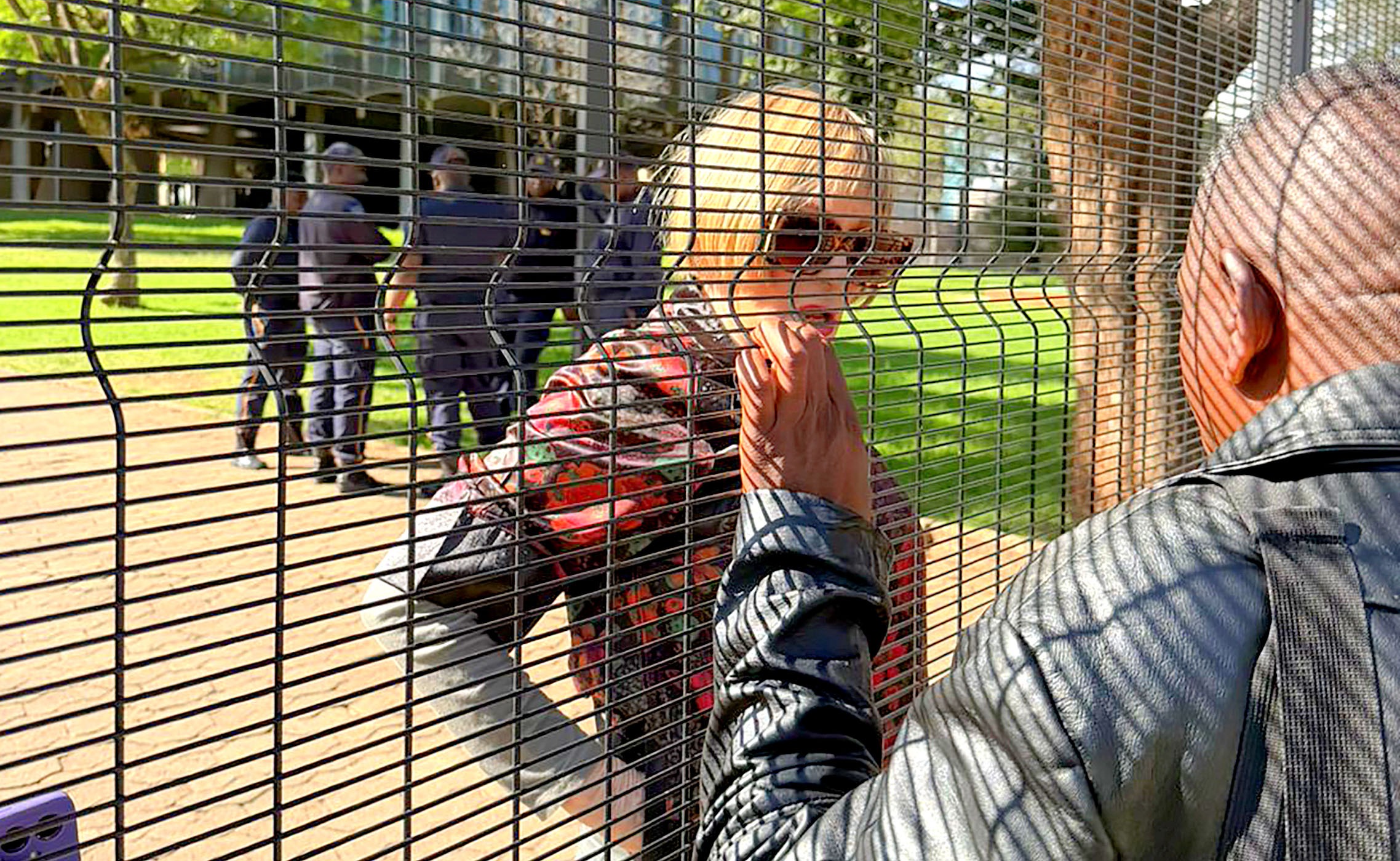
 DA Johannesburg mayoral candidate Helen Zille said she was briefly barred from exiting the Johannesburg Metro Centre on Thursday. (Photo: Supplied)
The Democratic Alliance on Wednesday said its Johannesburg mayoral candidate, Helen Zille, was prevented from carrying out an oversight visit at the Metro Centre, raising fresh concerns over transparency at the site.
“Duly elected public representatives were chased by security guards who prevented them from carrying out their lawful oversight responsibilities,” said Zille.
She further alleged that after exiting the building, the group was “prevented from leaving the premises by security personnel”, describing the situation as “forced detention without any lawful basis”.
The City of Johannesburg had not publicly responded to the claims at the time of publication.
Zille said the visit was intended to assess both the condition of the abandoned Metro Centre and the status of residents’ building plans and other sensitive records believed to still be housed inside the building.

“The purpose of the inspection visit was to assess the condition of the building and determine where and how residents’ building plans and other sensitive records are currently being stored,” she said.
She said the City’s refusal to allow access was “deeply alarming” and raised serious questions about transparency and accountability at a time when major decisions were being taken about the building’s future.
Civil society demand answers
Separately, the Johannesburg Heritage Foundation last month issued a formal letter of demand to the City, calling for independent oversight — including access to inspect the records at the abandoned Metro Centre — and the release of three critical reports.
These include a full inventory of development planning records held at the site, an assessment of their condition, and a detailed plan for their removal, digitisation and long-term safeguarding.

The foundation has also requested the reports and documentation underpinning the decision to condemn and evacuate the Metro Centre after a fire in 2023, raising questions about the basis on which the building was declared unsafe.
Although the City did respond to the association this week, an oversight visit was not approved, nor were any of the requested reports released.
At the centre of the dispute are thousands of development planning records, including building plans and town planning files, which underpin property rights, development approvals and the city’s regulatory system.
“The whole history of the city lies in these plans — they reflect the social, architectural and environmental development of Johannesburg, including its apartheid past, and it is of vital importance that they are preserved,” said Heather Dodd of the Johannesburg Heritage Foundation.
The records form a core administrative and historical archive, documenting everything from individual building approvals to broader patterns of urban development across Johannesburg.
/file/attachments/orphans/ED_557107_495732.jpg "The Johannesburg Metro Centre has been vacant since 2023. (Photos: Gallo Images / Fani Mahuntsi)")
In a response letter dated 16 April, City Manager Dr Floyd Brink confirmed that a “substantial volume” of development planning records, including building plans, were left inside the Metro Centre when it was vacated in 2023 following structural and fire safety concerns.
The City said the records are currently “safeguarded” under controlled conditions, with limited daily access granted to officials to retrieve files.
It outlined a high-level plan to digitise the records, with Microsoft appointed to undertake the process, and to transfer physical documents to the Gauteng Provincial Archives for long-term storage.
Once digitised, the City said, the records would be integrated into an electronic system accessible to officials and, “where legally permissible”, the public.
However, the response did not address the Heritage Foundation’s core demands.
No inventory of records was provided. No condition assessment was released. No detailed plan, with timelines, was shared on how the records will be secured, removed or digitised. And no documentation was provided to substantiate the decision to condemn and evacuate the Metro Centre.
Nor has the City indicated whether independent oversight or access to inspect the records will be allowed.
The Johannesburg Crisis Alliance said that nearly two years after the Metro Centre was evacuated, the City continues to rely on a manual retrieval system from within the building to carry out core planning functions.
For residents and developers, the consequences are already visible.
Property owners and property professionals told Daily Maverick they are increasingly being forced to redraw building plans — often at high cost — because original plans cannot be located or accessed. Banks are requiring updated plans before approving transactions, adding delays and costs to an already strained property market.
Despite this, the City’s response frames the situation as controlled and transitional, without acknowledging the administrative disruption or financial burden being borne by residents.
/file/dailymaverick/wp-content/uploads/2025/05/PHOTO-2025-04-25-15-01-21dd.jpg "An office inside Johannesburg’s abandoned Metro Centre. (Photo: Supplied)")
Dodd said the City’s response failed to engage meaningfully with the issues raised.
“What next? It’s an answer that says nothing,” she said.
“If challenged, they say, ‘We have responded.’ But there is still no plan of action being shared, which seems to indicate there is no plan of action.”
She said the foundation would consider its next steps, including possible protest action, saying they wanted to avoid legal action against the City as this would burden ratepayers and delay any resolution. DM
Comments
Scroll down to load comments...