



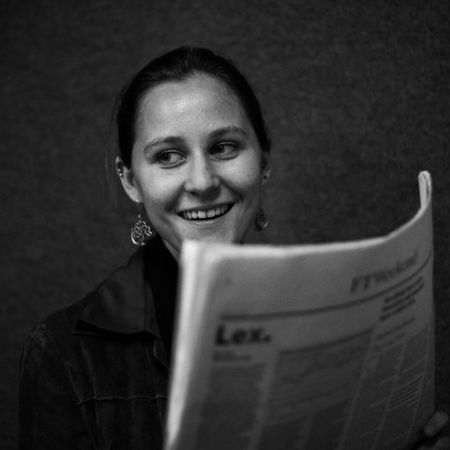
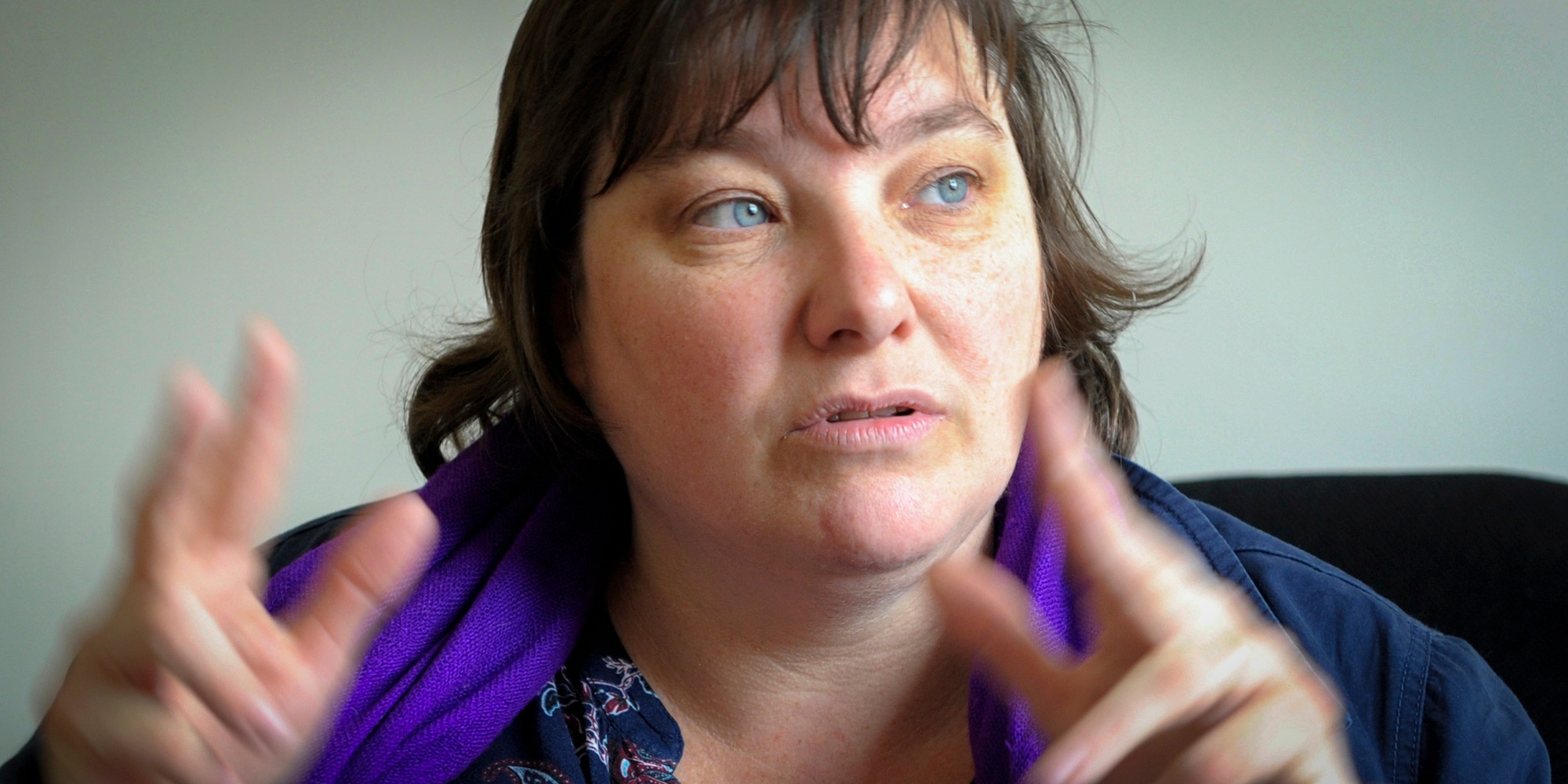
 Dr Michelle Meiring, founding director of Paedspal and a paediatric palliative care consultant, on 24 June 2019. (Photo: Joyrene Kramer)
 What does it mean to live a purpose-driven life?
This is a question that would be on the mind of anyone who sat across from Dr Michelle Meiring, a woman who has made her life’s work the advancement of paediatric palliative care in South Africa.
It is not an easy calling to take on. Most people hope to go their whole lives without having to face the reality of a child dying. Sadly, not everyone can.
Meiring considers working in this space to be a privilege.
“We always used to say to patients, ‘sorry, there’s nothing more that we can do’, which is a terribly abandoning thing to say, and it’s actually a bit of a misleading term. What we mean is, there’s nothing we can do from a curative perspective – we can’t cure your child – but that doesn’t mean there’s nothing that we can do,” Meiring reflected.
“In fact, I can say that when you get to a point where there are no more curative options, there’s actually a hell of a lot that needs to be done, and that is the work of palliative care.”
For the past 10 years, Meiring has been at the helm of Paedspal, an organisation she founded in 2016 to address the desperate need for palliative care services for children with non-curable illnesses.
Working with children in this position means tackling pain management and symptom control, but also something more.
/file/attachments/orphans/PHOTO1DrMichelleMeiringrightperformsabedsideconsultin2016-1_981905.jpg "Dr Michelle Meiring (right) performs a bedside consult in 2016. (Photo: Supplied / Michelle Meiring)")
As Meiring puts it, “in palliative care, something we say is that you might not die cured, but you can die healed. And what we mean by that is, even though a family loses a member, there’s often secondary healing that happens in that process if they are supported properly.
“If they aren’t, it’s devastating, and people have complex grief from which they never recover. So, not only are we impacting on the child in that moment, but we can actually make a huge difference in the lives of those families.”
/file/attachments/orphans/spotlight-meiring-Di-subbed-MAIN-option-3_876775.jpg "Dr Michelle Meiring. (Photo: Joyrene Kramer)")
Palliative care goes beyond medical interventions, extending into a complex space Meiring describes as “the work of dying properly”.
“You are basically journeying with families at the most desperate time of their lives… It’s going to happen whether you’re there or not, but just being able to do something and provide a little bit of light at the end of a very dark tunnel, I think, is very satisfying.”
Root of purpose
Daily Maverick’s conversation with Meiring comes at a pivotal moment in her career – she is stepping down as CEO of Paedspal to go into full-time academia. For the past 15 years she has worked part-time at the University of Cape Town, convening the paediatric option of the postgraduate diploma in palliative medicine.
“My global career goal is to assist in the development of paediatric palliative care in South Africa… The biggest gap at the moment is research. Without it, we don’t have a solid evidence base,” Meiring explained.
“Many of us who have been pioneers in the paediatric palliative care field have been so focused on patients, because that’s what drew us to the space, that we haven’t had time to do the research, or even sit down and write articles about our experiences.”
Meiring has a wealth of experience to draw from. She cut her teeth as a young paediatrician in Johannesburg during the height of the HIV/Aids pandemic in South Africa, completing her specialist training between 1998 and 2002.
She went in knowing that she loved working with children, but she could never have anticipated the onslaught of death that came with the health crisis.
“It was terrible, and we weren’t really equipped as young registrars to deal with it. And the ethos of paediatrics is very much that children are not meant to die, which you can understand – death is the enemy, and we need to fight this,” she recalled.
Meiring would do everything she could to ensure that children did not die on her shift. Her “epiphany”, as she describes it, came one night while working in the intake ward at Chris Hani Baragwanath Hospital, when a four-month-old was admitted with all the classic signs of advanced HIV infection.
/file/attachments/orphans/PHOTO5MandaKankaaprofessionalnurseatPaedspalatanoutreachevent_528046.jpg "Manda Kanka, a professional nurse at Paedspal, at an outreach initiative. (Photo: Supplied / Michelle Meiring)")
/file/attachments/orphans/PHOTO4PatientandhermomdoingARTtherapy1_541297.jpg "A Paedspal patient and her mother take part in art therapy. (Photo: Supplied / Michelle Meiring)")
“In those days, we weren’t allowed to take HIV-positive babies to the ICU [intensive care unit], because there were so many of them… It was a distributive justice regulation. If you put all of the HIV kids [in intensive care], you’re not going to have space for anyone else. It was very, very difficult,” she said.
Meiring remembers running around “like a headless chicken” trying to keep the baby alive through the night. He died at 7am, one hour before her shift ended.
“I remember feeling the sense of… ‘Could you not just have given me one more hour’. And then I realised how depersonalised I’d become. This baby had become a challenge to get into the next day, and I didn’t really think about the implications of the baby’s death on the mom… We hadn’t been taught how to communicate sensitively,” she said.
“The mom had this very violent grief response… I just felt so helpless, and I walked away dissatisfied.”
Meiring realised that if she had acknowledged the baby was too sick to survive, she could have done more to relieve his pain, and counsel his mother ahead of his passing.
Source of action
This awareness pushed her to seek answers at the Houghton Hospice in Johannesburg. When she found out that the facility did not admit children, she offered to trade her skills as a paediatrician for a better understanding of palliative care.
Meiring’s work in paediatric palliative care began in earnest with a five-bed room at the hospice, and the founding of her first NGO, the Children’s Homes Outreach Medical Programmes (Chomp).
In the years that followed, Meiring would play a key role in shaping palliative care for children across the country. She went on to run the first consultative paediatric palliative care programme in South Africa at Baragwanath Hospital. When the scope of her NGO moved beyond children’s homes to healthcare facilities, it was re-christened Big Shoes.
“Big Shoes went for 10 years. We established a branch in Durban in 2008, and then we established a branch in Cape Town in 2009. That’s actually how I came down to Cape Town… and it was also the point at which I... started off with 10 hours a week at UCT trying to integrate more paediatrics into the mostly adult palliative care diploma at the university,” she said.
This path was not without its setbacks. A decade into Big Shoes’ operations, a new CEO recruited to lead the organisation ended up defrauding it, resulting in its closure. Meiring did not give up. Not long after, she secured funding from the Mapula Trust to start Paedspal.
Manda Kanka, a professional nurse with Paedspal, joined the organisation in 2018. She had previously worked with Meiring during the establishment of a 10-bed palliative care unit at Sarah Fox Children’s Convalescent Hospital in Cape Town, leaving a 20-year post at Red Cross Children’s Hospital to support the initiative.
“I think that all of us feel better or react better when we know what is going on, and that is one of the things that Paedspal offers – communication all the time, and seeing that there’s this holistic approach and the whole family is involved,” Kanka said.
/file/attachments/orphans/PHOTO3Paedspaltrainingworkshop1_997115.jpg "Paedspal conducts an advanced care training workshop. (Photo: Supplied / Michelle Meiring)")
“What I’ve seen is that children get better symptom control, especially pain control. And what is beautiful is that you now see doctors starting to do it themselves. They’re not waiting for the palliative care team anymore. And my personal experience is that from the nursing education that we’ve done at other facilities... the sisters start to feel comfortable with end-of-life care.”
Kanka described Meiring as a “wonderful teacher” in palliative care.
“Every time I go with her into the hospital, I just realise why I’m doing what I’m doing, and it’s always with pride that you sit in lectures that she’s giving, knowing that you are part of Paedspal,” she said.
Tracking of change
Over the course of her career, Meiring has seen the spectrum of diseases in paediatric palliative care change.
“When I started… 60% of my caseload was HIV. Now, I can’t even say 6% because these kids are doing so well… It’s not over yet, but it is much more controlled than it was,” she said.
“Reflecting on Paedspal’s caseload, we have a lot more rare diseases, children with neurological conditions like cerebral palsy... unfixable heart problems. A little bit more like the First World country profiles.”
There are still gaps in the system. Meiring noted that in 2016, the World Health Assembly passed a resolution on palliative care, cementing it as a basic human right that needed to be integrated into healthcare systems and funded by governments.
/file/attachments/orphans/PHOTO2Paedspalofficeopeningribboncutting2016_211906.jpg "The ribbon-cutting ceremony at the opening of the Paedspal offices in 2016. (Photo: Supplied / Michelle Meiring)")
Meiring served on the steering committee behind the introduction of South Africa’s first National Policy Framework and Strategy on Palliative Care (2017-2022), which was later extended for two years after the government struggled to meet its stated objectives, before expiring. The Department of Health has yet to appoint a new person to carry the policy into a second term, she explained.
“I think South Africa’s improving. There’s more palliative care teaching integrated into training medical students. You have to start from early. There’s a scattering of initiatives, but it’s really not where it needs to be. We’ve still got a lot of work to do… There’s so many competing interests, and if we can’t even fund our core services, adding palliative care is often framed like a bit of an add-on, and a non-essential,” she said.
During this new stage of her career, Meiring will not only be focusing on academia, but also driving the establishment of a Paediatric Palliative Care Centre of Excellence in Cape Town that will merge clinical services, training and research under one roof. The centre will bring together Paedspal, UCT and the Rohan Bloom Foundation, among other organisations.
/file/dailymaverick/wp-content/uploads/spotlight-meiring-Di-subbed-MAIN-option-2.jpg "Paedspal founding director, Dr Michelle Meiring. (Photo: Joyrene Kramer)")
“Cipla South Africa has been brokering this deal with us, and we’ve just secured funding. They’re going to be giving us R50-million to secure a building,” Meiring said.
“The building is going to house the inpatient unit, outpatient unit, accommodation for family, and then also offices for training and research, and we’re also trying to bring in a private medical component... so we want to run a public-private partnership.”
The US-based St Jude Children’s Research Hospital, which has already provided some support for bursaries under the UCT palliative care diploma, has committed to funding two-year training programmes for two palliative care specialists at the Centre of Excellence from 2028, Meiring continued.
Another international partner, the Cicely Saunders Institute of Palliative Care at King’s College London, will be assisting in the development of research programmes at the centre.
Work in paediatric palliative care can be gruelling and emotionally charged, Meiring reflected. Practitioners need to maintain perspective, or it can overwhelm them.
“It’s not for everybody... The other thing that I like about it is, I think medicine has become too scientific. We focus a lot on the science of medicine, and the art of medicine gets lost behind, and a lot of the art is in the other domains – the psychosocial and the spiritual – which is more of the healing part of medicine,” she said. DM
/file/attachments/orphans/ChildrensReporterV2_187851.jpg "Tamsin-DG-Murray-Trust")