



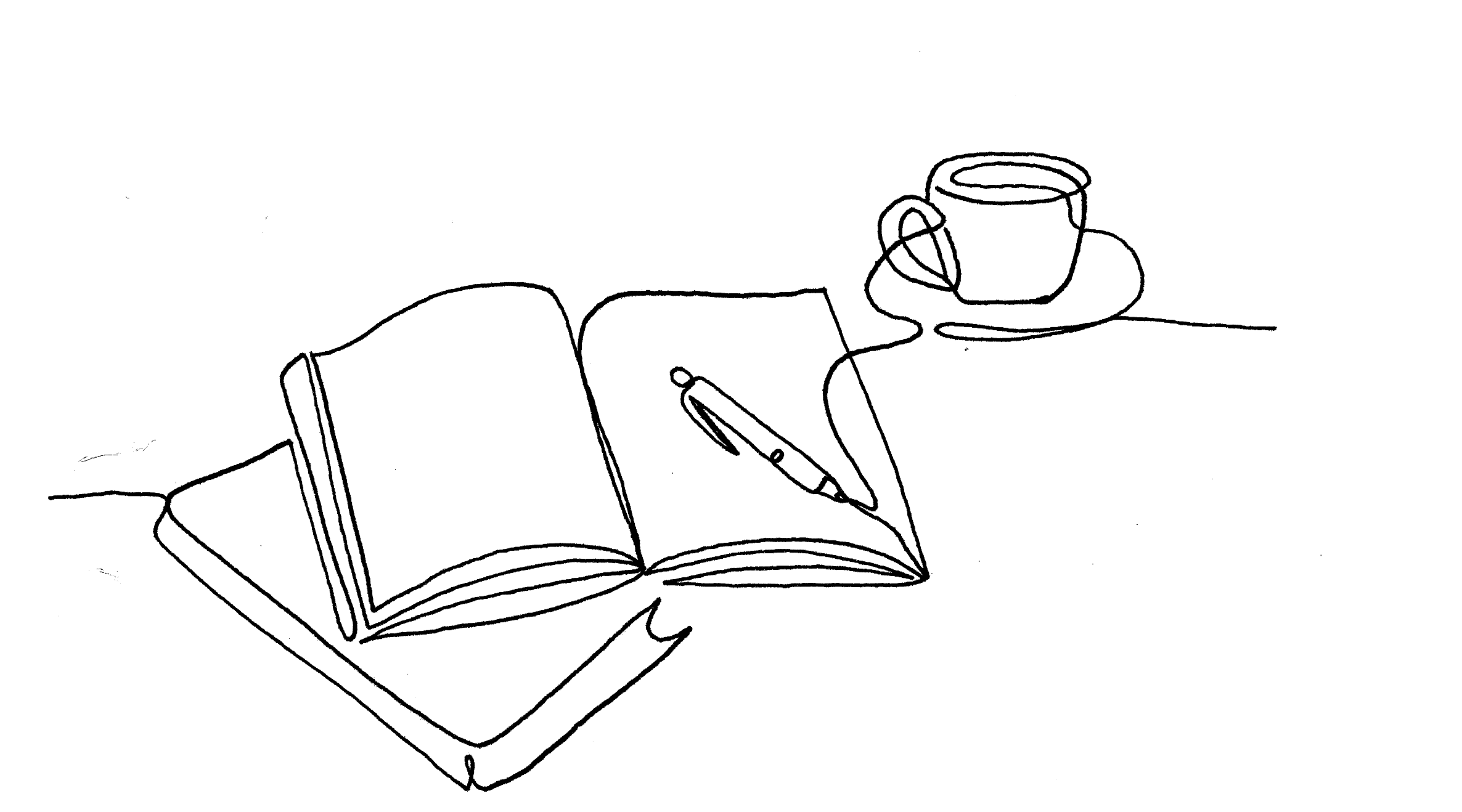
 The slower pace of handwriting gives us space to consider our words more carefully. (Illustration: Megan Janovsky)
In today’s tech-focused world, we tend to deviate more to the digital. We tap away at our computers, we gaze at our screens and our thumbs fly across the keypads on our phones.
These actions tend to be more reactive than proactive.
We are either responding to emails and messages, or indulging in the next dopamine-inducing diversion. Sometimes we are typing original messages or planned content, but often these are abbreviated and linked to immediate thoughts rather than considered inputs.
The act of physically writing something down involves effort and energy. There is something about the more measured pace of writing that slows the brain down to think in longer sentences, as opposed to the often much shorter bursts required for digital communications.
Writing requires deeper thinking, and tapping in to more of our brain’s potential to create, to solve, to strategise and to understand.
In his international bestseller Thinking, Fast and Slow, Nobel Prize winner Daniel Kahneman talks about two thinking systems.
The first involves activities that are fast, intuitive and automatic – like recognising a face, driving a well-known route or thinking of a standard answer.
The second includes activities that are slow, deliberate and effortful – like solving a complex problem, weighing up options or structuring thoughts and choosing one’s words.
We tend to be lazy about using the second system, and bypass it for the quicker results of the first. Kahneman advocates slower thinking for more meaningful outputs, using decision-making frameworks and more structured analysis, which are techniques that work hand in hand with the practice of handwriting.
Handwriting as a personality trait
In the British Library’s Treasures Collection, I recently discovered a number of original manuscripts, including those of Charlotte Brontë, Jane Eyre and Virginia Woolf.
Looking at the physical pages, I was struck by how handwriting itself can also hint at a person’s personality and character, that digital texts by comparison can sometimes be inhibiting as a method of expression.
The manuscripts gave the impression of “working pages”, with parts of sentences crossed out, words inserted and phrasing adjusted.
It reminded me of the care involved with crafting a manuscript or original document – first in setting the words down on the page, second in perfecting them, and third in the process of editing and eliminating to reach an improved overall effect.
Skipping the written word in favour of digital convenience may quietly limit both our creativity and the quality of our work. The slower pace of handwriting gives us space to consider our words more carefully, refining both clarity and intent as we go.
Writing for our benefit
Long handed does not necessarily mean long winded.
Writing a to-do list can be the first important step to getting things done. The important thing is to be sure that what is on your list is meaningful, and necessary.
If you have written your list and put it in a visually accessible place, you have a good chance of both reminding yourself what you have planned to do, and getting it done.
If you are looking for an easy way to incorporate the practice of writing back into your life, writing lists, along with a physical diary, is a concrete way of achieving this.
Writing does not always have to result in lengthy documents – it can also be used as a tool for brainstorming.
A simple spider diagram – where you write down a central goal or objective in the centre of a page, and then jot down the associated ideas or solutions that come to mind around it – is an effective method for strategising and organising.
Seeing the words written down on the page can stimulate other ideas – and using long hand rather than structured typing feels more creative, as well as opening up the brain to different ways of thinking and solving problems.
The human brain itself is a nonlinear system, with thoughts branching off in every direction, so making a spider diagram feels naturally intuitive as a brainstorming tool.
The next time you have a problem to solve, a system or process to organise or a strategy to design, grab your notebook and experiment with a free-flowing spider diagram as a starting point, which you can add to as your ideas evolve.
Julia Cameron advocates morning pages as a creative tool in The Artist’s Way.
Each morning, just after waking up, the practice involves writing two long-hand pages of stream-of-consciousness writing – basically whatever comes to mind.
The concept is not to achieve a specific written outcome or to write qualitatively – the idea is to fill the pages, and empty some of the thoughts filling your mind.
By clearing some of this mental clutter, we free up more space for deeper thinking, and writing down some of the concerns floating around in our minds can make them more visible and easier to deal with.
Morning pages are about pitching up at the page with regularity. It does not have to be first thing, or every day, or two full pages, but the process helps to clear space in our heads and results in written pages, which in itself can be satisfying.
The act of creating a piece of reflective writing, or journaling, can offer immense benefits too.
In their Great Book of Journaling, Eric Maisel and Lynda Monk illustrate many instances of how journal writing can “support a life of wellness, creativity, meaning and purpose”.
Writing in a journal can serve as a record of everything from emotions to travel, from experiences to progress tracking, from recording memories to fleshing out ideas, and from practising gratitude to developing coping skills.
If you are unsure where to start with a journaling practice, it can be helpful to follow prompts, which can encourage you to reflect more deeply on your current circumstances, stances and options.
Writing and thinking about these can bring about positive change and fresh perspectives. If you are wanting your journaling practice to be lighter, simply recording experiences and events can be a very enjoyable way to appreciate experiences and record memories that you will be able to refer to in time to come.
The receptacle that you choose for all of these written possibilities is important too.
Consider buying a book or two (one for personal writing and one for work) that resonates with you, and use it as a vehicle to slow down your thinking. Including more long-form writing in your life creates opportunities to reconnect with clarity and with quality, and in a world that encourages speed and constant input, that seems like a good idea. DM
Comments
Scroll down to load comments...