




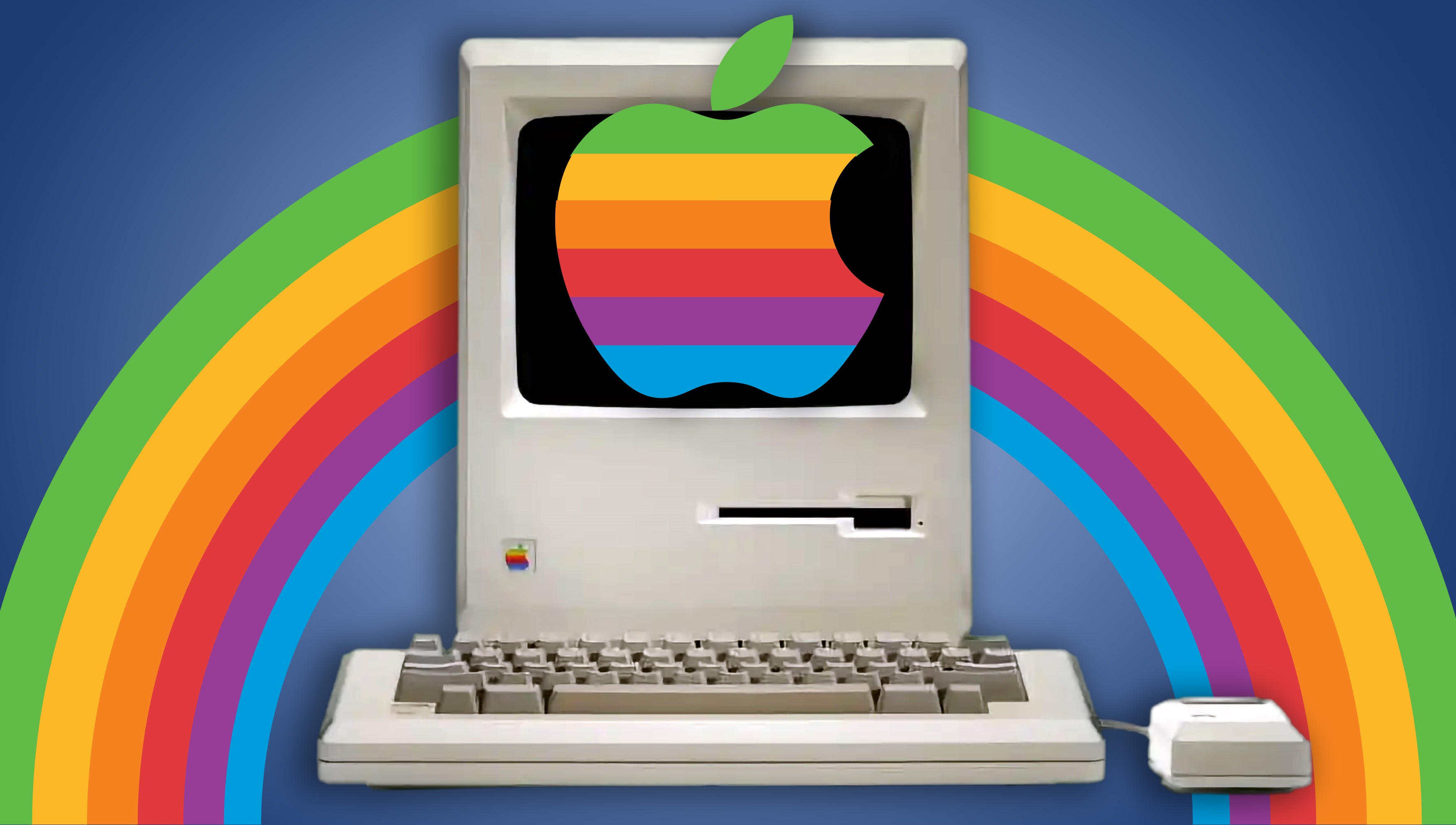
 Illustrative image: An Apple Macintosh computer from circa 1984. (Photo: Science & Society Picture Library/Getty Images); Rainbow. (Vecteezy); Apple logo: Wikimedia Commons
 Even if his beloved iPad had been invented in time to deliver his opening address at the founding of the Congress of South African Trade Unions (Cosatu) in 1985, Cyril Ramaphosa would have found it difficult to get his hands on an Apple device.
In that October — a month after Steve Jobs was forced out of the company — Apple suspended sales to South Africa. Citing the nation’s apartheid policy and political pressure in the United States, it became the first company to explicitly withdraw for political reasons. Apple’s European regional office informed its local distributor, Base2, that it would no longer sell its computers but would, in some capacity, continue to supply spare parts.
“Apple was quite plain that its reasons were political,” John Floisand, then managing director of Base2, told the media when the announcement was made. “Apple felt that, in view of the current feeling in the United States and recent events here, it did not want to be in South Africa, and so they are pulling out.”
The almost stillbirth of the free press
The Weekly Mail (now the Mail & Guardian) is one year younger than the Macintosh, but the effect of Apple’s bold statement against apartheid slapped different for an emerging newspaper. The boycott made technology scarce. Journalists, however, embrace the constraints that breed innovation. With a single ageing Mac, the Weekly Mail pioneered desktop publishing, earned a reputation for fearless reporting, and was ultimately suspended for four weeks by President PW Botha in 1988.
Max du Preez picked up the desktop-publishing baton with Vrye Weekblad to keep the free press running.
That four-week suspension was the second boot dropped on the fledgling desktop publishing industry; the first came from the US Comprehensive Anti-Apartheid Act of 1986, which banned the sale of computer hardware to regime-enforcing entities like the South African Police and the South African Defence Force. This sent the Mac supply chain underground at the worst possible time.
Suppliers like Texas-Carolina Trading Company, however, used these grey market areas to release the pressure from Apple’s stringent sales quotas. Then director Ed Buckner acknowledged that the company sold hardware into the region, using non-government-aligned retailers during the sanction years.
The pipeline flowed through Botswana before jumping the border. This ironically sped up the timelines from product launch to office use to around three weeks for some Mac models.
These computers became the backbone of the mid-80s desktop publishing ecosystem that replaced the lead-casting printing process with streamlined mainframes and digital typesetting.
This solved the cost problem — bringing down infrastructure capex from printing presses costing millions of rands, to hardware costing thousands of rands. But it didn’t stop the state from policing the newsstands.
Plugging into the system
Undeterred, the journalists kept working the Apple machine daily to keep Die Groot Krokodil and his Doctor Death at bay, and the paper came back swinging as the Mail & Guardian in 1993.
It was then that Gavin Dudley, a young tech enthusiast, joined their ranks. Recognising the internet’s potential to safeguard South Africa’s fragile democracy, he helped propel the paper into the online world.
Driven by the scars of apartheid, the editors and publishers moved for a presence in the virtual world, where censorship would be more difficult. Dudley joined the cause thanks to his website design skills, a rarity in the early days of the internet.
It was a single question, “Who is Steve Jobs?”, asked by cofounder Irwin Manoim, that secured him the position.
“At that point, HTML was still being written by text editors,” Dudley recalls. It was an era predating user-friendly web design tools, where a single website could demand hours of meticulous coding. Despite the limited resources, technological hurdles and the lingering impact of Apple’s withdrawal, the paper became a digital trailblazer, launching South Africa’s first newspaper website in 1994, ushering in a new era of African journalism.
While its domestic readership was small, the newspaper recognised a global audience hungry for news from home. This expat community fuelled growth, putting it in direct competition with the media giant and mouthpiece of the apartheid regime, Naspers.
To survive, it scaled rapidly. “We knew that by the time Naspers figured it out, they would just come and swamp everyone, which is ultimately what happened,” Dudley explains.
/file/attachments/orphans/Lindsey-mac_762720.jpg "Illustrative image: Apple. (Image: Wikicommons) | Steve Jobs. (Photo: Justin Sullivan) | (By Daniella Lee Ming Yesca)")
Accelerating adoption
The launch of Mweb in 1997, South Africa’s first consumer ISP, accelerated internet adoption, giving the Mail & Guardian a wider reach through a dedicated internet line - across the very network owned, at least in part, by Naspers.
The newspaper embraced multimedia storytelling, a groundbreaking feat in those days. A fitting example Dudley cites was a commemoration of the Sharpeville massacre featuring historic audio clips — the gunshots, the shouting — a potent experience for web users in 1998.
“Daily news completely changed the game for us,” Dudley says. While the website flourished, technology continued to democratise across the country. The launch of mobile networks like Vodacom in 1994 brought connectivity to millions.
To be fair, the cornerstone of that digital democratisation was Telkom. Established in 1991 when the government spun out telecommunications from the creaking South African Post and Telecommunications parastatal, Telkom partnered with Vodafone to bring mobile telecommunications under a subsidiary.
This subsidiary grew to be Vodacom, which Telkom sold in late 2008 in preference for its own 3G network.
Dudley still sees a bittersweet legacy. Even as the country navigates new challenges in its pursuit of democracy, the internet remains a testament to the resilience born out of the fight against apartheid — a resilience embodied in the journey of the free press.
President Ramaphosa has since delivered multiple State of the Nation Addresses from his iPad that detailed ambitious plans to build smart cities and equip citizens with the skills needed to be competitive in this perpetual fourth industrial revolution. And they were reported by a free press. DM
This story first appeared in our weekly Daily Maverick 168 newspaper, which is available countrywide for R35.
/file/attachments/2991/DM-17042026001CPTJHB_115125.jpg)