




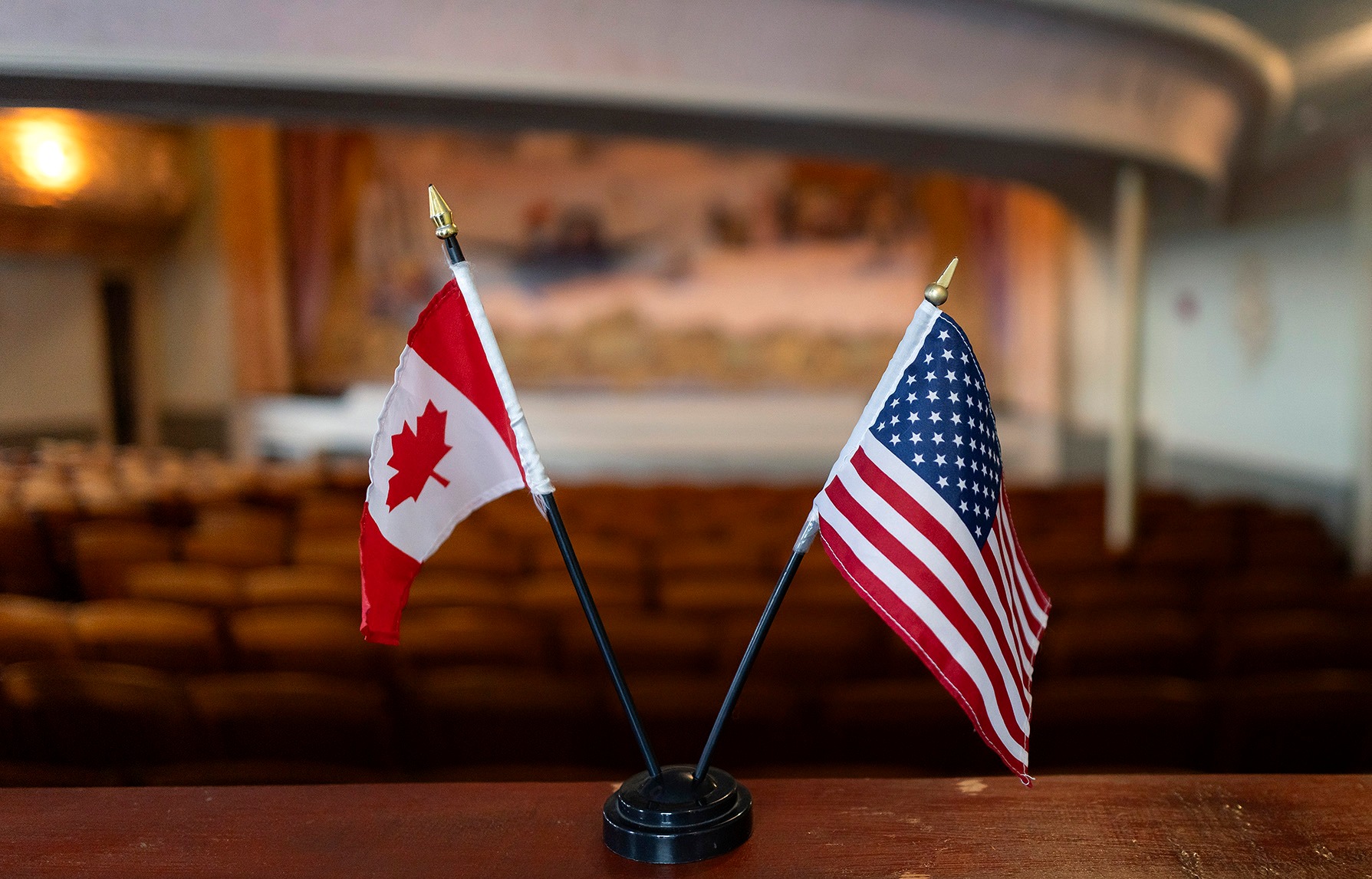
 A US and a Canadian flag displayed inside the Haskell Free Library and Opera House, 1 April 2025. (Photo: EPA / JUSTIN LANE)
The global political backlash against Donald Trump’s second term began in my homeland of Canada and while it’s not on the scale of the Iran war, it’s inflicting real pain on the US economy.
According to Forbes Magazine and other outlets, Canadian vehicle visits to the US were down 35% in the 14 months since Trump took office. The cumulative loss to the US economy is about $4.5-billion and counting and surely counts as one of the biggest tourist boycotts in history over such a short time.
I’m a Canadian, and I know that we are generally regarded as “nice people” – though, to be honest, having lived here for the better part of the past three decades I can honestly say that South Africans are far more polite.
But one of the things that defines our national identity is that we are not Americans – and my accent rather annoyingly remains a point of confusion with South Africans whom I first encounter – but as I pointed out in this column last year, we take an “elbows up” approach to threats to our sovereignty which Trump did in his first weeks of office.
That phrase refers to the style of play of the late great Canadian hockey icon Gordie Howe, who liberally applied his elbows to the faces of opponents in an era when players did not wear protective masks or helmets. That’s only a penalty if the ref sees the infraction.
“Elbows up” has been our battle cry against Trump, and it helped propel Canada’s Prime Minister Mark Carney – once a hockey player himself – to electoral victory last year.
Carney’s Liberal Party was dead in the water as former prime minister Justin Trudeau’s popularity sank like a stone. And Carney’s “elbows up” approach to Trump thwarted the Conservative Party under Pierre Poilievre, a sort of Canadian version of “Trump lite” who seemed destined to win by a landslide.
Viewed through this prism, the recent defeat of Hungary’s far-right Viktor Orbán after 16 years in power started in Canada. Trump’s second term has been far more extreme, menacing and unhinged than his first, and it is dealing a fatal blow to the far right – downright fascist in some cases – movement on the global stage.
One measure of progressive or liberal success – be it issues of race, gender, sexual orientation, the environment or democracy – is the scale of the right-wing backlash to such progress. We have come a long way, and while I can understand some of the criticism of “woke culture” and the like, there is a mounting backlash to the efforts to roll back these gains.
As a Canadian who resides in South Africa, I take pride in the role that both my homeland and adopted country have taken on this grand stage of history.
Canada under Conservative Prime Minister John Diefenbaker led the drive in 1961 to expel the apartheid regime from the Commonwealth. His motives have had their critics, but at the time it was a progressive and moral stance to take.
And while Canada did shamefully provide a template for the Bantustans with its own policy of “Native Reserves”, Canadian governments Liberal and Conservative in the 1980s publicly opposed apartheid and for the most part – with glaring exceptions – supported sanctions against the white-minority regime in Pretoria.
Canadian boycotts of US products such as booze have also been significant, and that is instructive as we Canucks like to dop.
Canada, it must be said, has a shameful history of colonialism, racism and other affronts to humanity. Much of the public infrastructure in my home province of Nova Scotia in the late 18th and early 19th centuries was derived from custom taxes raised from the import of goods that were the product of slave labour in the Caribbean.
But at this stage in the 21st century, we are among the leaders in the fight against the fascist – a term I don’t use lightly – Maga movement. Canadians are literally on the front lines of this fight and are voting with our tourist dollars.
I for one have no travel plans to the US, a country where I lived and worked for more than four years and have a deep affection for – I know that Maga does not define America.
Apartheid ended and Maga’s obituary will also hopefully be written soon. And I am proud as a Canadian of our part in the demise of both. DM
Comments
Scroll down to load comments...