




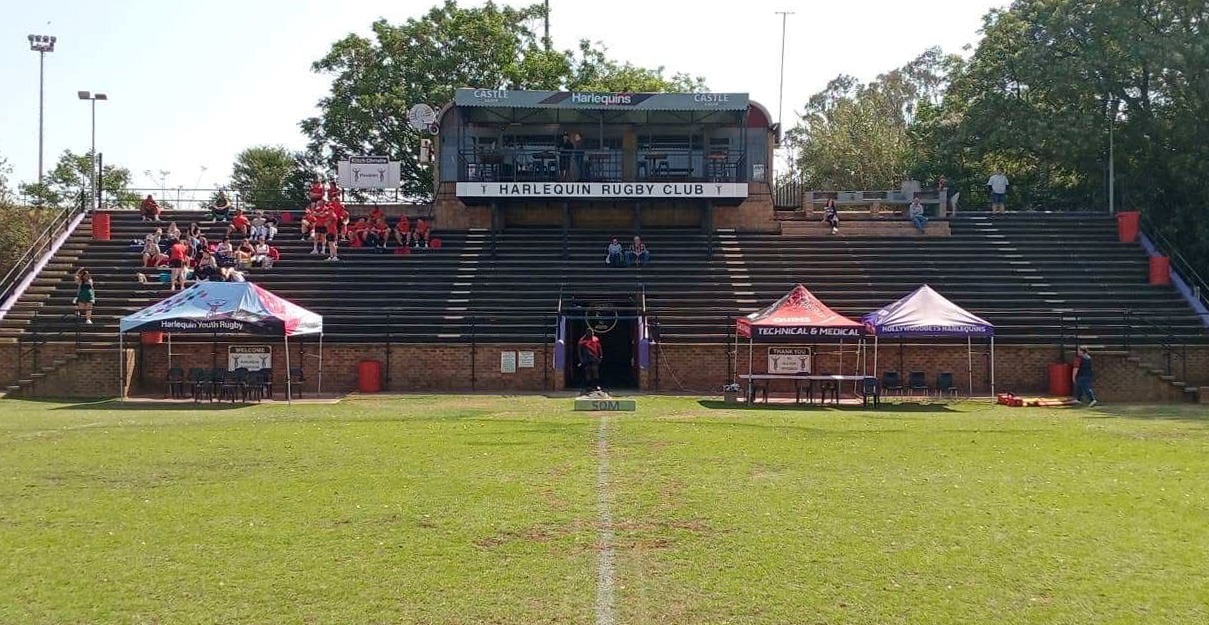
 The future of the Harlequin Sports Club, one of Pretoria’s oldest sporting institutions, hangs in the balance as a legal and administrative standoff with the City of Tshwane threatens its survival. (Photo: Supplied / Harlequins Equity Partners)
 The future of Harlequin Sports Club in Pretoria remains uncertain after it received a land-use contravention notice, highlighting a growing reality: sports clubs must comply or risk losing their footing.
Whether cities, under the Government of National Unity, are tightening governance and enforcing compliance more consistently, or seeking to unlock land for development amid financial pressures, the outcome is the same: sports clubs operating outside current regulations are increasingly vulnerable to losing their land.
In turn, it is the broader community that stands to lose, as these clubs often provide access to sporting facilities and community-oriented activities.
Recently, the situation with the Harlequin Sports Club in Pretoria became yet another case study. In 2019, the Pirates Sports Club in Johannesburg was in a similar boat.
The future of Harlequins Sports Club remains uncertain, despite avoiding immediate closure after the deadline of a land-use contravention notice issued by the City of Tshwane Metropolitan Municipality.
/file/attachments/orphans/pajl11nyfi_802356.jpg "Harlequin Sports Club was founded in 1903 and is the oldest club in Pretoria. It houses the Harlequin Rugby Club, above. (Photo: Harlequin Rugby Club)")
Almost a month ago, on 17 March, the city issued the club with a land contravention notice, calling on it to cease operations.
It gave the club 28 days – until 14 April – to “remove all material related to the contravention and restore the property to its original state”.
“In case of failure to comply, the City of Tshwane reserves the right to, without further notice, institute criminal proceedings and/or seek appropriate high court relief to enforce compliance with this directive in terms of relevant legislation,” the contravention letter said.
The club applied for an extension, but has yet to receive a response to that request.
At the centre of the dispute is the land’s zoning status. The property is classified as “undetermined”, which does not permit commercial activity.
Thus, the club is in breach of the city’s by-laws by operating places of refreshment and entertainment, shops, sports and recreational grounds and places of instruction and business, according to the notice.
This is despite the club applying in 2021 to have the land rezoned. It is still awaiting the council’s approval.
According to Ben Eybers, President of Harlequins Sports Club, the club sought legal assistance from civic organisation AfriForum and has, in the interim, sent two letters to the city and received a response on Thursday, 9 April, of which the details are divulged further on.
According to Samkelo Mgobozi, the City of Tshwane’s mayoral spokesperson, the Executive Mayor Nasiphi Moya has engaged directly with the club, and the city remains open to finding a mutually beneficial solution.
“The City fully recognises the important role that Harlequin plays in the community and in the development of sport more broadly,” Mgobozi told Daily Maverick via email correspondence.
“[But] this matter must be understood within the broader work under way in the City to restore lawful, transparent and efficient administration.
“The Multiparty Coalition Government is rebuilding institutional credibility, improving turnaround times, strengthening enforcement and ensuring that land use management is applied fairly and consistently.”
/file/attachments/orphans/TW_0099560_910349.jpg "Supporters on the field during the Gold Cup semifinal match between Quins-Bobbies Rugby against College Rovers at Harlequin Sports Club in 2017. The club has been a focal point of the community for more than 100 years. (Photo: Gallo Images)")
Historic roots
The Harlequin Sports Club, dating back to 1903, houses one of the oldest rugby clubs in Pretoria. It is deeply rooted in the social and sporting fabric of Pretoria with about 800 members and 40 permanent employees.
Several schools, such as Crawford and Afrikaans Hoër Seunskool (Affies), also use the club’s facilities.
For many years, the property was owned by the city and leased to the club.
However, in the late 1990s, the club procured the land from the city council and put it in a trust called the Harlequin Trust, said Eybers.
At some point, the trust sold a piece of the land to the United States Agency for International Development (USAid), and during that time, a change occurred to the property’s zoning status, which the club was unaware of, said Eybers.
Due to this historical anomaly, which Eybers said the club had been investigating, the land use on the property was indicated as “undetermined”.
“Ever since, we’ve been trying to find out who changed it, why was it changed and what happened,” said Eybers.
In 2021, the club, acting to correct the matter, applied to the city to upgrade the zoning of the property to commercial land so that it could continue to operate as normal without non-compliance worries.
“We are somewhat surprised by the approach taken thus far,” said Pieter de Bruyn, spokesperson for Harlequin Equity Partners (Harlequins Pro).
“It’s been more of a protest approach as opposed to fixing what needed to be fixed. But it’s very positive to hear that it seems the [nonprofit] club has also now taken this more constructive route.”
Harlequins Pro is the developing professional rugby arm of the club, operating alongside Harlequin Rugby Club’s long-standing non-profit structure.
To address growing uncertainty, De Bruyn issued a statement last week to confirm that contingency plans were in place for the professional side, and, to his knowledge, also for the amateur side, should the club face enforcement action, which could still happen at any time.
De Bruyn believes that the contravention order is not malicious.
Rather, it reflects the intention to ensure compliance while encouraging the transformation of sporting facilities to better serve the broader Tshwane community.
“This is likely not the first or the last time a metro or a municipality will raise issues with sports clubs,” De Bruyn said.
“These mostly must transform into facilities for the wider population of a metro, in this case, Tshwane. Not only just for the residents of Groenkloof, but Harlequin’s club, with brilliant facilities, needs to play a bigger role.”
Zoning dispute unpacked
According to Mgobozi, the city is processing the application submitted in 2021. However, the pending application did not mean that compliance obligations were automatically suspended, he said.
“Activities on site are required to comply with the applicable land use and regulatory framework at all times,” said Mgobozi. “The issuing of a contravention notice reflects this requirement. It forms part of the City’s responsibility to apply the law consistently, while the application process continues in parallel.”
Harlequin submitted its rezoning application to town planners, The Practice Group, in 2021, with the City of Tshwane Metropolitan Municipality confirming receipt on 29 November 2021, according to the response letter referred to above.
The application was circulated to internal departments, with all required comments received by 19 September 2023, allowing it to move to the evaluation stage.
However, delays followed.
The City, in its response to the club, cited IT and network issues, as well as a backlog within its Land Use Management section. In addition, the application remained incomplete, noting that 43 objections raised during public participation still required further engagement, said Mgobozi.
While Harlequin told Daily Maverick that it had addressed the objections and resubmitted in 2023, Mgobozi said that updated plans reflecting agreed development limits had not been provided, with formal communication issued to the club on 21 November 2025.
Additional delays relate to outstanding technical requirements, including correcting an environmental approval, finalising consultations with Water and Sanitation, and securing input from external bodies such as Gautrans and Telkom.
According to Mgobozi, these issues had been communicated and had to be resolved before the application could proceed.
Pirates club
/file/attachments/orphans/RUNNERS-AT-PIRATES-21K_255463.jpg "The Pirates 21K half-marathon. (Photo: Hot FM)")
Similarly, in 2019, Johannesburg’s Pirates Sports Club was almost forced to cease operations.
That was because the Johannesburg Property Company (JPC) moved to cancel the Pirates’ lease because it had allowed the WastePreneurs, a recycling non-profit organisation, to operate on a small portion of the land.
The city viewed this as an illegal sub-lease.
Unlike Harlequin, Pirates do not own the land but lease it from the city.
After the WastePreneurs won an interdict in the Johannesburg high court in late 2019, the eviction of Pirates was halted, and the club’s lease, which ends in 2034, was effectively reinstated.
Then, in July 2025, the City of Johannesburg announced plans to potentially sell or re-lease several prime land assets, including Pirates, Marks Park and Killarney Country Club.
/file/attachments/orphans/TL_2469604_445543.jpg "Provia Mashiane of Pirates Rugby Club and Bernice Strydom of Collegians Valkyries during a Betway Women’s Club Championship match. (Photo: Lefty Shivambu / Gallo Images)<br>")
Many of these clubs were on long-term leases where they paid nominal rent – Killarney pays as little as R2 a year. The City argued these leases were relics of the past that benefited a small elite.
Furthermore, the City was and still is facing significant revenue shortfalls.
By reclaiming this land, it aimed to either sell it for high-density housing or renegotiate leases to market-related rates.
After a public outcry, the situation remains at a stalemate, but it nevertheless highlights sports clubs’ increasing need for compliance, or they risk losing their land altogether. DM