




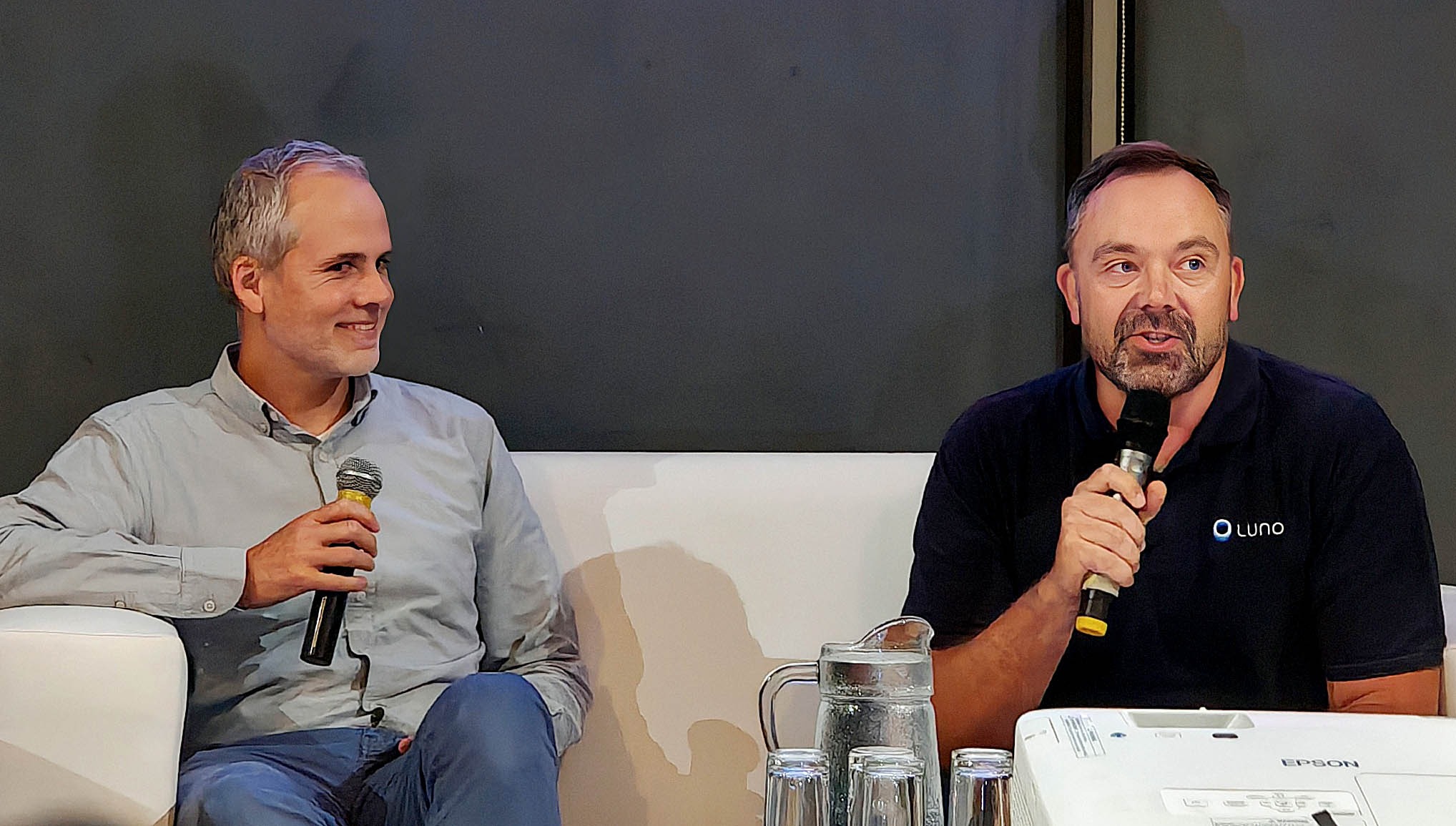
 Sanlam financial markets CEO Jacques le Roux (left) was interviewed at Kelvin Grove in Cape Town by Luno country manager Christo de Wit about the Zaru stablecoin that is yet to come to the market operationally. (Photo: Lindsey Schutters)
 It’s more difficult than you expect to find a juicy, well-proportioned beef slider (that’s what we call mini-burgers now, btw) delivered at conference volume. Each subsequent platter that replenished the swiftly depleted stocks at the Kelvin Grove venue didn’t let the catering team down. It was a Thursday evening at half past dinner time, and the consistency of quality was welcomed.
The occasion? The second Mainstreaming Digital Assets: Institutional Adoption in South Africa event, hosted by Bitcoin Events – the same crowd that put Blockchain Africa Conference and Crypto Fest on the map.

The audience? Around 70 high-value institutional players, including C-suite executives from banks and financial institutions, chief investment officers, digital transformation leaders from major financial firms, executives from asset managers, and me – a no coiner.
Let’s get digital
“For some, they just want to use it. They don’t want to build it. They just want to use it, so [that] they have a use case. That’s music to our ears because we want to build it so that other people can use it,” was Sanlam Financial Markets CEO Jacques le Roux’s response to Luno country manager Christo de Wit’s questions about the market reception of the pair’s Zaru stablecoin.
Le Roux could tell from my giggles when we met earlier that I had expressed some views about the institutional payments venture he’s embarked on with Luno, EasyEquities and Lesaka.
Overall, it would appear that the institutional reception of the Zaru launch has been, in his words, “highly encouraging”. The broader financial sector is not only embracing the technology, but actively driving its expansion by bringing ready-made use cases and brainstorming new applications for the stablecoin in traditional finance (TradFi).
There was no time to go for another round of sliders before the next couple of panels took to the sofas. And by the time the formalities were over, the patties were ice cold and the bar was charging R27 for a 500ml bottle of sparkling water – at least it wasn’t the mini bottles.
Wiehann Olivier (Forvis Mazars director) and his fellow panellists repeated the popular lament about the slow movement of the regulators.
The much-vaunted stablecoin regulations that were promised in 2025 have still not seen the light of day, and there are already three working rand-backed digital assets in the market, Zaru included.
Asset or long-term liability?
“Digital assets were designed to facilitate peer-to-peer payments over the internet without a need for [an] intermediary and a lot of people believe that ‘without a need for intermediary’ means ‘beyond regulations’... which is false. We need something like regulations to protect someone that … wants to participate in specific industry or specific sector or the asset class,” was one of the sweeping direct statements made from the couches.
“Large institutions love regulations because it provides them with a clarity that they know they can enter a market and they can do that safely.”
Ironic, then, with all this regulatory stagnation, that an institution like Sanlam would forge ahead with a stablecoin project for institutional use – normal folk will get a chance to put it into practice afterwards. And that South African regulators have issued more than 300 crypto asset provider licences to date.
I was enjoying a beef skewer (that’s what we call sosaties now) earlier in the evening while eavesdropping on a discussion about the institutional fear of instability in the still-to-be adequately regulated local crypto market.
I get it, it’s difficult to build a stablecoin house when the foundations could be shaken underneath it.
/file/attachments/orphans/IMG_20260409_1905431_829910.jpg "Sanlam financial markets CEO Jacques le Roux was interviewed at Kelvin Grove by Luno country manager Christo de Wit about the Zaru stablecoin that is yet to come to market operationally. (Photo: Lindsey Schutters)")
Whose money is it, anyway?
While the regulatory concerns and frustrations were shared by the bulk of the audience, perhaps the most fascinating revelation was made when Le Roux spoke of the complex reality of balancing a rand-backed stablecoin.
“Choosing between fixed and floating interest rate assets is critical. If a portfolio is overly sensitive to interest rate movements, an unexpected rate hike could cause the underlying assets to drop in value, again compromising the peg. The portfolio must be structured to honour the token’s core promise: that its value will never fall below zero.”
To manage these risks in the South African context, the Sanlam team knew they could not simply mirror US stablecoins like USDT. Why? Because while US Treasuries are highly liquid and cheap to unwind, South African Treasury Bills operate differently and carry different liquidity penalties.
Consequently, Zaru is initially being backed by Cisca-regulated money market funds, which are already diversified, hold a value pegged to one rand, and offer the high liquidity required.
He also explicitly ruled out backing the token with volatile assets such as bitcoin or gold, which could halve in value in a single day and destroy the system’s integrity.
Obi-Wan warned that only a Sith deals in absolutes. The general consensus from the conference is that it all hinges on the will of the regulators. There was a great disturbance in the domestic crypto market forces when Zaru launched. The butterflies in my tummy are probably anxiety about whether this stablecoin will finally have utility … or maybe it was too many sliders. DM