




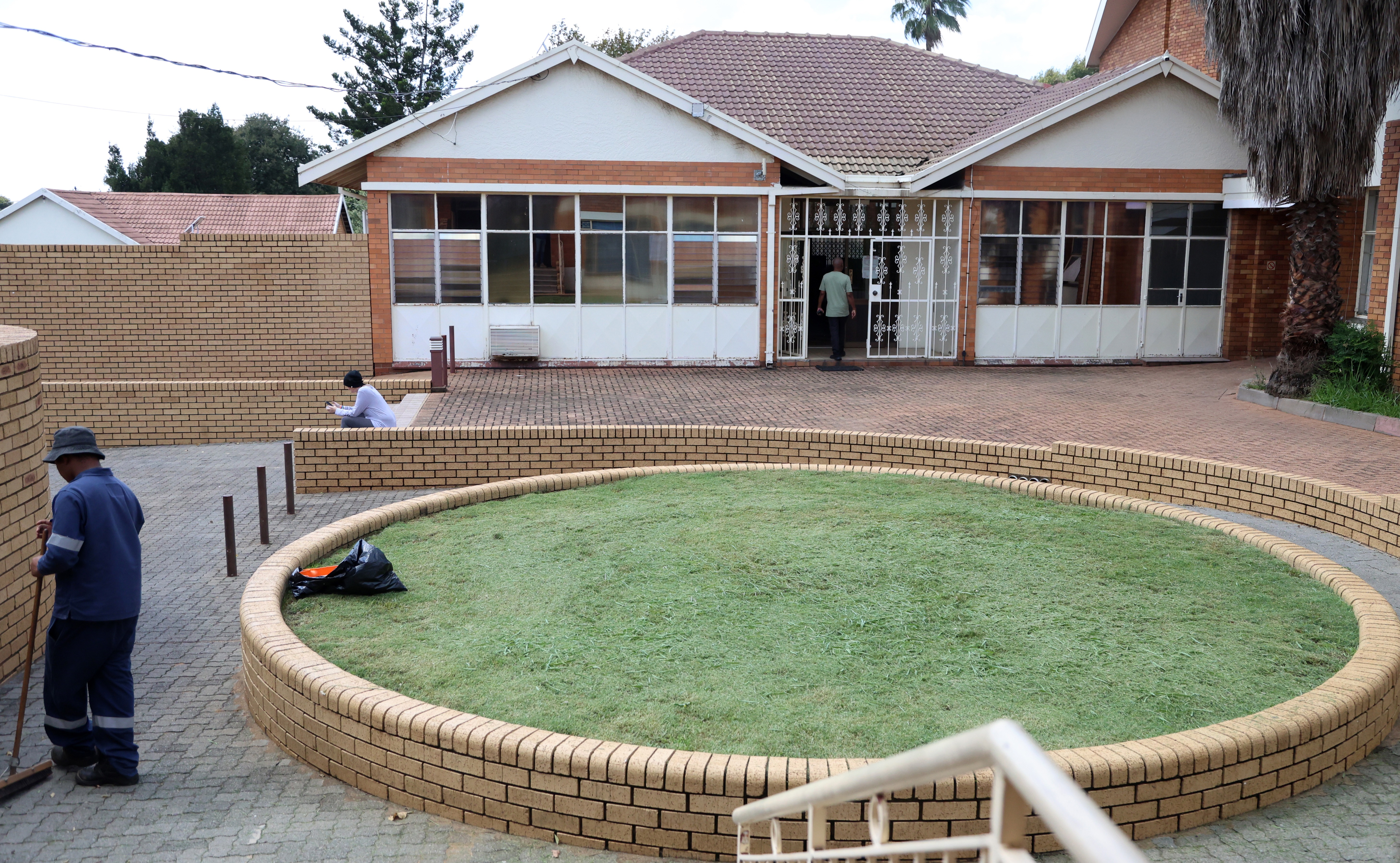
 Inside the Talisman Foundation, a Johannesburg psychosocial rehabilitation centre providing long-term care for people living with mental health conditions. (Photo: Felix Dlangamandla)
Earlier this week, the National Prosecuting Authority finally announced criminal charges against those responsible for the Life Esidimeni tragedy, which saw the Gauteng Department of Health (GDoH) move 1,711 patients into unvetted NGOs, resulting in 144 deaths and 44 missing persons.
At the same time, a potential new crisis is unfolding in Johannesburg that feels hauntingly familiar. With a 14 May eviction deadline looming for the Talisman Foundation, families and civil society organisations are sounding the alarm that the GDoH may be about to embark on another tragedy.

The Talisman Foundation is a psychosocial rehabilitation centre that specialises in the long-term care and treatment of people with mental health conditions such as bipolar mood disorder, depression and schizophrenia.
The Foundation’s 200 registered beds are supported by a 19-person clinical team, including a psychiatric nurse and social workers.
For 50 years, the Talisman Foundation has served as a pillar of Johannesburg’s mental healthcare landscape and is now facing a hurried dismantling.
/file/attachments/orphans/6I1A7237_515488.jpg "The reception area at the Talisman Foundation in Johannesburg. (Photo: Felix Dlangamandla)")
According to Timothy Makoni, the foundation’s financial manager, the property owner, the Old Apostolic Church, had initially offered Talisman the opportunity to purchase the building for R14-million during the Covid-19 period. However, the timeframe provided to secure the purchase was extremely limited, making it practically impossible for the foundation to raise the necessary funds.
Makoni explained that when Talisman later explored funding options, the asking price had escalated significantly to R30-million.
He further noted that efforts to renew the lease over time became increasingly difficult, with revised terms that were disproportionately weighted in favour of the property owner, leaving the foundation in a progressively more precarious position.
Makoni confirmed that there were 172 residents at the facility and that they were actively fundraising for their relocation.
/file/attachments/orphans/6I1A7296_751497.jpg "A view over the Talisman Foundation, a Johannesburg-based psychosocial rehabilitation centre providing long-term care for people living with mental health conditions. (Photo: Felix Dlangamandla)")
A rushed and opaque intervention
Rather than collaborating on a safe transition plan, GDoH has stepped in with an unannounced, fragmented approach that has deeply unsettled the facility.
Chairperson of the Talisman Foundation Jackie Tau said the NGO fully grasped the severity of the situation, but stressed that safely moving a vulnerable community required careful planning and extensive negotiation with patients’ families.
“The only solution we thought was appropriate was for us to be given enough time to look for an alternative building for all our residents,” Tau said.
Tau described the GDoH’s strategy as unclear and poorly conceived, explaining that health officials had drawn up a schedule to move roughly 64 selected residents in batches of five, while offering no clarity on the fate of the remaining patients.
He said the GDoH had shown little interest in negotiating with the landlord for more time.
“The GdOH says they are chasing the 14th of May; their worry is the termination of the lease, but Talisman’s worry is the livelihood of the residents,” he said.
/file/attachments/orphans/6I1A7271_724797.jpg "Staff work a busy kitchen while they prepare meals for residents. (Photo: Felix Dlangamandla)")
At risk: A ‘home away from home’
For Candice Perigadu, whose 60-year-old mother has battled bipolar disorder since she was 26, the Talisman Foundation marked the end of a decades-long search for adequate care. After years of misdiagnosis, her mother moved into the facility in 2023 and underwent a profound transformation.
“If I could explain it in one [sentence]: that is home away from home,” Perigadu said. When a family bereavement triggered a relapse, Talisman provided an extra caregiver, delivering around-the-clock support.
Perigadu recalled her mother’s initial reaction of shock and tears to the eviction notice, mourning the impending separation from a roommate who had become her closest confidante.
Beyond the social heartbreak, a relocation threatens to strip away structured activities, such as working as a machinist and a gardener, that gave Perigadu’s mother a vital sense of purpose.
“She knew that she could not live with normal people, because her normality was people like her. It created such a safe environment for her to be herself,” Perigadu explained.
Perigadu said taking her mother back home was not an option, as her children were in play therapy to process previous exposure to their grandmother’s illness.
“There is a huge concern and a fear of ‘What do we do then if they can’t find a place?’ Because I’ll be putting my children’s lives at risk, financially I’m not in a position to pay the extra costs, and I’m not equipped to handle a relapse,” she said.
Mbali Tshabalala is concerned that the eviction threatens to erase the only period of stability her 40-year-old brother, Linda, has ever known. Diagnosed with bipolar II and psychosis in 2008, Linda spent more than a decade trapped in a cycle of denial, habitually throwing away his medication. That destructive pattern finally broke when he arrived at Talisman in 2021.
“He came home one day to explain to me what his condition is about, which is something he had never done before,” Tshabalala recalled.
/file/attachments/orphans/6I1A7317_253577.jpg "Pharmacy staff prepare medication for residents at the Talisman Foundation. (Photo: Felix Dlangamandla)")
As Tshabalala works night shifts, the facility is her only lifeline. Left at home, Linda struggles to maintain his strict daily medication schedule.
Tshabalala said she has no Plan B.
“It was such a struggle to find Talisman. He has made such good progress and a lot is at stake for those of us who have literally no one else,” she said.
This profound sense of displacement is echoed by the family of 35-year-old *David Lombard. Diagnosed with schizophrenia in his early twenties, his life was a tumultuous cycle of instability until he found the foundation, where he has lived for the past 12 years. Managed by his brother, *Derek from the UK, David’s care was anchored to the belief that his living situation was permanent.
“He refers to it as his home. He said to me, ‘This is my home. These are the people I know. This is the place I thought I was going to grow old in,’ ” recalled Derek.
/file/attachments/orphans/6I1A7242_178937.jpg "A resident reads a newspaper at the Talisman Foundation in Johannesburg, reflecting a quiet moment in daily life. (Photo: Felix Dlangamandla)")
Derek attributes his brother’s decade of stability directly to what he describes as a phenomenal bond with a specific facilitator at Talisman.
“I’m in charge of my brother’s care since my parents passed away, and I don’t know what I would do without her [the facilitator],” Derek said.
“She knows how to hold a firm line with him, but there is a deep sense of care. You can’t just transfer that kind of trust to a new facility in 90 days. You are pulling the rug out from underneath someone whose entire stability is built on that trust.”
/file/attachments/orphans/6I1A7229_482407.jpg "Residents move along a corridor at the Talisman Foundation. (Photo: Felix Dlangamandla)")
Legal red flags
Asiphe Funda, an attorney at public interest law centre SECTION27, said that there had not been any meaningful consultation with the Talisman Foundation.
She said the foundation had contacted the GDoH, informing the department that it was searching for new premises, but stressed the logistical impossibility of finding a fully licensed facility within a three-month window.
“From the 4th of February up until mid-March, the GDoH started going to the Talisman Foundation daily, and in this process, they requested access to patients’ files and started interviewing patients for relocation. That has caused panic,” said Funda.
She noted that a psychologist at Talisman formally warned the department that the process had already led to regression in several patients.
Crucially, Funda pointed out that the 14 May date was merely a letter of notice from the property owner, not a legally binding court order.
Funda said one of the most alarming aspects was that the department’s proposed list of alternative NGOs raised red flags, as two of those facilities had the same names as facilities implicated in the Life Esidimeni tragedy.
‘Give us 12 months’
When stakeholders pressed the department for clarity, the responses were vague.
“They could not confirm whether or not it’s the same facilities, and when we asked if inspections had been done, how site visits were conducted, and how facilities were vetted, they [weren’t] able to furnish the Talisman Foundation or us with that information,” Funda said.
Funda explained the legal obligations of the GDoH, noting that while the NGOs operated autonomously, the state retained the primary constitutional and statutory duty to care for these vulnerable individuals.
“It’s the department that doesn’t have facilities for mental healthcare patients, and that is the void that is filled by the NGOs,” she said. Because the government funds these organisations to act on its behalf, the department is legally compelled to intervene in a way that safely resolves the matter.
SECTION27 has contacted the landlord directly, pointing to South African eviction laws that carefully balance a landlord’s property rights with the necessity of securing alternative accommodation for vulnerable groups.
“This is not to say it is to deprive that landlord of its property, but just to say, give us 12 months,” Funda said, explaining that a year was a realistic timeframe needed to secure compliant facilities.
“After Life Esidimeni, the Health Ombud cautioned against uncoordinated and hurried relocation of patients, and particularly mass relocations,” she said.
The Health Ombud report also stated that proper deinstitutionalisation required that primary and specialist community-based mental health services be developed, adequately resourced, and budgeted for before patients were moved.
‘An earthquake, a volcano or a bomb’:
The circumstances for a rushed relocation
Professor Lesley Robertson, an adjunct professor in the Department of Psychiatry at the University of the Witwatersrand, spoke in her individual capacity from her experience as head of the community psychiatry clinical unit at Sedibeng District Health Service. She outlined why the proposed relocation was so dangerous.
The nature of severe mental illnesses, such as schizophrenia or bipolar disorder, she said, lay in their profound disabling effects. These conditions impaired a patient’s ability to plan, problem-solve, work, as well as their attention, concentration, working memory and social cognition.
Because of these functional impairments, people with mental illness required safe, structured, humane living conditions. While families would ideally provide this, the reality of family stress related to poverty, substance abuse and emotional instability often triggered relapses at home.
Because of this, the GDoH relies heavily on licensed NGOs.
/file/attachments/orphans/6I1A7268_735235.jpg "Residents queue for lunch, part of the daily rhythm at the care facility. (Photo: Felix Dlangamandla)")
For a person with severe psychosocial disability, an abrupt move could completely destabilise their fragile mental state.
“The reason that they’re needing all this help is that’s where the impairment in functioning is stemming from, it’s how the brain processes stress, change and emotions. That period of adjustment requires an intense control of emotions which might not be within the capacity of the individual, so they would really feel that change of environment,” Robertson explained.
The loss of a structured environment could cause patients to become uncontained, which could result in their hurting themselves or others and necessitating hospitalisation.
When asked under what circumstances a fragmented, rushed relocation would be justified, Robertson was blunt: “If there’s an earthquake, a volcano, or if a bomb had to drop on them. It’s got to be something of that magnitude.”
She advocated for a “Critical Time Intervention” model used in Brazil, which took a minimum of nine to 12 months to safely transfer patients. “You can’t just put a person from one high level of care into a much lower level of care. The actual level of care needs to be transferred as well,” she stressed.
Department outlines strategy
In response to questions, the GDoH stated that it had introduced a “structured and clinically supervised process” to relocate mental healthcare users safely.
“The department wants to assure the public that this process is being managed strictly in accordance with legislative and policy frameworks, with careful attention to the lessons learned from the Life Esidimeni tragedy,” read the statement.
The GDoH said there would be no mass or uncoordinated movement of patients, insisting that all relocations would be conducted in a controlled, phased and clinically supervised manner to safeguard patient safety and dignity.
To ensure continuity of care, the department outlined a contingency plan that included the formation of a multidisciplinary task team, conducting individual clinical and psychosocial assessments of all residents, and identifying suitable placements within other licensed state facilities. The department added that, where clinically appropriate, it was also considering family reintegration.
In the interim, the GDoH has halted all new admissions to stabilise operations and committed to paying Talisman’s subsidy until every resident was safely relocated.
The department noted that Talisman Foundation remained an independent organisation and should the NGO successfully secure new, compliant premises on its own, all efforts would be made to ensure the speedy consideration of a licence application.
The landlord’s response
According to its official website, the Old Apostolic Church is a global Christian denomination with a vast footprint incorporating over 1.81 million members and 7,000 congregations across 25 countries.
The Old Apostolic Church responded through its legal representatives, Boela van der Merwe Attorneys, stating that a formal process was under way in accordance with the lease agreement, that the church remained fully compliant with its obligations, and that GDoH was first alerted to the cancellation in November 2025.
The firm described further comment as “premature” while the process was ongoing, stating that the church would not provide information or statements while the matter remained sub judice.
The law firm said that should “any negative publications or press releases” be made about the church, it held instructions to approach the high court on an urgent basis to interdict the publication, demand a formal apology and seek punitive costs.
‘Never again’
Outside the Talisman Foundation building hangs a plaque dedicated to the victims of the Life Esidimeni tragedy. The plaque bears the words: “Never again shall the rights of mental healthcare patients be denied.”
/file/attachments/orphans/6I1A7214_620462.jpg "A plaque at the Talisman Foundation in Johannesburg, a space for healing, care and long-term mental health support. (Photo: Felix Dlangamandla)")
For the Talisman Foundation, these words represent a daily commitment to ensure that the dignity, safety and wellbeing of every resident remain at the centre of all decisions affecting their care and placement.
With specialised licensed beds already a limited resource, the removal of 200 more beds creates a void that the province cannot fill.
“We do not have enough hospitals, and we do not have enough NGOs as it stands. Talisman Foundation is a long-standing, high-quality NGO. This is disastrous. It’s simply disastrous. It’s created a huge crisis for these individual people and for our health system,” said Robertson. DM
*Names changed to protect privacy.
Comments
Scroll down to load comments...