



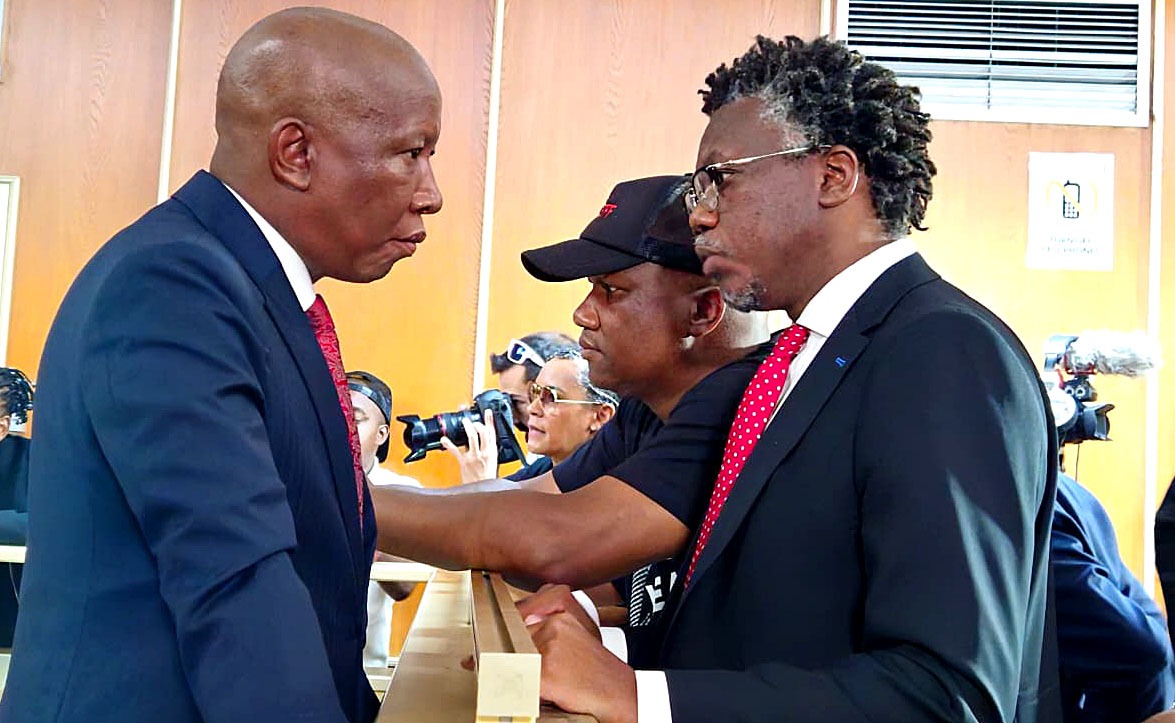
 EFF leader Julius Malema (left) and the party’s secretary-general Marshall Dlamini (centre rear) discuss matters with advocate Tembeka Ngcukaitobi SC (right) at the East London Magistrate’s Court before Malema’s sentencing hearing on 15 April 2026 in KuGompo City, Eastern Cape. (Photo: Andisa Bonani) 15 April 2026
EFF president Julius Malema told supporters outside the East London Magistrates’ Court that efforts to imprison him were part of a broader attempt by “capital” to silence radical voices in South Africa.
He said his vision of economic freedom would not be silenced, even if he were to be jailed.
Malema was addressing scores of EFF supporters after the first day of sentencing proceedings, during which the State and defence presented their arguments. The magistrate is expected to deliver judgment on Thursday (16 April 2026).
“When we grew up, persecution has always been part of our lives, capital wants to use us to silence the dejected masses of our people, we know what is at play, we are not in doubt that capital has a central role in trying to silence the radical voice in SA,” he told the crowd.
“They use us to show that whoever dares to speak truth to power must be jailed; we shall not be silenced under any circumstances. They can imprison me, but they will never imprison my ideas. They will never suppress the idea of economic freedom in our lifetime.”
Scores of EFF supporters and Malema backers turned the streets of KuGompo City (formerly East London) red as they gathered ahead of his sentencing on Thursday. The State is seeking a 15-year custodial sentence.
/file/attachments/orphans/ED_604154_568222.jpg "Members of the SAPS control EFF supporters as leader Julius Malema arrives at East London Magistrates’ Court for sentencing proceedings on 15 April 2026. (Photo: Gallo Images/Randell Roskruge)")
Party members gathered outside the court singing and chanting the controversial “kill the boer, kill the farmer” slogan after marching from Jan Smuts Stadium, where they held a night vigil on Tuesday ahead of the court proceedings.
Proceedings began with State prosecutor Joel Caesar, who argued that Malema had to be jailed because he testified to having planned to possess two firearms in a condensed gathering of 20,000 people.
Caesar based his argument on four matters, which he said called for imprisonment.
‘Premeditated conduct’
He told the court that the most aggravating feature of the case was that Malema’s conduct was not spontaneous, impulsive or accidental.
“It was planned, deliberate and executed with precision. The accused (Malema) himself testified under cross-examination that the decision to discharge the firearms was a collective decision of the EFF leadership and was planned to entertain the crowd and ensure that they were not bored, when he said: ‘Everything was perfect and calculated and designed to be the way it was done.”
Caesar submitted that the act was not a lapse in judgement, but a carefully staged act, deliberately executed by a trained and experienced political leader who knew the event would be attended by thousands of supporters.
‘Live rounds among 20,000 people’
The prosecutor said the sheer scale and volume of Malema’s conduct was a powerful aggravating factor.
“The accused discharged approximately 15 shots from a 9mm handgun, followed by a further seven shots from a semi-automatic assault rifle. The Remington round, discharged into the air in a built-up area, retains lethal kinetic energy on descent. The potential for mass casualties was real, foreseeable, and scientifically established.”
He argued that the Sisa Dukashe Stadium, situated in Mdantsane, where EFF supporters had gathered in 2018, was a densely populated residential area.
“The risk to people in the surrounding community – not only the 20,000 in attendance, but also residents in the immediate vicinity, was extreme. That no one was killed or seriously injured was a matter of fortune, not mitigation.”
‘The role model that should have been’
Caesar argued that Malema set a precedent for Bitou municipality mayor Nokuzola Kolwapi, who was seen discharging a firearm during a celebration marking the return of her son from ulwaluko, a sacred Xhosa initiation ceremony marking the transition into manhood.
He said Malema, a member of Parliament and the founder and president of the EFF, commanded the loyalty and admiration of millions of South Africans, many of whom regarded him as a transformative leader.
/file/attachments/orphans/ED_604115_158672.jpg "EFF leader Julius Malema in the dock at East London Magistrates' Court for sentencing proceedings on 15 April 2026. (Photo: Gallo Images / Randell Roskruge)")
“This status is not a mitigating circumstance, it is a significant aggravating factor. The accused’s conduct conveyed to 20,000 supporters and, through video footage widely circulated thereafter to the nation at large, that the public discharge of a semi-automatic rifle is an acceptable and exciting form of political celebration.”
Caesar said the implicit endorsement of firearms as instruments of political theatre by a national leader was a harm that transcended the immediate physical risk of the discharge.
“This court is therefore called upon not only to punish the accused for his individual conduct, but to vindicate the constitutional principle that public office and political prominence do not confer immunity from criminal sanction.”
‘No show of remorse’
The prosecutor said Malema had maintained that he committed no offence despite being convicted after a full trial.
“[He] described these proceedings as an abuse of the NPA resources, an incompetent prosecution and attributed the undisputed discharge of 22 live rounds to a political vendetta by AfriForum and others, including the President of the Republic, racism and even the holy spirit. He showed no insight whatsoever into the grave danger he created for 20,000-plus people and the surrounding residential community.”
The charges date back to 2018 when Malema was attending the EFF’s fifth birthday celebrations at the Mdantsane stadium.
The court found that he had taken an assault rifle from his former bodyguard, Adriaan Snyman, and fired several shots into the air during the event.
The court rejected Malema’s claims that the assault rifle was a toy and fired blanks. He was found guilty of several crimes, including unlawful possession of a firearm, unlawful possession of ammunition, discharging a firearm in a built-up area or public place and reckless endangerment of people or property.
/file/attachments/orphans/ED_604136_765562.jpg "EFF leader Julius Malema in the East London Magistrates’ Court for sentencing proceedings on 15 April 2026. (Photo: Gallo Images / Randell Roskruge)")
Co-accused’s firearm returned
Malema’s defence lawyer, advocate Tembeka Ngcukaitobi SC, took issue with how Malema’s co-accused, Snyman, who has since been acquitted, was handed back his firearm before the judgment was delivered.
“What happened here is that the prosecutors, in their own showing, agreed with one of the accused persons to take the firearm before the judgment was given. This raises profound questions about the propriety of the conduct of the prosecutors; they admit they sent an email stating that if he’s acquitted, he may collect his firearm, whereas the provision of Section 32 of the Criminal Procedure Act states that the judge/ magistrate who presides may make that order.”
Ngcukaitobi argued that the return of the firearm to its owner meant the State did not take the matter seriously.
“The State says there are emails that were exchanged, but they have not been produced as evidence. We submit, therefore, that there is a potential irregularity which flows from the non-compliance with Sections 34 and 35. It shows that the State did not regard the offence as serious, otherwise why would you return the instrument of the commission of the offence prior to the delivery of the judgment? This is relevant to the sentencing.”
‘Evidence misread’
He said it had to be looked at closely as to why the State wanted Malema to be incarcerated, as clarified in Caesar’s supplementary heads of argument.
“The first is the idea of premeditation. It seems they actually misread the evidence because the planning Malema talked about was the actual celebratory event and not the commission of the offence.”
Ngcukaitobi said Malema was convicted for firing a bullet, and not the 22 rounds stated by Caesar.
“The State hinges its case on the premeditation, but if the basis of the premeditation is a misconstrual of the evidence, the magistrate can discard it. They overlook the fact that we are talking about one bullet. The second reason for the State to want to send Malema to jail is about two firearms. We don’t understand why they say this because the actual court findings don’t say this at all; it’s the wish of the State. The findings talk of a firearm and not two.”
/file/attachments/orphans/ED_604131_147583.jpg "Supporters outside the East London Magistrates’ Court during EFF leader Julius Malema’s appearance for sentencing on 15 April 2026. (Photo: Gallo Images / Randell Roskruge)")
He said they faced a similar issue in which the State distorted the findings to build a narrative. Ngcukaitobi said that, on the court record, there was a disjuncture between what the State was arguing and what the court had found.
“You can send a man to prison for reasons the judge did not find him guilty of. The correct finding is one bullet in a stadium of 20,000 people. Now ask yourself, in those circumstances, should someone be sent to prison?” Ngcukaitobi argued.
“It’s absurd that they want him to be jailed for 15 years. It’s a game they’re playing to inflame the passions of the public.”
Regarding Malema’s public standing as a role model, Ngcukaitobi said that while public figures should be good examples in society, Malema had to be looked at differently.
“The State says Malema is special, and that’s why he deserves a harsh punishment, but we are saying he must be treated as per the Constitution that says everyone is equal before the law. What we have here is a State that keeps changing its case depending on what it wants to achieve at a particular point.”
Ngcukaitobi said they had taken into account that Malema should bear responsibility as a leader in society, but it had to be done fairly, without fear or favour, and that did not constitute imprisonment. DM
Comments
Scroll down to load comments...