




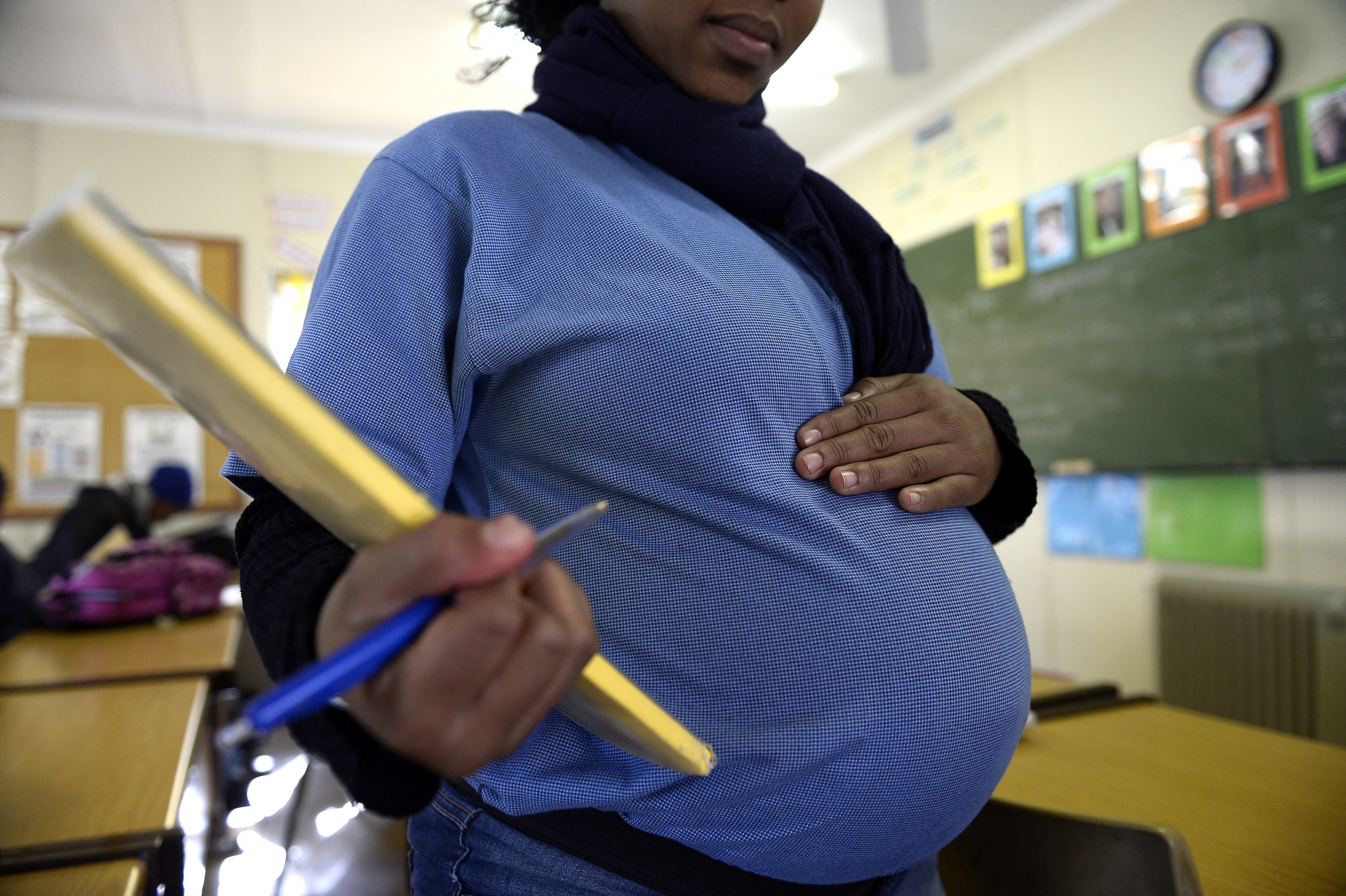
 A pregnant pupil at the Pretoria Hospital School specialised in teenage pregnancy. It is a public school opened in 1950 and originally dedicated to sick children. (Photo: Stephane de Sakutin / AFP)
A positive pregnancy test has historically brought an abrupt end to a young girl’s high school career in South Africa — often leading to quiet expulsions, unbearable stigma and a permanent exit from the education system.
The Department of Basic Education is seeking to change that permanently with new draft regulations that propose an ironclad academic safety net, mandatory reporting laws involving the police and social services, and replace punitive measures with mandatory, individualised support plans.
Minister of Basic Education Siviwe Gwarube emphasised that South Africa has made significant progress in protecting the rights of pregnant learners.
“We have moved away from a painful past where young girls were expelled or forced out of school due to pregnancy; these practices contributed to alarmingly high dropout rates. These regulations build on that progress and reaffirm our commitment to dignity, inclusion and equal opportunity,” she said.
The government gazetted the proposed regulations on the management of pupil pregnancy in schools on 25 March and is open to the public for comment until 24 April.
A two-tiered blueprint for support
The primary goal of these mandates is to ensure pregnant learners and young mothers can continue their education in a supportive, stigma-free environment without fear of expulsion. To achieve this, the regulations establish a two-tiered support system that includes district-based and school-based support teams.
The district-based support teams have four primary roles under the regulations:
- They must take reasonable measures to protect the learner’s right to basic education. When necessary, they are responsible for advising on alternative methods to reasonably accommodate the learner both during her pregnancy and after childbirth.
- They are required to equip school-based support teams with training on these specific regulations.
- They must lead and oversee the overall process of managing learner pregnancies by mobilising resources and support to schools. This ensures that schools can provide access to professional advice, referrals and services.
- They must support schools in strengthening their referral processes to connect with social and health sector partners, as well as nongovernment organisations.
The School-Based Support Team is responsible for coordinating a multi-sectoral response to manage a learner’s pregnancy, including:
- Working with the principal to develop and regularly review an individualised care, counselling, and support plan for the expecting learner.
- Connecting the learner to school nurses or health facilities for antenatal/postnatal care, and to social workers for psychosocial support.
- If the biological father is also a learner, the team must refer him to the Department of Social Development for further guidance.
- Packaging all homework, classwork and assessments to ensure the learner’s education is not interrupted during any pregnancy-related absences.
Holding offenders accountable while protecting the learner
The draft regulations establish non-negotiable reporting protocols to protect vulnerable learners and hold offenders accountable, while strictly safeguarding the young mother’s privacy.
Depending on the circumstances, the policy mandates specific, immediate action:
- If the pregnant learner is under 16: The pregnancy is treated as a statutory issue and must be reported immediately to the South African Police Service (SAPS) and the Department of Social Development (DSD).
- If the father is a fellow learner: The School-Based Support Team must be informed. Their responsibility is to refer him to the DSD so he can receive appropriate guidance and support.
- If the father is a staff member: Whether an educator or non-educator, the school must report the incident to SAPS, DSD, Clinical Forensic Medical Services, the South African Council of Educators (Sace) and the provincial education department’s Employee Relations Directorate.
- If the father is an outside adult: The school is required to report the incident to SAPS, DSD and Clinical Forensic Medical Services.
The regulations strike a careful balance between these mandatory reporting duties and the student’s right to privacy. While schools must notify authorities when these criteria are met, educators are strictly prohibited from interrogating the learner or pressuring her to reveal the identity of the father.

Ensuring academic continuity for expecting learners
Under the draft regulations, schools are required to provide several specific academic and physical accommodations to ensure that a pregnant learner can continue her education. These accommodations include:
- Schools must modify furniture, facilities and equipment to ensure the learner can attend classes safely and comfortably.
- The School-Based Support Team must package all classwork, homework and assignments for the learner. During extended absences, the principal must track missed content against Annual Teaching Plans and ensure parents receive all the necessary study materials and lesson notes.
- School-based assessment tasks must continue whether the learner is at home or at school, and the school is required to provide written notice of all formal test and examination dates.
While expecting mothers are generally expected to write in standard exam rooms, schools must provide alternative arrangements if so dictated by a medical professional. The regulations outline strict protections for final exams:
- Grades 4 to 11: If a valid medical report prevents a learner from completing her end-of-year exams, her final grade must be calculated using her existing continuous assessment and practical marks.
- Matric (NSC) candidates: A principal is strictly barred from deregistering an NSC candidate. If a matriculant is declared medically unfit or her final exam is disrupted by her pregnancy, she is guaranteed the right to write the next officially scheduled exam.
What principals must do
The school principal is the primary authority responsible for implementing these regulations on the ground. Their core duties include:
- Confidentially tracking the learner’s absences and their return to school on the SA-SAMS system to protect her privacy.
- Proactively connecting the learner with clinics for antenatal care and social workers for psychosocial support.
- Collaborating with parents and the school support team to draft an individualised support plan, and arranging the necessary study materials to cover missed coursework during extended absences.
- Securing safe exam accommodations, managing medical emergencies and ensuring that no NSC candidate is ever deregistered.
- Fulfilling the legal obligation to report cases of statutory rape or staff involvement directly to the police and social services.
Stakeholders weigh practical flaws and systemic discrimination
Although the new regulations aim to create a national standard of support, education stakeholders warn that the policy needs significant adjustments before it can actually work in schools.
Dr Juane van der Merwe-Mocke of the Federation of Governing Bodies of South African Schools (Fedsas) says the organisation broadly supports the objective of safeguarding a learner’s right to basic education.
However, she expressed concern that the draft expects too much of school staff.
“While the draft does provide for referrals and support structures, it should more clearly and consistently emphasise that educators and school staff are not trained health practitioners, social workers or therapists,” Van der Merwe-Mocke said. While schools should play a supportive and coordinating role, she said that necessary professional interventions had to remain the strict responsibility of appropriate health and social service providers.
The organisation notes that the regulations need to better recognise the role of School Governing Bodies (SGBs), who are ultimately left to manage the resources, support measures and practical policy implementation at the school level.
The draft, Van der Merwe-Mocke concluded, must be strengthened to make it more legally sound, more practical and more responsive to the realities facing schools.
According to Pila-sande Mkuzo, an attorney at the Equal Education Law Centre (EELC), schools are still actively finding ways to push pregnant learners out of the system, despite previous national guidelines.
Mkuzo notes that the EELC’s advice clinic continues to field cases of blatant, unlawful discrimination.
“These include SGBs adopting pregnancy policies that provide for the automatic exclusion of pregnant learners,” Mkuzo said.
Other punitive tactics employed by schools include refusing to readmit a learner in the year she falls pregnant, demanding medical emergency deposit fees, and even forcing parents or guardians to chaperone the pregnant learner at school every day.
Mkuzo hopes the strict new framework will finally give substance and meaning to the rules, ensuring pregnant learners can remain in and return to the classroom without fear of bullying, victimisation, discrimination or expulsion.
Daily Maverick reached out to the South African Democratic Teachers’ Union (Sadtu) for its stance on the draft regulations. The union had not responded by the time of publication.
How to submit comments
Written submissions on the draft regulations must be addressed to the Director of Legal Services and marked for the attention of advocate Zukile Ntshwanti. You can submit your comments via one of the following methods:
- Email: LearnerPregnancyRegs@dbe.gov.za
- Hand delivery: Department of Basic Education, 222 Struben Street, Pretoria, 0001
- Post: Private Bag X895, Pretoria, 0001 DM
Comments
Scroll down to load comments...