




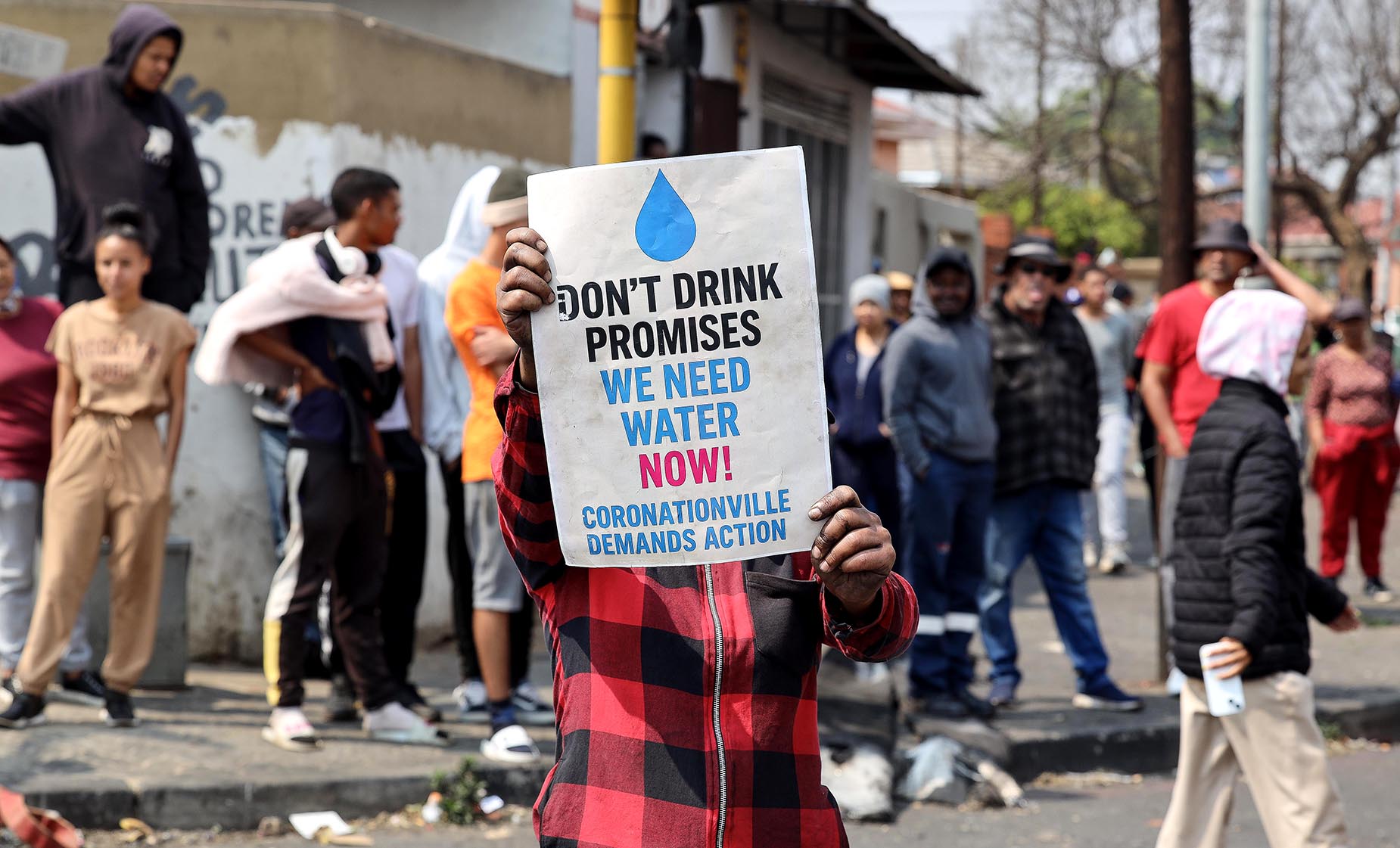
 Coronationville residents protest against water shortages on 10 September 2025. They had reportedly been demonstrating for weeks. Several people were hit by rubber bullets as police tried to disperse the crowd after the protest turned violent and chaotic. (Photo: Gallo Images / Fani Mahuntsi)
Gauteng residents have contended with a prolonged water crisis for years, which has left many residents and businesses with intermittent access or completely dry taps.
The crisis has forced many of the province’s residents to turn to alternative sources, such as boreholes, led to a dependence on water tankers in some communities and, for the most vulnerable and underserved, a reliance on unsafe water sources.
/file/attachments/orphans/ED_381138_866644.jpg "Finetown residents are forced to queue for water from tankers on 23 May 2022. The area had reportedly not had running water for a week. (Photo: Gallo Images / Fani Mahuntsi)")
The South African Human Rights Commission (SAHRC) has taken notice, and following a large volume of complaints about persistent and widespread water shortages, infrastructure failures, governance challenges and recurring service delivery disruptions, it has initiated an investigative inquiry into the water crisis in the province.
Section 27 (1)(b) of the Constitution guarantees that everyone living in South Africa has the right to access water and mandates that the state take reasonable legislative and other measures to achieve the progressive realisation of this right. But for many on the ground, this is not the reality.
“These challenges have had a disproportionate impact on poor and marginalised communities, residents of informal settlements, schools, healthcare facilities and social care institutions. Thus undermining dignity, health, safety and access to basic services,” the commission said.
“Where access to water is unreliable, unsafe or structurally unequal, the consequences extend beyond service delivery failure and constitute a direct threat to the enjoyment of fundamental human rights, including dignity, equality, life, health and an environment not harmful to health or wellbeing.”
The commission added that the crises raised obvious concerns that systematic human rights violations are taking place and it had therefore “deemed it appropriate, in the public interest to conduct a formal inquiry”.
/file/attachments/orphans/ED_584981_196695.jpg "Residents protest against the water crisis outside the Johannesburg Council Chambers on 1 November 2025. They demanded urgent action to end what they describe as a ‘human rights and economic emergency’ caused by the worsening water crisis, as well as accountability, transparency and dignity in the city’s water system. (Photo: Gallo Images / Fani Mahuntsi)")
Among other things, the inquiry aims to:
- Assess the extent, nature and root causes of water access challenges across Gauteng, including infrastructure failures;
- Assess the impact of the water crisis on the enjoyment of fundamental human rights, particularly for vulnerable and marginalised communities;
- Determine whether the current state of affairs constitutes a systemic human rights violation, and whether any limitation of rights is justifiable;
- Examine whether state actors have taken reasonable and adequate steps to progressively realise the right of access to sufficient water;
- Assess governance, planning, budgeting, infrastructure management and emergency response systems; and
- Make findings, recommendations and directives aimed at addressing systemic failures and securing sustainable access to water.
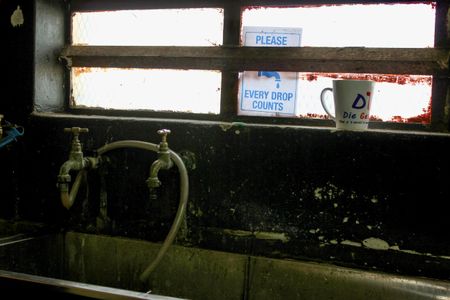
The water tanker mafia
The SAHRC added that, beyond an infringement of constitutionally enshrined rights, the water crisis has produced secondary systemic harms, resulting in the emergence of the water tanker mafia, which the rights body describes as “informal and exploitative”.
The mafia emerged as a result of municipalities’ use of private water tankers in areas experiencing water interruptions. What was meant to be a stopgap measure has resulted in the emergence of criminal networks that often obtain tenders through corruption, engage in vandalism of water infrastructure, thereby exacerbating the crisis, and illegally charge residents for access to municipally supplied water.
/file/attachments/orphans/IMG-20260210-WA0010_956997.jpg "Residents of the Waterworks informal settlement near Lenasia scramble to fill their containers. The area has not had running water since it was established. Residents depend entirely on delivered water. (Photo: Supplied)</p>
<p>")
“Prolonged and recurring water outages have created dependence on unregulated private water tankers, entrenching inequality, profiteering and commodification of a constitutional right,” the commission added.
This week, Daily Maverick reported that the Department of Water and Sanitation was encouraging municipalities to insource water tankers to minimise opportunities for corruption.
While the SAHRC published a policy document detailing how the government could tackle the water mafia, the water crisis inquiry will also seek to examine the emergence and the impact of the water distribution economy and tanker dependency.
Have your say
The commission is calling on all stakeholders affected by the water crisis in Gauteng to make written submissions to the rights body.
Whether you live in an area affected regularly by unreliable or no water access, a civil society organisation, a researcher, activist or even a government or municipal worker, submissions are open to the entirety of South Africa.
Reports may include information on the causes of the identified challenges, the impact of the water crisis on affected communities, existing responses and interventions, and proposed steps for addressing the crisis.
Interested parties have until 30 April 2026 to make written submissions, which can be dropped off at the SAHRC Gauteng offices or emailed to the commission.
Physical address:
Gauteng Provincial Office, 4th Floor, Sentinel House Office Park-32 Princess of Wales Terrace, Parktown, Johannesburg.
E-mail: gpwaterinquiry2026@sahrc.org.za
The inquiry is set to take place from 19 to 21 May after the commission has evaluated the submissions. It said it will use its discretion to invite selected stakeholders to make oral submissions at the inquiry. DM
Comments
Scroll down to load comments...