




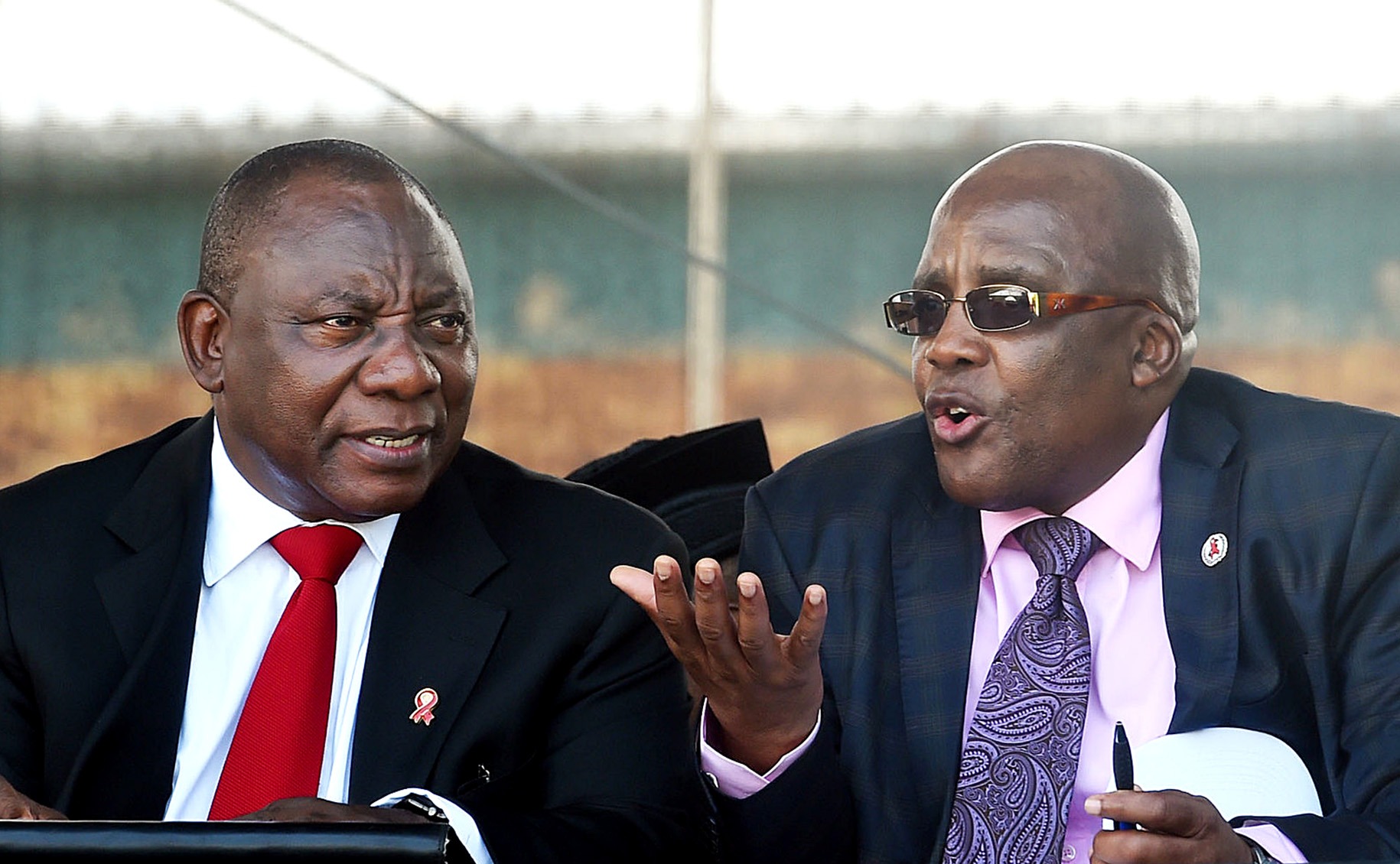
 President Cyril Ramaphosa and Minister of Health Dr Aaron Motsoaledi. (Photo: GCIS)
The mood music from the national Department of Health hasn’t been good for some time.
The department hasn’t got a clean audit in any of the past five years. The Digital Vibes scandal, a disputed oxygen tender in which the department had some involvement, and the recent suspension of the director-general and chief finance officer, have all raised red flags.
There has also been a lack of incisive leadership and coherent long-term planning on urgent crises like the shortage of healthcare workers in the public sector. The ball has been dropped on cost-containment and regulation of the private healthcare sector – recommendations from the Health Market Inquiry published in 2019 have largely been left on the shelf. Low-hanging fruit, like fixes to regulations determining who can and cannot prescribe different schedules of medicine, have seemingly been ignored.
The national Department of Health is a big organisation, and like any big organisation it needs good management to thrive and fulfil its mandate. The evidence we can see from the outside, and some accounts we’ve had from people working in and with the department, all suggest that things haven’t been running smoothly for some time. Which is not to say there aren’t several committed and capable people in the department – there are and we’ve often reported on their work – it is just that they often seem to be swimming against a tide of institutional dysfunction.
The roles here are worth stating clearly. While the minister of health should shape health policy direction and make the big picture decisions, the responsibility for managing the department day to day and accounting for its finances sits with the director-general of health. A useful shorthand is to think of the minister as the chairperson of the board, while the director-general is the CEO. Ministers are politicians, directors-general are managers of organisations.
Charged and suspended
In March, it was announced that Dr Sandile Buthelezi had been placed on precautionary suspension from the position of director-general for health. It followed him being charged with fraud, theft and contravention of the Public Finance Management Act (PFMA). Chief Financial Officer Phineas Phaswa Mamogale and Deputy Director-General for Tertiary Health and Hospital Services, Dr Malixole Percival Mahlati, are also facing charges of fraud and theft and have also been suspended. The Hawks are also reportedly investigating Buthelezi for accepting a bribe. Hopefully the law will run its course and we will get clarity on whether or not Buthelezi is guilty of any offences.
Buthelezi was appointed to start as director-general in June 2020 when Dr Zweli Mkhize was SA’s minister of health. Even though the president appoints directors-general, we suspect that Mkhize hand-picked Buthelezi and that President Cyril Ramaphosa went along with it. Buthelezi and Mkhize had previously worked together in KwaZulu-Natal. Buthelezi was also previously the CEO of the South African National Aids Council, where Ramaphosa would have encountered him in his previous role as deputy president.
There is an impression in some health circles that Buthelezi was a yes-man who almost always went along with the minister’s wishes. The lack of clean audits, the various charges and investigations, and hearsay from various sources suggests that governance under Buthelezi wasn’t great – although we admittedly don’t have a full picture since we are not in the department.
More than one person has remarked to us that they miss the days when Malebona Precious Matsoso was director-general for health.
Mkhize’s resignation was forced in August 2021 by a Special Investigating Unit report on the Digital Vibes scandal, but Buthelezi stayed on after he was cleared in a disciplinary inquiry.
Directors-general are appointed for five years at a time, so Buthelezi still had some time on the clock when Dr Aaron Motsoaledi returned as minister of health after the 2024 elections. As we argued at the time, Motsoaledi, more than most ministers, needs to work with a director-general who can tell him “no” when the situation demands it and protect the department from being distracted from its core functions by the political winds of the day. From what we’ve heard, Buthelezi was not that kind of director-general. Maybe then it is not surprising that his contract was extended for a year – it would originally have ended in May 2025.
Buthelezi will almost certainly remain suspended until his extended contract ends at the end of May 2026. In the meantime, Dr Nicholas Crisp has been appointed as the acting director-general of health for a period of three months.
Are we building a capable state?
The position of director-general for health was recently advertised with an application deadline of 30 March. Given Crisp’s three-month appointment, it will probably be a while before we’ll know who the new director-general will be.
As with any organisation with serious problems, the appointment of a new leader provides a unique opportunity to turn things around. Appoint the right person and the department can start a meaningful process of professionalising and building capacity. Appoint the wrong person, and the department is doomed to another five years of muddling along, or worse.
Much of the work of building a more capable state has to do with clarifying lines of authority and creating mechanisms that prevent undue political interference. In this regard, Ramaphosa’s recent signing of two public service reform acts into law is very welcome, but we need more. While appointing directors-general for long periods is good for stability, we need better mechanisms to remove underperforming ones – one idea is to explicitly tie annual contract renewals to the audit outcomes of their departments.
But legal and structural changes will only take us so far. A capable state will ultimately have to be run by capable people. There will no doubt be pressure on Ramaphosa to appoint this or that person because they are loyal ANC members or because the minister prefers him or her.
If Ramaphosa is serious about building a more capable state, and a more effective national Department of Health, he will not allow himself to be swayed by such insularity. Running an organisation such as the Department of Health is not only a job that affects the health of everyone in SA, both in the public and private sector, it is also just an extremely difficult job – it requires a world-class manager.
Ultimately, appointing the country’s top health official, and ensuring that the national Health Department functions better, is a life and death matter. Let’s hope that this time round the president treats it as such. DM
Marcus Low is the editor of Spotlight.
This piece was published by Spotlight – health journalism in the public interest. Sign up to the Spotlight newsletter.
/file/dailymaverick/wp-content/uploads/2024/07/Spotlight-logo-new.png)
Comments
Scroll down to load comments...