



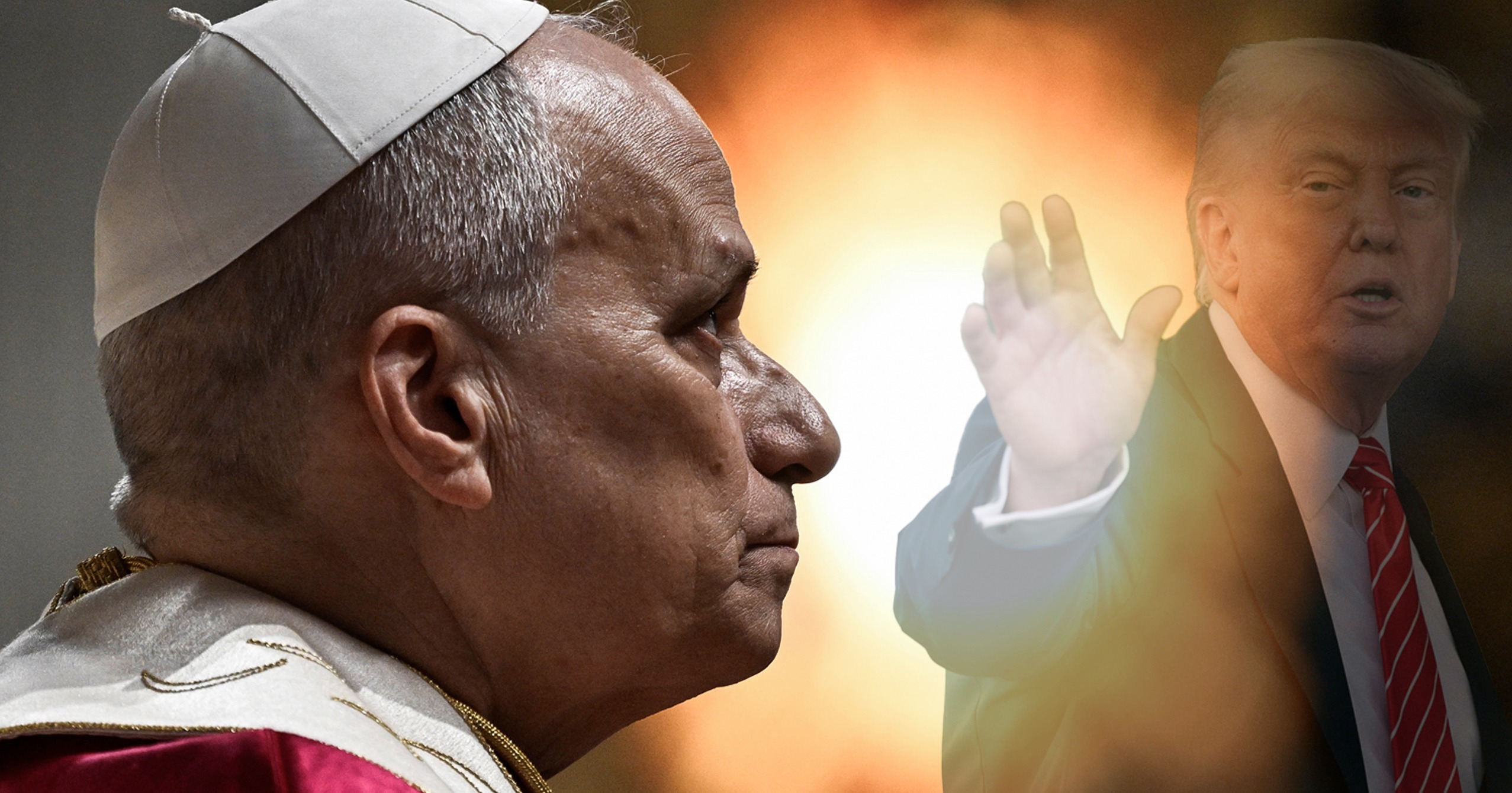
 Illustrative image | Pope Leo presides over a prayer vigil for peace in the world at St Peter’s Basilica in the Vatican City on 11 April 2026. (Photo: Simone Risoluti / Vatican Media via Vatican Pool / Getty Images) | US President Donald Trump speaks to reporters outside the West Wing of the White House on 8 May 2025. (Photo: Anna Moneymaker / Getty Images)
In a lengthy Truth Social post on 12 April 2026, Trump launched an extraordinary attack on Pope Leo XIV, the first American-born pontiff. Trump described the pope as “WEAK on Crime, and terrible for Foreign Policy”, accused him of “catering to the Radical Left” and insisted that Leo XIV should “get his act together as Pope… stop… focus on being a Great Pope, not a Politician”.
Moments after his ramble about Pope Leo, he also put an AI-generated picture of himself as Jesus on social media, which caused a massive backlash across the Christian world. He took it down later, claiming he thought it was him being a doctor for the Red Cross, and simultaneously bombastically said he would not apologise to the pope because the pope “said things that are wrong”.
The tirade was triggered by Pope Leo’s repeated calls for peace amid the US-Israeli war on Iran, which he has labelled “atrocious” and urged an immediate “off-ramp” to prevent further bloodshed. Trump, in an unhinged post, even claimed credit for Leo’s election, suggesting the conclave chose an American only to appease him. The nationality of the pope has nothing to do with how the cardinals of the Catholic Church elect a pope – even if Trump thinks it is about him.
The Church has always distinguished between the spiritual mission of the papacy and the temporal realm of politics. From the earliest centuries, popes have been shepherds, not senators. Vatican II’s Gaudium et Spes makes this explicit: the Church’s role is to interpret the signs of the times in the light of the Gospel, not to craft policy or endorse parties. The Gospel is at the centre of the pope’s response – one that popes proclaim in season and out of season, no matter who is war-mongering in the world.
Pope Leo has continued his predecessor, Pope Francis’s advocacy for peace, by insisting that the Church’s social teaching on war, poverty, migration and the dignity of every human person be clearly and unwaveringly articulated in a world where most national leaders are failing to offer a moral vision which seeks the way of dialogue and multilateralism. The teaching of the Church flows from the scriptures and the Church’s long tradition, not partisan ideology.
/file/attachments/orphans/GettyImages-2271129545_229882.jpg "Pope Leo responds to questions about US President Donald Trump’s recent statements during the flight to Algeria on 13 April 2026. (Photo: Simone Risoluti / Vatican Media via Vatican Pool / Getty Images)")
When Trump tries to demean the pope or demand he remain silent on foreign policy, he misunderstands the very nature of the papacy. History testifies that popes have always spoken prophetically when leaders pursue unjust violence. Pope John XXIII’s Pacem in Terris condemned the nuclear arms race during the Cold War. John Paul II condemned apartheid in South Africa and refused to officially visit the country. He opposed the 2003 Iraq invasion, warning it would destabilise the Middle East and cause untold suffering – we know now, 23 years later, that he was right. Pope Francis decried the wars in Syria, Ukraine and Yemen, calling each a “defeat for humanity”. The Church can never remain silent on racism, human rights abuses, injustice and war, no matter when or by whom.
Pope Leo stands in this unbroken line. His criticism of the Iran conflict is not “radical left” ideology; it is the consistent teaching of the Church that war must meet strict criteria of justice: legitimate authority, just cause, right intention, last resort, proportionality and reasonable chance of success. The current campaign, with its civilian casualties, infrastructure destruction and risk of regional escalation, fails these tests dismally.
Trump’s various framings of the war, as regime change or necessary self-defence against nuclear threats, have ignored the moral cost: once violence is unleashed, it spirals beyond control. Pope Leo has never denied legitimate defence; he has insisted that true security, the flourishing of people, flows from justice and dialogue, not from being an aggressor and opening the door to a perpetual war.
In response to Trump’s rant on social media, Pope Leo responded aboard the papal plane en route to Africa on Monday for his first papal trip to the continent. He delivered a calm, unwavering reply: “I have no fear of the Trump administration or of speaking out about the message of the Gospel… We are not politicians. I do believe in the message of the Gospel as a peacemaker.”
This exchange confirmed that he is not and will never be a politician. He is a spiritual leader, and therefore, when heads of state embark on an immoral war, the pope’s prophetic duty is not silence but courageous witness, most especially for the people who suffer at the hands of those in control of powerful militaries. The pope’s refusal to equate his moral critique with political manoeuvring is not evasion; it is fidelity. He does not propose legislation or negotiate treaties. He proclaims peace and good news for all.
To label the pope’s stance “political” is also to invert reality. It is the war itself that has become a political project, wrapped in slogans of strength and “America first” at the expense of innocent people who want to simply get on with their daily lives. The pope does not seek to topple administrations or sway elections. He invites all – presidents, generals and citizens – to act morally and for the common good.
Hours after the Trump debacle, US Vice-President JD Vance (who claims to be a staunch Catholic but shows little knowledge of the substance of Catholic teaching) weighed in on Fox News. He dismissed the spat as “not particularly newsworthy” and went on to say that “it would be best for the Vatican to stick to matters of morality… and let the president of the United States stick to dictating American public policy”. Ironically, that is exactly what Pope Leo was doing; war is a matter of morality. One might ponder the vice-president’s literacy and comprehension abilities. Vance also said that the AI-generated image was posting a joke and that Trump likes to “mix it up on social media”.
Pope Leo’s African journey, coinciding with this controversy, underscores the point: the Church’s preferential option is for the poor and the suffering, those who pay the blood price of distant wars. By refusing to give in to intimidation and fear, the pope models the courage to stand up against drunk power and offer a moral vision.
Trump’s post also referenced Covid-era restrictions and Venezuela, suggesting the pope is soft on crime or naïve about threats. These are red herrings. The Church has long condemned drug trafficking, crime, punishment and terrorism. But it equally condemns the militarised responses that create more victims than they protect. True strength lies not in dominance and being the “strongest and most powerful by far” in the world but in restraint, not in nuclear brinkmanship but in verifiable disarmament and diplomacy.
Critics may claim the pope’s words hurt the Church by alienating some Catholics. Yet history proves otherwise. The Church grew strongest when it refused to bow to Caesar. Silence in the face of grave evil would erode moral authority far more than bold speech. Pope John Paul II showed the world this when he stood firmly against the Communist Bloc.
Pope Leo XIV’s calm response to Trump’s aggression is neither weakness nor partisanship. It is the ancient, prophetic vocation of the Church: to proclaim the Gospel of peace when the world chooses the sword. In an age of endless conflict, his voice reminds us that peace is not the absence of enemies but the presence of justice. Trump may prefer a “MAGA” brother or a silent pontiff, but the pope answers to a higher throne, not to Washington. Trump, despite his own delusions of grandeur, is not the centre of the universe.
As Leo XIV began his visit to Africa, his message was stronger than ever when he landed in the first of his four-country visit, Algeria. Speaking in Algiers, he said: “The future belongs (to) those who do not allow themselves to be blinded by power or wealth… Africa knows all too well that people and organisations that dominate others destroy the world.”
Pope Leo encouraged leaders in that country to build a society based on the principles of justice and solidarity. “Today, this is more urgent than ever in the face of continuous violations of international law and neocolonial tendencies.” That is not politics. That is the Gospel. And the world – especially its most powerful leaders who have chosen the path of death and destruction – need to hear it now more than ever. DM
Fr Russell Pollitt SJ (entered the Jesuits 2001; ordained 2006) is the director of the Jesuit Institute of South Africa.
Comments
Scroll down to load comments...