




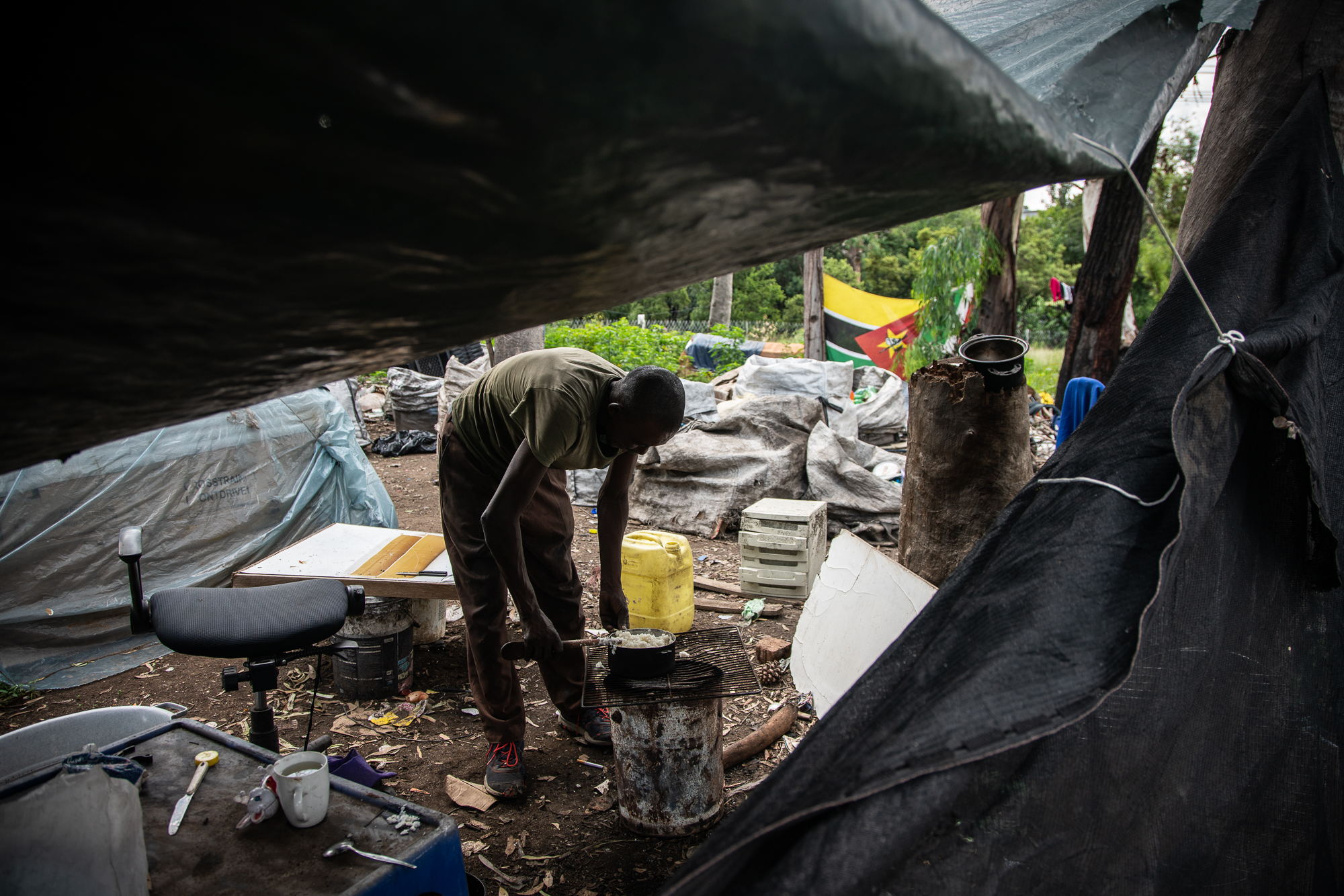
 A waste reclaimer prepares food in a makeshift camp on the edge of Braamfontein Spruit. (Photo: Shaun Swingler)
The ghosts of the City of Gold’s history haunt its landscape today and one of its most visible manifestations is the informal settlements that have sprung up like mushrooms after a rain.
I have watched one grow over the past 15 years. As the crow flies, it lies about 1km from our house in Parkmore on the banks of the Braamfontein Spruit behind the Pick n Pay on the corner of Winnie Mandela Drive and Republic.
For years I ran past it regularly with our German short-haired pointer, and have also observed it from the Field & Study Park, where we walk our dogs, that lies across it on the other side of the spruit. A few years ago it was still an all-male affair with a few makeshift shacks.
It has since expanded into a bustling community with women, children and livestock, and it is linked to the informal economy through the business of recycling. The banks of the spruit around the camp are littered with canvas bags filled with plastic, bottles and other recycling items.
Many of its residents can be seen on the nearby streets dangerously navigating traffic in their wheeled trolleys while collecting refuse for resale in a supply chain that remains opaque.
There is a grim irony in the way these men – for I have only seen men engaged in this task – now scrape a living from the trash of Joburg’s streets. Most in the squatter camp near my suburb hail from Lesotho and Mozambique – at least that is the perception – and they have been discarded to the trash heap of history by the economic forces that forged Johannesburg in the first place on the banks of the spruit.
They represent a growing underclass that is the consequence of the South Africa’s once-vast mining migrant labour system, which once employed almost 500,000 foreign workers who for decades were subjected to ruthless exploitation. The latest update I could obtain was from more than three years ago when that number stood at 35,000 and it has probably fallen further since.
The fathers, grandfathers and great-grandfathers of many of these informal trash collectors no doubt worked in South Africa’s mines. But the lack of economic development back home means that the City of Gold retains a shimmering if misleading allure – it remains a place of opportunity, even if that is limited to the arduous and thankless task of collecting recycled garbage.
The same holds true for many of the zama zamas involved in the dirty and dangerous extraction of illicit gold. They have simply followed their fathers’ passage to the informal gold sector where they are also being exploited and work in often harrowing conditions.
It underscores a sobering point: that life huddled precariously in an informal settlement lacking basic services while earning a living in such a hardscrabble manner is regarded as a step up from village life in Lesotho or Mozambique.
Along with empathy – tempered by the admission that as a middle-class and rate-paying suburban resident I would rather not have an informal settlement so close – I have to admire their grit and determination. To call them stoic would be to miss the point. They are engaged in a daily struggle for survival because of their historical circumstances, and taking control of their destiny in the best way that they can.
And hanging over them is the sinister threat of xenophobic attacks which erupt periodically in South Africa.
Another risk, of course, is being apprehended and deported, and a raid took place at the informal settlement described above in the early hours of 9 April. One of my neighbourhood WhatsApp groups showed video footage of about 20 SAPS and Home Affairs vehicles in a convoy before dawn – which then had to turn around because it was headed to the wrong side of the spruit!
This was part of a Home Affairs initiative known as “New Broom”. Home Affairs Minister Leon Schreiber was on hand and tweeted about it shortly after.
“Before daybreak this morning, I was on the ground as Operation New Broom swept through Sandton, Johannesburg, arresting dozens of illegal immigrants for deportation. We continue to scale up enforcement, including through the use of drones and biometrics, to restore rule of law,” he tweeted.
I did hear a drone in the skies that morning as I was walking my dogs and in the afternoon I spoke with a resident of the camp – who unprompted showed me his South African Smart ID card – as he was fetching water from a tap in the park.
He told me that many people had been apprehended in the raid, including children, and that they were all from Lesotho and Mozambique. He was of Lesotho and South African heritage and his ID card prevented him from being swept up by the New Broom.
I have yet to see any evidence that the shacks and other structures are being removed, but perhaps that will be the next sweep of the New Broom.
/file/dailymaverick/wp-content/uploads/groundup-wastepickers-inset-3.jpg "Piles of plastic, cardboard and cans for recycling surround the the waste reclaimers’ camp on Braamfontein Spruit. (Photo: Shaun Swingler)")
Home Affairs has long been riddled by corruption and maladministration, and Schreiber has done admirable work on many fronts within the Government of National Unity to confront this shambolic mess, including slashing backlogs for visas, IDs and passports.
New Broom falls into this efficiency drive and while the wording and imagery it evokes are ominous – a broom sweeps away unwanted dust and debris – illegal immigration is clearly an issue that needs to be addressed in a sensitive manner without stoking the embers of xenophobia and hate.
But how many of those caught up in the 9 April action will return? I would bet that most of them are likely to be back because there are clearly no meaningful opportunities for them back home.
It’s a vicious and seemingly endless cycle and New Broom can be seen in this light as the latest tool in what is essentially a version of a “Forever War”.
South Africa’s mining industry is no longer the exploitative industrial meat grinder that defined it under apartheid. But its toxic social legacy lives on in many of these informal settlements, which stand as grim testimony to the hopes and dreams that the City of Gold still inspires among the region’s poor. DM
Comments
Scroll down to load comments...