




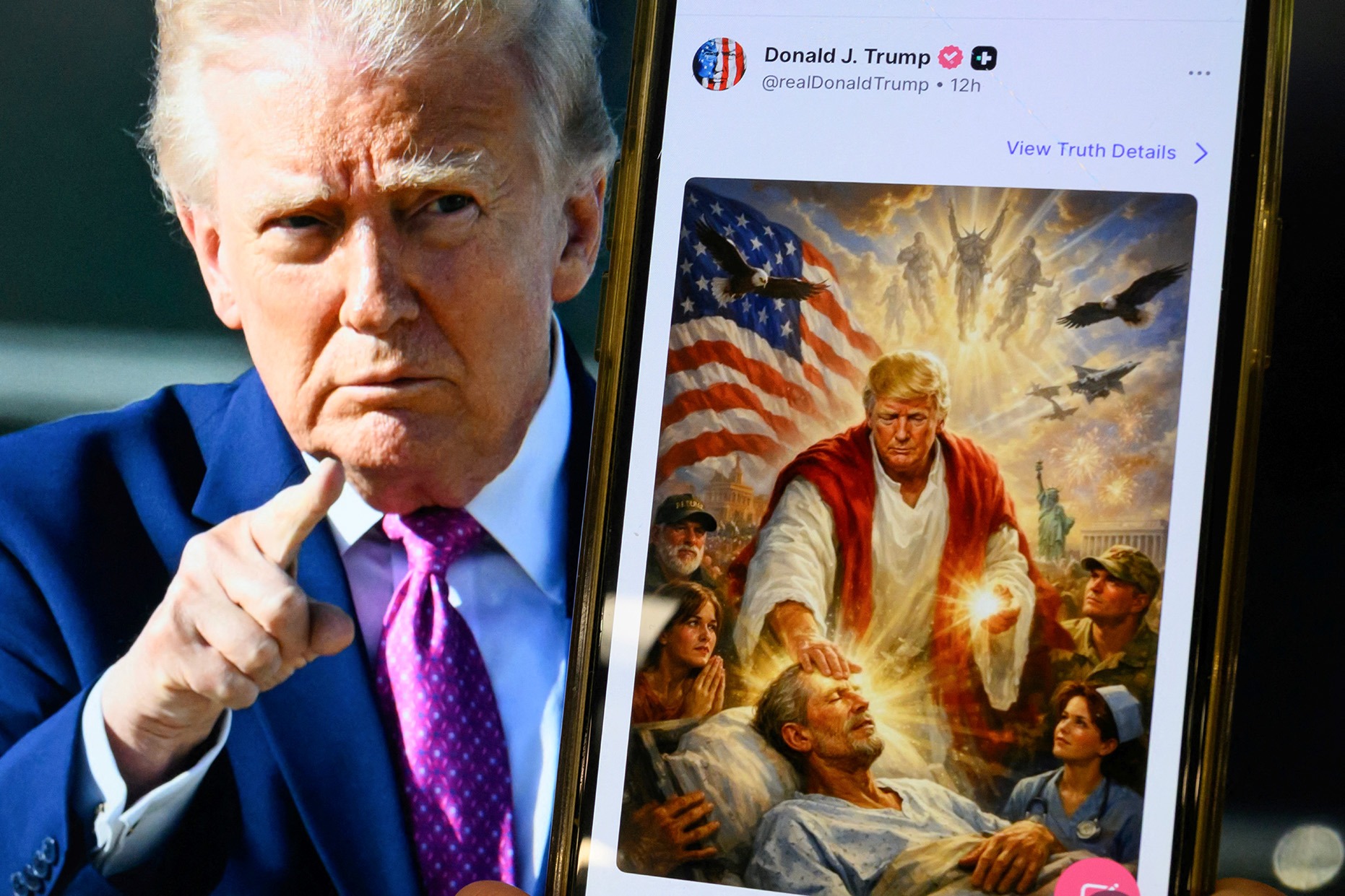
 This photo illustration, created on 13 April, shows a picture of US President Donald Trump on a screen and an AI-generated picture he posted on his Truth Social platform, seemingly depicting himself as Jesus Christ after criticising Pope Leo XIV. (Photo: Mandel Ngan / AFP)
The Catholic Church should never be a platform for political theatre. It would be convenient for political players across the world if it were. While the church does not seek quarrels with political leaders, neither can we remain silent when innocent people are being killed on immoral grounds, and when political players make bad decisions. Attacking the sanctity of the church and the papacy, and the deeper moral vision they represent, is also not acceptable and cannot be met with silence.
A social media post and verbal remarks by US President Donald Trump about Pope Leo XIV are a cause for great concern. President Trump claimed the Holy Father was “weak on crime”, “terrible for foreign policy”, and said he did not “want a Pope who thinks it's OK for Iran to have a Nuclear Weapon”. Trump posted that the pontiff was “a very liberal person” and should “stop catering to the radical left”.
Trump also suggested in the post that the Holy Father was elected pontiff “because he was an American, and they thought that would be the best way to deal with President Donald J Trump”.
“If I wasn’t in the White House, Leo wouldn’t be in the Vatican,” Trump wrote.
The Conclave last year, at which Robert Francis Prevost was chosen as the successor to St Peter, was one of the most profound and beautiful moments in the life of the church — for me personally so, as I participated in the Conclave.
/file/dailymaverick/wp-content/uploads/2025/05/GettyImages-2214095522.jpg "The newly elected pontiff, Pope Leo XIV, is seen for the first time from the Vatican balcony on 8 May 2025. (Photo: Antonio Masiello / Getty Images)")
The one thing I can attest to is that those of us gathered in the Sistine Chapel did not consider any particular political leader as a factor when we elected the Holy Father. Nor did we consider the nationality of the future pontiff. Under the guidance of the Holy Spirit, we elected the person who was best suited to become head of the church, who could best respond to the era we live in, and who would best serve all the peoples of the world.
In the time he has been Pope, Leo XIV has demonstrated that he is the right choice. He has clearly pronounced the church’s position on the major issues besetting the world, including the treatment of migrants, the climate crisis, the need for truth in the era of disinformation and AI, and opposition to war and military intervention.
These are not the pope’s personal positions. It is the stance of the Catholic Church as a whole that we all represent and defend.
The Holy Father has already responded to the US president’s slander en route to his historic visit to Africa. He affirmed: “I am not a politician, and I do not want to enter into a debate with him [Trump]. I do not think the message of the gospel should be abused as some are doing. I continue to speak strongly against war, seeking to promote peace, dialogue, and multilateralism among states to find solutions to problems.”
/file/attachments/orphans/13902411_718296.jpg "Pope Leo XIV during his meeting with the Algerian community in the Basilica of Our Lady of Africa in Algiers, Algeria, on 13 April. (Photo: Luca Zennaro / EPA)")
‘No fear’
In response to a question from a journalist, he added: “I have no fear of the Trump administration or speaking out loudly of the message of the gospel, which is what I believe I am here to do, what the church is here to do.”
This applies to all of us. We are here to bear witness to the gospel, no matter who this makes uncomfortable. Speaking truth to power has been the church’s position throughout the ages. We cannot be silent in the face of injustice and when the innocent are suffering.
The papacy is not merely an office of governance — it is a witness. From the Apostle Peter to the present day, the bishop of Rome has been called to speak to the conscience of the world — often uncomfortably, often prophetically and that witness has never been contingent on political approval. Indeed, the gospel most often unsettles those who wield power.
Criticism, even sharp criticism, has its place in a free society. The church herself has endured, indeed rightly at times, and has benefited from criticism and scrutiny. What is at stake here is not a policy or political disagreement; it is the temptation to recast moral teaching as partisan provocation.
When the successor of Peter speaks about the dignity of migrants, the demands of justice, or the responsibilities of nations toward the vulnerable, he does so not as a politician advancing an agenda, but as a shepherd articulating principles rooted in the gospel and with concern for those whose voices are often not heard.
Ethical imperatives
It is precisely because these principles, these ethical imperatives, transcend borders and ideologies and so become inconvenient for some. They challenge both left and right, liberal and conservative, powerful and powerless alike. To interpret them solely through the lens of political advantage is to misinterpret — perhaps intentionally — their nature and the church itself.
Trump is, of course, entitled to his views. Yet with influence comes responsibility. Words shape not only opinions but also the moral climate in which societies live. When public discourse descends into caricature or hostility, it erodes the very possibility of genuine dialogue — the kind of dialogue our fractured world so desperately needs.
The church does not ask political leaders to agree on every matter. We do, however, call upon them to engage with truthfulness, seriousness, honesty and respect for others and human life itself.
The church has endured emperors, revolutions, and ideological storms. It will endure this moment as well. But endurance is not the same as indifference.
Our hope remains that there may be a rediscovery of civility, a renewed commitment to the common good and to peace. Beyond politics lies a deeper question, one that confronts every leader and every citizen alike: How do we achieve peace and the moral reset that our world so desperately needs? DM
Cardinal Stephen Brislin is the Archbishop of Johannesburg and president of the Southern African Catholic Bishops’ Conference.
Comments
Scroll down to load comments...