




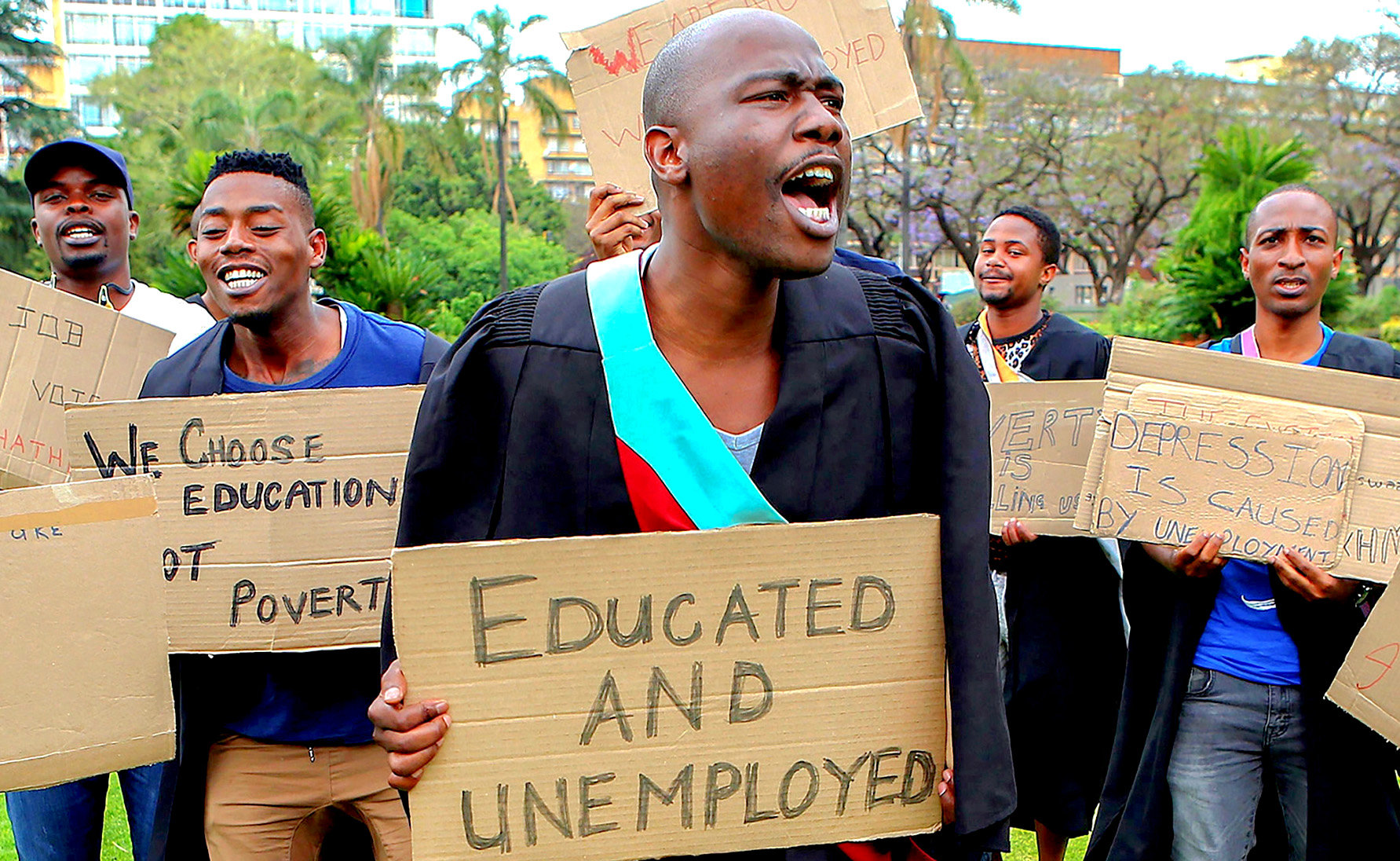
 Unemployed graduates gather at Burgers Park before marching to the Union Buildings in Pretoria. The graduates, who possess qualifications ranging from economics to fine arts and teaching, handed over a memorandum to officials demanding that the government to come up with solutions to tackle rising unemployment. (Photo: Gallo Images / Phill Magakoe)
 While a new cohort of graduates is celebrating their hard work after a long academic battle in the hope using their degrees to gain employment, the reality of finding a job is that it remains difficult, with many existing graduates struggling to find employment.
With more than a million students enrolled in public universities and an annual graduation output of 220,758 students, the Department of Higher Education and Training (DHET) is producing a surplus of graduates who might find it difficult to get employed, with Statistics South Africa (Stats SA) revealing that unemployment has increased among graduates. Industries such as education, construction, safety and security, and agriculture are providing jobs, while others are experiencing a downturn.
In the department’s 2024/2025 annual report, universities produced 31,316 graduates in teacher education, a higher number than the planned 30,000. A total of 207 graduates were produced in veterinary science, 3,620 in doctoral programmes, 11,851 in engineering, 10,218 in natural and physical sciences, 8,873 in human health sciences, and 778 in animal health sciences.
Meanwhile, Technical and Vocational Education and Training (TVET) colleges enrolled 564,089 students, but only 18,195 graduates were placed into workplaces, a shortfall from the planned 21,000.
Daily Maverick spoke to university graduates who attained their qualifications years ago but are still facing difficulties in finding jobs.
Graduates facing hardship
They spoke of how difficult it had been to find employment since finishing tertiary education. Kwenadi Kamogelo Kwadi, a graduate with a Bachelor of Engineering Technology degree from Nelson Mandela University, said that after graduating almost two years she had not found employment.
“I’m in this internship that is ending at the end of August, and it’s something not even related to what I’ve studied. There’s just this underlying fear that I don’t really have anything solid.
“I live with anxiety. Some days or nights when I wake up, I have panic attacks because of all the time that I invested and the little money that I was getting from home when I was in varsity, and how much I have sacrificed and how much they have sacrificed. And unfortunately, things are not going the way that you thought they would. It’s the most devastating thing… I knew I wanted to study engineering, and then I got exposed to marine engineering at varsity, and I got interested in it,” said Kwadi.
A Cape Peninsula University of Technology Information and Technology Honours graduate, who wanted anonymity, said every time he applied for a job the negative responses were painful.
“I graduated two years ago, if not three. I have never been employed. As a young man there are expectations back at home. Every student, whenever they graduate, their parents expect something from them. I have been unemployed for a couple of years, and it does something to me psychologically. It doesn’t affect only me; it affects my family and the people around me, because there are so many people who would want to see me succeed,” he said.
Daily Maverick also briefly spoke to a fashion graduate from Nelson Mandela University, who also asked for anonymity and said there had been no sign of employment. She said she had dropped her fashion dream.
“I ended up baking cakes. It wasn’t easy (to let go of fashion); it broke because I had to sell my sewing machine to pay for baking classes,” said the graduate.
Caesar Smile, a graduate in Chemistry from Cape Peninsula University of Technology, said he could not find employment in the chemical industry and had to do another course at Walter Sisulu University.
“There was a stage when I felt useless because I spent time doing chemistry, and I felt like I had wasted my time. I reached a point of depression because I was known as a graduate at home, not working. I had to try to study another qualification, and it is still the same case. I had to apply with a letter of completion because I owed the previous university money. This is really depressing,” said Smile.
Who has been absorbed and where?
Despite many students graduating from various fields, only a few are absorbed into the workforce. Daily Maverick spoke to Department of Employment and Labour spokesperson Teboho Thejane, who said that the job opportunities registered by employers on the Employment Services of South Africa for the period April 2025 to October 2025 were mainly in the agriculture sector, followed by safety and security, construction and education.
Referring to the recent Stats SA report, he said: “In the third quarter of 2025, most graduates were absorbed in the Community, Finance and Trade industries. In the fourth quarter of 2025, most graduates were absorbed in the Community, Private Households and Trade industries; The most significant declines were observed in the Finance and Transport industries between the third and fourth quarters of 2025.”
/file/attachments/orphans/Siya-education-unemployment_862277.png)
Responding to whether a lack of investment or skills contributed to this low intake of graduates, Thejane said it was a bit of both.
“Skills and investment are critical to creating employment opportunities. The current levels of high employment can be alleviated by skills development in areas that are currently highly absorbing graduates,” said Thejane.
YES programme
Daily Maverick also spoke to the CEO of the Youth Employment Service (YES) programme, Ravi Naidoo, who addresses the country’s youth unemployment crisis by empowering businesses to create jobs for our unemployed youth.
Naidoo said the programme had successfully placed 57,915 youth between January 2025 and April 2026.
“We are seeing significant growth in future-facing sectors. Currently, the highest volume of placements is concentrated in Digital/Information and Communication Technology, Green Economy (specifically renewable energy and environmental management), Financial Services, and Global Business Services... Of our current cohort, 47.84% are NQF Level 6+ graduates (degree, diploma or higher),” said Naidoo.
North-West University Professor Linda du Plessis, Senior Deputy Vice-Chancellor: Teaching and Learning, told Daily Maverick that while higher education must adapt curricula for employability, it could not resolve the labour market mismatch alone. This challenge necessitated systemic coordination between education, industry and the government. She added that students needed to find opportunities using their degrees.
“SA universities are increasingly giving pragmatic, not idealistic, guidance. The advice I will give to young people and students is to diversify your skill set early. There are so many training possibilities to pair your degree with digital skills (data, coding, analytics), communication and project management. Skills acquisition does not always require a formal qualification. Some can be achieved through self-study or through flexible online courses. Students can participate in community outreach events, thereby getting skills in project management and communication. Students should realise that a degree is not the end of learning; it is the beginning of life-long learning,” said du Plessis. DM