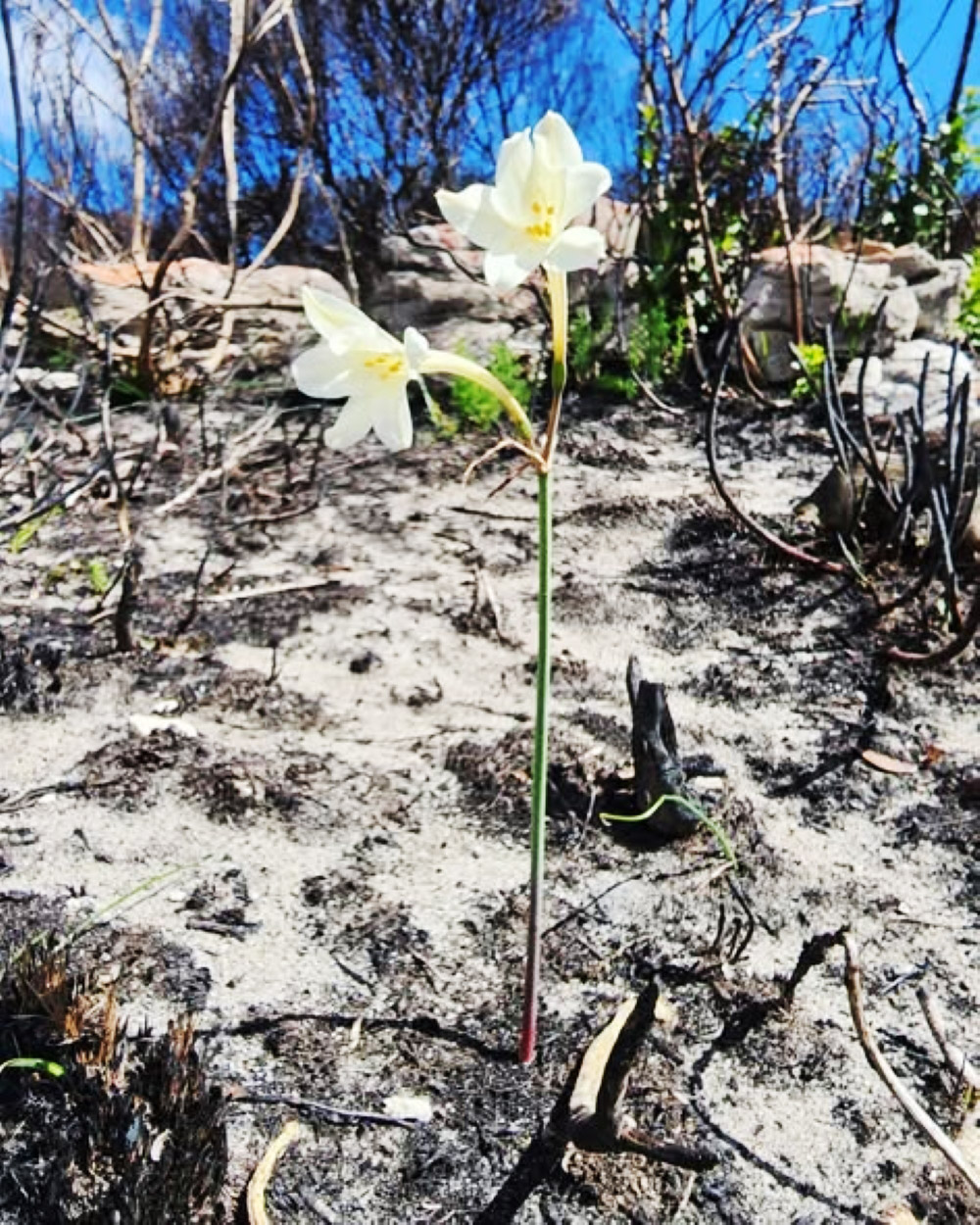
 The first white fire lily (Cyrtanthus leucanthus) after the fire, last seen four years ago. They are range-restricted and occur on coastal lowlands, and it is inferred that they are pollinated by nocturnal moths. (Photo: Supplied)
 The smell of smoke has gone from the wild fynbos sanctuaries and the farmlands of the Overberg in the Western Cape. But the landscapes remain scorched and scarred by a blaze so staggering in its intensity that few will forget its impact.
The fires have damaged residential homes and farms, and led to the destruction of wildlife – snakes, tortoises, birds, nesting areas and small animals that could not escape.
And yet, in the aftermath of fire, something weird and wonderful is happening. Among the ashes and blackened vegetation, plants like the exotic blood-red fire lilies (Cyrtanthus ventricosus) are popping up either single or in clumps from the bare earth, flaunting their beauty against a backdrop of twisted burnt branches gnarled by heat.
/file/attachments/2989/16IMG_0004_818750_237471.jpg "Cyrtanthus ventricosus, a fire lily species most commonly seen in the first few weeks after fire. (Photo: Jasper Slingsby)")
Driving along the R43 to Gansbaai and Pearly Beach, where the fires were savage, these scarlet, candelabra-like flowers have the chance to show off without being cowered by thick vegetation, including weeds and invasive species.
In many ways, these eye-catching displays are nature’s rescue mission for the sunbirds that feed off the lilies’ nectar when the rest of the ground is parched.
“It’s breathtaking to see plants bursting out of the ground – some that have been absent for years,” said Sean Privett, a long-time botanist and managing director of the Grootbos Foundation in the heartlands of the Cape Floral Kingdom between Gansbaai and Hermanus.
Bounty and surprise
At a recent presentation titled “Out of the Ashes: Lessons from a Fire”, Privett emphasised that fire is a natural event in the fynbos region and has been for millions of years, promoting growth and seed germination. A fire of this magnitude – the biggest in two decades – will have awakened seeds that have remained dormant underground for years. There could be an explosion of new growth in the coming rainy season.
/file/attachments/2989/16RedDisaWikimediaCommons_217770.jpg "The red disa (Disa uniflora) thrives after fynbos fires in the Western Cape, using the cleared, sunny environment to bloom. (Photo: Supplied)")
“We have no idea what plants are going to emerge – maybe plants we’ve never seen before. Last week, we located the rare Cyrtanthus guthrieae – the Bredasdorp lily. It grows nowhere else on the planet and is hugely endangered, with only 250 adult plants left in the wild.”
The discovery of the rare lily by a team from the Custodians of Rare and Endangered Wildflowers was so significant that a floral artist was brought to the area with paints and brushes to record the sighting in real time.
Creative endeavours and botany aside, the enormity of the recent wildfires raises many issues about finance, security, vigilance and risk reduction. And the cost of it all? In one word: prohibitive.
/file/attachments/2989/16firesmoke_577736_327151.jpg)
One emergency helicopter water-drop costs R60,000 an hour. The fire raged for five days and required a fleet of helicopters working eight hours a day to contain it. The maths is sobering.
“We can’t now breathe a sigh of relief and think, okay, the fire has been and gone,” Privett says. “Fires do not stop at boundary fences or walls of homes. Through lessons learned in the past, the nature reserves around Grootbos have a network of fire controls that reduce the risks, but this fire has taught us many more lessons.”
Lesson one is keep the weeds out: “That means now,” he says.
Lesson two is use managed burns to reduce the fire risk and create a veld mosaic based on the age of the vegetation.
Working together is the only answer, he says. “It won’t be the first big fire or the last that we will have to do battle with – and that is a certainty.” DM
This story first appeared in our weekly DM168 newspaper, available countrywide for R35.
/file/attachments/orphans/DM-13032026001CPTJHB_763962.jpg)