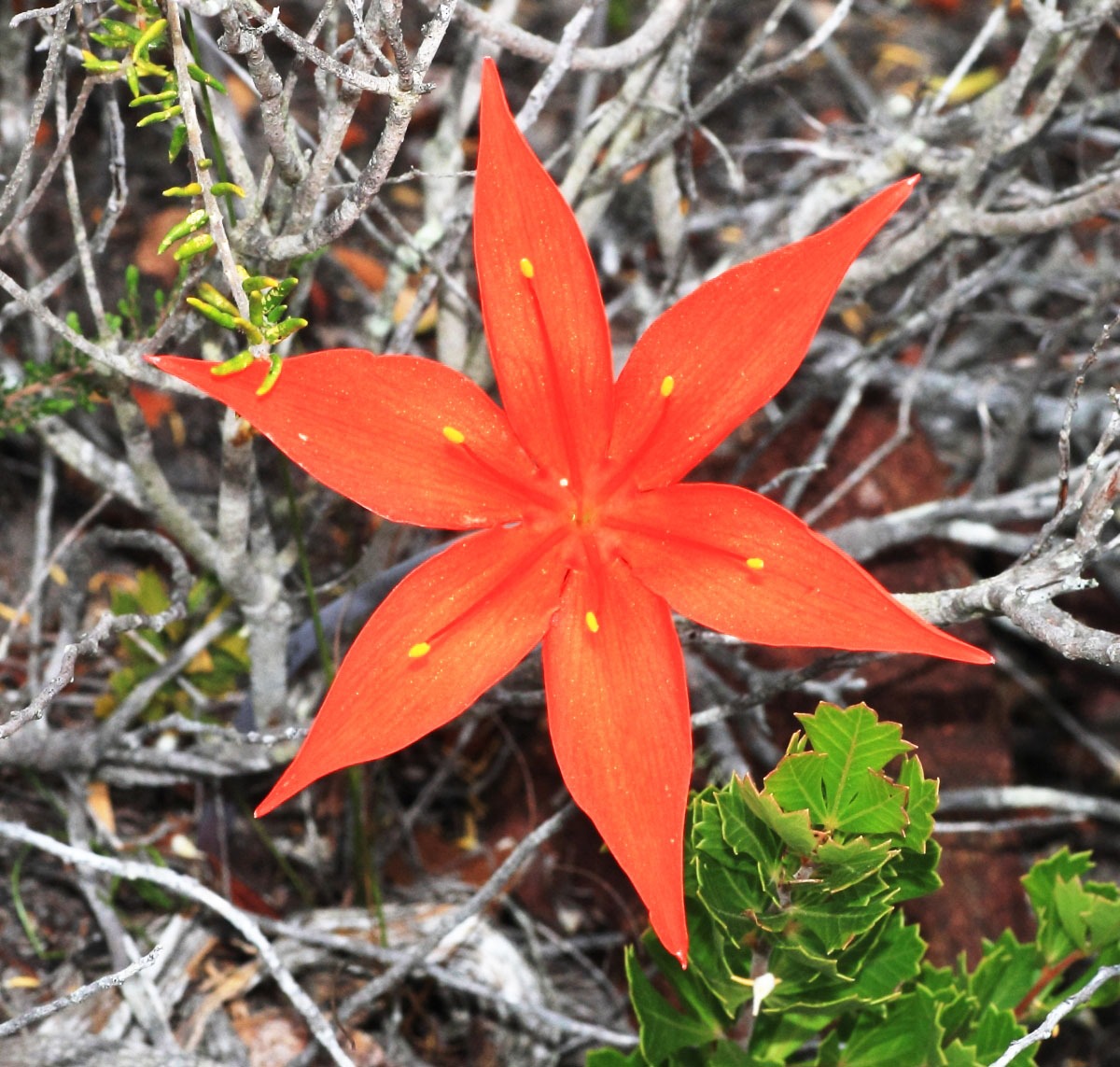
 The recently discovered Cyrtanthus guthrieae or Bredasdorp lily. (Photo: iNaturalist)
 Seeking flowers here, there and everywhere, a new breed of volunteers have taken on the role of environmental protectors, identifying and researching rare and endangered plants that grow in the wild, many of them in the Western Cape part of the Cape Floristic Region.
As the leaders of the Custodians of Rare and Endangered Wildflowers (CREW) will tell you, there are a whole lot of ancient natural rhythms that play out in the realm of wildflowers. Undisturbed, wildflowers can look after themselves. When conditions are just right, they pop up to show off their finery and then fade away, awaiting their next turn to shine.
This rhythm is only disrupted when human interaction gets in the way. Alien invasive plants, ploughing, cattle grazing and construction all add up to one thing – a loss of biodiversity and an entry in the International Union for Conservation of Nature Red List. Ismail Ebrahim is a senior specialist scientist and project manager at CREW in the Cape Floral Kingdom, a position affiliated to the South African National Biodiversity Institute and funded by the Botanical Society of South Africa.
He explained the importance of real-time monitoring of rare and endangered plant species.
“We need to know why numbers are dwindling, and what can be done to reverse the situation. Otherwise, plant species would die out without anyone knowing.
“I would certainly support the idea of an overarching body like Birding SA – say Wildflowering SA – to coordinate and share information,” he said.
Ebrahim added that an exciting part of the job was to find new species or rediscover one thought to have been lost. He was part of the team that recently identified the critically endangered Cyrtanthus guthrieae, or Bredasdorp lily, which appeared after the recent fires. It is found only in a localised area on the lower slopes of the Soetmuisberg near Bredasdorp and fewer than 250 mature individuals exist.
According to research on the lily, much of its former habitat on the lower slopes of the Heuningberg has been used for crop cultivation, with agricultural expansion taking place in the past 10 to 15 years. The few remaining subpopulations are threatened by severe overgrazing and uncontrolled spreading of alien invasive plants.
/file/attachments/2989/08Nivenia_stokoei_13939121_530607.jpg)
A Kogelberg CREW expedition last week involved a tough 12km hike through an ocean of wetland fynbos, followed by a challenging climb up a steep south-facing slope of the Platberg – all in the hope of finding a seldom-seen bright blue iris, the Nivenia stokoei.
Said one member of the team: “We are happy to go any distance, up any mountain and into the steepest valleys just to get a glimpse of a rare, endangered plant.”
Riebeek Kasteel-based wildflower volunteer Bridget Doyle joined a recent mission to retrieve indigenous bulbs from a proposed runway for aircraft near the Karoo town of Quaggafontein.
“It was dry and stinking hot in the middle of the Karoo, but being able to retrieve bulbs that would otherwise be destroyed in the excavation was such a worthwhile task,” Doyle said.
As guided by the national biodiversity and aquatic impact assessment, all bulbs recovered from the Quaggafontein visit – 35 in all – will be used as propagation stock for future ecological restoration at Quaggafontein. DM
This story first appeared in our weekly DM168 newspaper, available countrywide for R35.
/file/attachments/2990/DM-10042026-001_386146.jpg)