




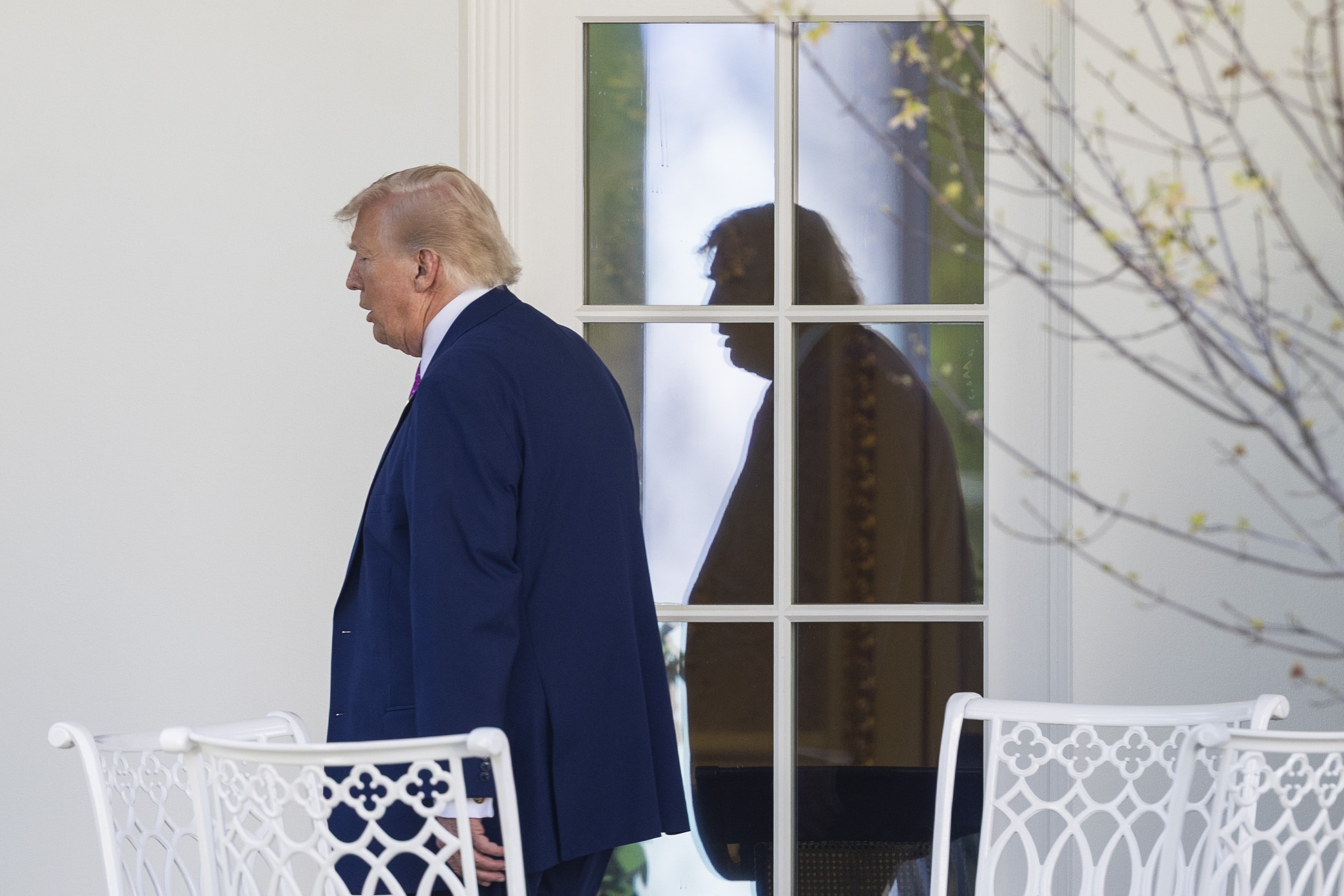
 US President Donald Trump departs the White House in Washington, DC, USA, 10 April 2026, for an event in Charlottesville, Virginia. The president did not respond to shouted questions. EPA/JIM LO SCALZO
 By Bo Erickson, Saad Sayeed and Asif Shahzad
Trump also said in a post on Truth Social that the U.S. would take action against every vessel in international waters that had paid a toll to Iran, and begin destroying mines that he said the Iranians had dropped in the strait, a choke point for about 20% of global energy supplies that Iran has blocked.
Iran's Revolutionary Guards responded with a statement warning that military vessels approaching the strait will be considered a ceasefire breach and dealt with harshly and decisively, underlining the risk of a dangerous escalation.
"Effective immediately, the United States Navy, the Finest in the World, will begin the process of BLOCKADING any and all Ships trying to enter, or leave, the Strait of Hormuz," Trump said in his Truth Social post.
"I have also instructed our Navy to seek and interdict every vessel in International Waters that has paid a toll to Iran. No one who pays an illegal toll will have safe passage on the high seas," Trump added.
"Any Iranian who fires at us, or at peaceful vessels, will be BLOWN TO HELL!" he added.
Six weeks of fighting has killed thousands, roiled the global economy and sent oil prices soaring as Iran prevented traffic through the strait.
MORE NEGOTIATIONS?
In an interview with Fox News after his post about the strait, Trump said that he believed Iran would continue to negotiate and called the weekend discussions "very friendly".
"I do believe they're going to come to the table on this, because nobody can be so stupid as to say, ‘We want nuclear weapons,’ and they have no cards," Trump told Fox News from his golf course near Miami, Florida.
Trump also said that NATO allies, whom he has criticised for failing to back the war he launched along with Israel on February 28, wanted to help with the operation in the strait.
There was no immediate comment from Washington's allies.
The weekend talks in Islamabad, which followed the announcement of a ceasefire last Tuesday, were the first direct U.S.-Iranian meeting in more than a decade and the highest-level discussions since the 1979 Islamic Revolution.
"The bad news is that we have not reached an agreement, and I think that's bad news for Iran much more than it's bad news for the United States of America," said Vice President JD Vance, who headed the U.S. delegation.
A U.S. official said Iran had rejected Washington's call for an end to all uranium enrichment, the dismantling of all major enrichment facilities and the transfer of highly enriched uranium. The two sides also failed to reach agreement on the U.S. demand that Iran cease funding for Hamas, Hezbollah and the Houthis as well as fully open the strait, the official added.
Iran's Parliamentary Speaker Mohammad Baqer Qalibaf, who led his country's delegation along with Foreign Minister Abbas Araqchi, blamed the U.S. for not winning Tehran's trust, despite his team offering "forward-looking initiatives".
Iran's President Masoud Pezeshkian, who discussed the talks in a call with Russian President Vladimir Putin, said Tehran wanted "a balanced and fair agreement".
"If the United States returns to the framework of international law, reaching an agreement is not far off," he told Putin, Iranian state media reported.
ISRAEL CONTINUES BOMBING LEBANON
Iran's semi-official Tasnim news agency said "excessive" U.S. demands had hindered reaching a deal. Other Iranian media said there was agreement on a number of issues, but the strait and Iran's nuclear programme were the main sticking points.
Despite the stalemate, three supertankers fully laden with oil passed through the Strait of Hormuz on Saturday, shipping data showed, in what appeared to be the first vessels to exit the Gulf since the ceasefire deal.
Israel has continued bombing Tehran-backed Hezbollah militants in Lebanon, insisting - along with Washington - that that conflict was not part of the Iran-U.S. ceasefire. Iran says the fighting in Lebanon must stop.
The Israeli military said it struck Hezbollah rocket launchers overnight into Sunday and black smoke could be seen rising in the southern suburbs of the Lebanese capital Beirut.
And in Israeli villages near the border, air raid sirens sounded, warning of incoming rocket fire from Lebanon.
(Reporting by Reuters bureaus worldwide, Writing by Idrees Ali, Lisa Shumaker, Raju Gopalakrishnan, Matthias Williams and Keith Weir; Editing by William Mallard, Gareth Jones and Alexander Smith)