




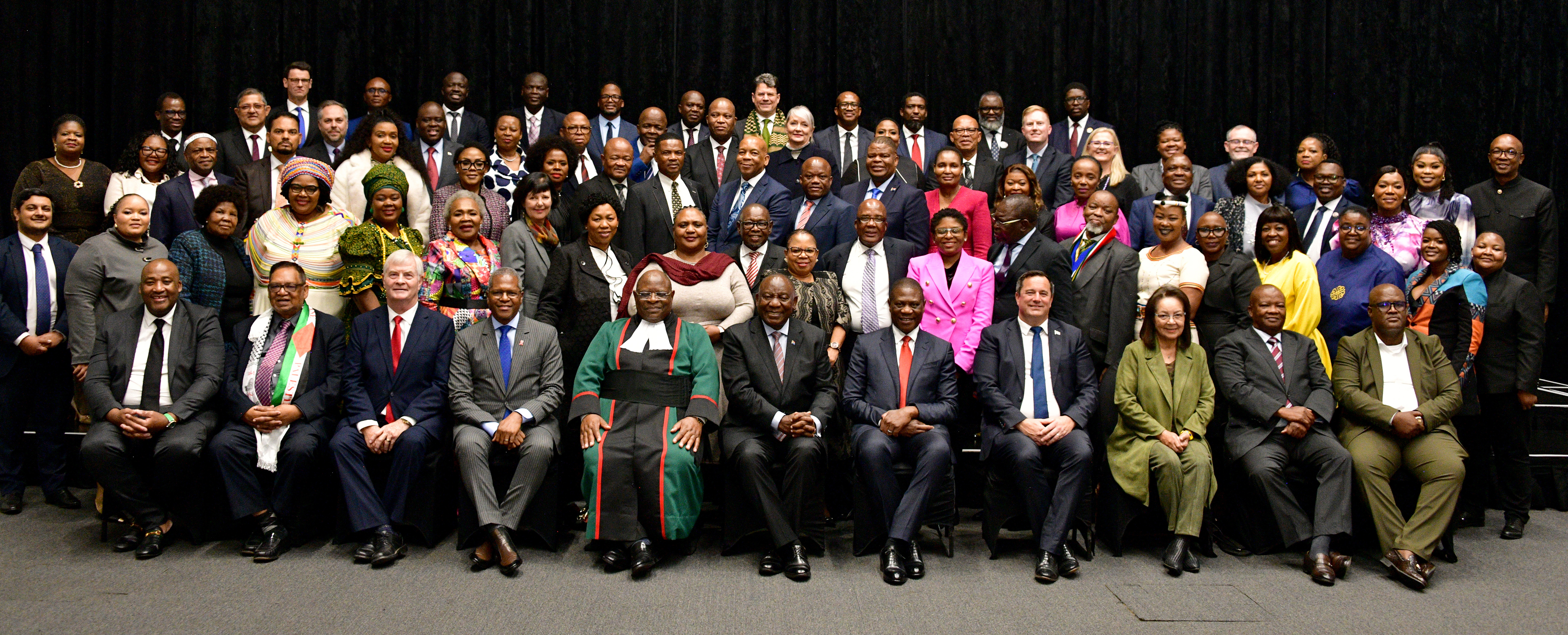
 Government of National Unity ministers with then Chief Justice Raymond Zondo (front centre). (Photo: Elmond Jiyane / GCIS)
 Nearly two years into South Africa’s Government of National Unity (GNU), the ANC has been accused of undermining its coalition partners by working closely with key officials in government departments and bypassing members from other political parties.
One particular concern among some GNU partners relates to the long-time practice of ANC parliamentary study groups, where department officials are allegedly giving exclusive briefings to ANC MPs outside formal parliamentary processes.
This is in conflict with government policy that the public service must be depoliticised and government departments “insulated” from party politics. The founding principles in the GNU’s Statement of Intent also make it clear that the public service must be “professional, merit-based [and] non-partisan”.
Basic Education Minister Siviwe Gwarube first suggested, in an open letter on 27 March, that an abuse of this practice was hindering attempts at reform in her department. In her letter, the DA minister warned the public that the reforms she had instituted in the past 20 months could be derailed by the “greed and misconduct” of a few individuals in the system.
/file/attachments/2990/ED_597454_670312.jpg "Minister of Basic Education Siviwe Gwarube at the Umlambo Foundation’s Reading Panel Conference held at Melrose Arch in Johannesburg on 24 February 2026. (Photo: Luba Lesolle / Gallo Images)")
“There are relationships and practices within the system that will be used to try to stall this work. There will be mudslinging. There will be accusations that some hope will stick. We will not be deterred.
“There will be resistance to change. It will come in many forms. It will include ad hominem attacks and the misuse of oversight and accountability processes to pursue personal agendas. As difficult as this fight will be, it has to be fought,” she said.
After the publication of the letter, Daily Maverick’s Rebecca Davis reported on accusations that Gwarube was being strategically and continuously undermined by senior officials in her department, who allegedly would meet the ANC’s basic education study group ahead of parliamentary sessions to share internal information.
It now appears that similar situations are playing out in other departments helmed by non-ANC ministers and deputy ministers.
‘Informal and secretive’
Deputy Minister of Defence Bantu Holomisa told Daily Maverick that the practice of officials giving exclusive briefings to ANC MPs was “an old ANC policy”.
“They have been practising this for years in almost all departments,” Holomisa said, adding that the South African National Defence Force was no exception. The [acting] secretary for defence [Thobekile Gamede] and other senior military officers have attended these meetings,” he claimed.
Daily Maverick requested comment from Gamede, but had not received a response by the time of publication.
Holomisa said the exclusive official briefings for ANC MPs preceded the GNU. But it is clear that they have become more of a problem in the national coalition, in which participating parties should be given an equal understanding of what is happening in government departments.
In the Department of Correctional Services, Minister Pieter Groenewald of the Freedom Front Plus confirmed to Daily Maverick that he had issued a directive “prohibiting this practice” several weeks ago.
Other ministers who spoke to Daily Maverick, including DA leader and Agriculture Minister John Steenhuisen and Minister of Forestry, Fisheries and the Environment Willie Aucamp, say they are aware of the issue but have not experienced it in their departments. “I know that it exists in other departments and it is totally wrong… It needs to be addressed,” Aucamp said.
Holomisa said that during a lekgotla in 2025, the GNU adopted a resolution to depoliticise the civil service. “In light of that resolution, I raised the issue of study groups at the meeting of leaders of political parties in the GNU last year. These study group meetings are not attended by other members of political parties, except ANC MPs,” he told Daily Maverick.
/file/attachments/2990/ED_518890_184836.jpg "UDM leader and Deputy Minister of Defence Bantu Holomisa at a Women’s Day Parade at Air Force Mobile Deployment Wing in Valhalla, Pretoria, on 30 August 2024. (Photo: Frennie Shivambu / Gallo Images)")
Holomisa, who is the leader of the UDM, detailed his concerns about the practice in a five-page letter to National Assembly Speaker Thoko Didiza and Public Service Commission chairperson Professor Somadoda Fikeni, dated 1 April. He copied in President Cyril Ramaphosa, Deputy President Paul Mashatile and leaders of the political parties in the GNU.
“As far back as our leadership engagement at the Cradle of Humankind [in November 2025] during our post-lekgotla reflections last year, I raised serious concerns regarding the existence and operation of so-called study groups.
“These platforms, in which directors-general and senior security personnel are subjected to engagements with members of Parliament from the largest party outside formal parliamentary processes, operate without clearly defined rules, procedures or accountability mechanisms. These secret meetings are the ones which are the cause of State Capture, no doubt,” he wrote.
According to Holomisa, the “informal and secretive” study groups typically precede the formal appearance of government departments before portfolio committees, joint standing committees, select committees and other parliamentary sessions.
“It is in this context that informal study groups emerge, allowing these MPs to exert influence over administrative decisions and direction. Notably, ministers or deputy ministers from other parties in the GNU are systematically excluded from these sessions.”
Unfair and outdated
According to Holomisa, the practice, which has been inherited by the GNU, is “deeply problematic” for two reasons. First, he said, it creates an “uneven playing field” in the national coalition since not all parties have equal access to the study groups.
/file/attachments/2990/ED_559069_432915.jpg "Professor Somadoda Fikeni at the roundtable on strengthening the political and administrative interface, held at the Sefako Makgatho Presidential Guesthouse in Pretoria on 30 May 2025. (Photo: Frennie Shivambu / Gallo Images)")
This, Holomisa said, undermines the “very spirit of inclusivity and fairness” that the GNU seeks to promote. “It is a continuation of a political culture that predates the GNU and has no place in a democratic dispensation committed to transparency and accountability,” he added.
In addition, Holomisa said the practice undermines the doctrine of separation between the executive, the legislature and the administration.
“Members of Parliament are constitutionally mandated to exercise oversight over the executive and the public service. However, when MPs become embedded in administrative processes through informal and opaque platforms, this oversight role is compromised. This conduct is in direct violation of the Constitution of the Republic of South Africa, which establishes a system of checks and balances to prevent the abuse of power and to ensure that each arm of the state operates within its defined mandate.
“The erosion of these constitutional safeguards is not a procedural lapse; it is a fundamental threat to democratic governance. This behaviour truly reminds me of the Matanzima era [in the former Transkei], where political directives laced with corruption were issued,” he said.
The chairperson of Public Interest SA, Tebogo Khaas, told Daily Maverick that the public service is required to be impartial and accountable to the constitutional order – not to partisan interests.
“At a principled level, any practice in which departmental officials provide exclusive briefings to a single political party’s parliamentary caucus is deeply problematic. It risks eroding the constitutional architecture that underpins the separation between the executive, the legislature and the public administration…
“Where officials are seen to align themselves, or are perceived to be aligning themselves, with a particular party’s internal processes, it compromises both the integrity of the administration and the legitimacy of parliamentary oversight,” Khaas said.
/file/attachments/2990/ED_519604_488915.jpg "Speaker Thoko Didiza at the social services cluster of ministers address in the National Assembly at the Good Hope Chamber in Cape Town on 4 September 2024. (Photo: Brenton Geach / Gallo Images)<br>")
In his letter, Holomisa urged Didiza to prohibit and investigate “any informal or irregular platforms” that threaten to compromise the independence of MPs. He also asked Fikeni to exercise the Public Service Commission’s constitutional mandate and investigate the involvement of public servants in such study groups.
In response to questions from Daily Maverick, Fikeni confirmed that the commission had received Holomisa’s letter and would investigate the issue. Daily Maverick requested comment from Parliament spokesperson Moloto Mothapo, but had not received a response by the time of publication.
Crossing the line
According to the ANC parliamentary caucus website, all ANC public representatives are allocated to study groups, and each group is headed by a chairperson and politically managed by a whip.
“The core function of the study group is to do political work on the legislative programme before the committee, political oversight in respect to matters coming before it, and formulate ANC policy for the relevant focus area. In doing this work, the study group ensures that ANC policies find practical expression,” it read.
Daily Maverick requested comment from the ANC, but had not received a response by the time of publication.
DA MP Emma Powell, the DA’s former international relations spokesperson, who abruptly resigned in July 2025, said ANC study groups “are often used to engage departmental officials and shape draft reports before they are formally tabled for multiparty consideration in committees”.
She went on: “This is not a new issue. It is a long-standing practice in most ANC-chaired portfolio committees that has been raised repeatedly and ignored over time.
“While internal party discussions are entirely legitimate, the line is crossed when parliamentary and departmental staff are drawn into off-record engagements that appear to predetermine outcomes before reports are formally tabled in portfolio committees. When reports are effectively settled before they reach the committee, oversight risks being reduced to a procedural formality rather than a meaningful check on executive power.”
She noted that the ANC chairs most of the roughly 45 committees in Parliament, spanning the National Assembly, the National Council of Provinces and joint structures.
“That concentration of chairing power gives the ANC significant control over agendas, processes and the overall direction of oversight, which is precisely why practices like pre-meetings and selective engagements with civil servants and parliamentary content advisers, who are by law required to be politically neutral professionals, have such a material impact on how Parliament functions in reality.
/file/attachments/2990/emma_powell_287699.jpg "DA MP Emma Powell. (Photo: www.pa.org.za)")
“I have repeatedly referred this issue to the Rules Committee, along with evidence of parliamentary committee advisers and senior departmental officials meeting in closed-door study groups with ANC members on committees to run through and edit reports prior to committee deliberations, but the practice continues in many committees.”
In 2020, for instance, according to Powell, DA MPs on the human settlements committee were informed by officials that the then chairperson of the committee, former ANC MP Rosina Semenya, insisted that all reports that were sent to her office, along with summaries and analyses by parliamentary officials, first had to go before the ANC’s study group on the committee before being circulated to all members of the committee and tabled for discussion at the full committee. Parliamentary officials had to attend these ANC study groups to advise the members and the ANC’s researcher.
Only after the reports had been edited and signed off by the ANC study group could they be tabled for discussion in the full portfolio committee, she said. This lengthy procedure had sometimes caused unnecessary delays in the work of the full committee, and consensus on items was largely a foregone conclusion.
Powell said the problem of reports having to be filtered through the ANC study groups “is compounded by the unchecked discretion exercised by committee chairpersons, which is routinely used to drive a partisan agenda through the machinery of Parliament itself”.
She said there was also a “clear and repeated” pattern of this in the Department of International Relations and Cooperation committee, on which she had served as the DA’s spokesperson.
“Engagements that align with ANC political interests, including with preferred foreign delegations and corporate-linked events, are prioritised and logistics even funded using parliamentary resources, while requests for balanced engagements, particularly with European partners and Ukraine, are blocked or handled unilaterally by the chair, with access tightly controlled to shape a single narrative. DM
This story first appeared in our weekly DM168 newspaper, available countrywide for R35.
/file/attachments/2990/DM-10042026-001_386146.jpg)