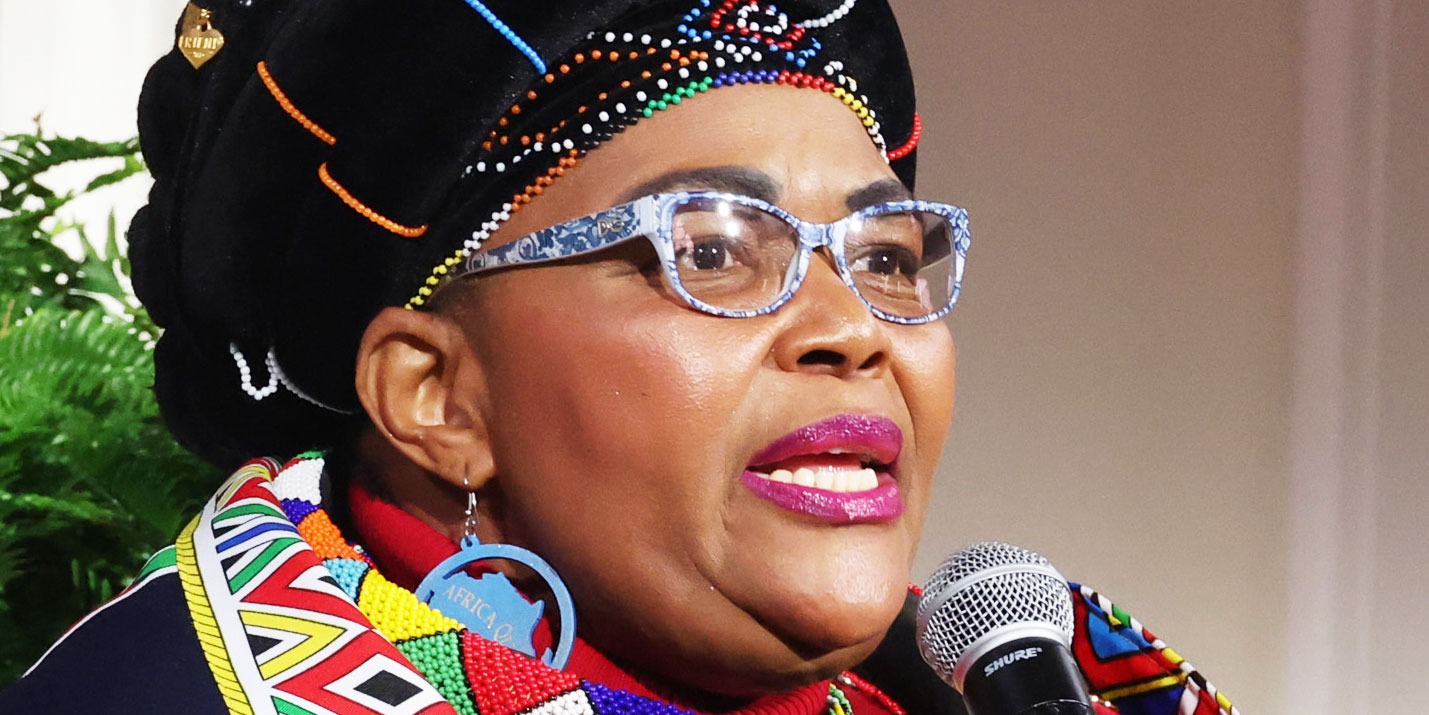
 Minister of Water & Sanitation Pemmy Majodina has laid down the law to municipalities about their duty to provide water and sanitation services to South Africans. ‘Where municipalities cannot deliver, we must intervene decisively. Accountability is no longer optional. It is non-negotiable,’ she told municipalities at a meeting in Midrand on 10 April. (Photo: Rob Kim / Getty Images for Global Citizen)
 The Minister of Water and Sanitation, Pemmy Majodina, and her senior officials have read the riot act to failing municipalities, threatening to hand over some of their functions to more competent bodies; to withhold municipal grant funds and to call in the Special Investigating Unit (SIU) to probe corruption by council officials and local “water mafias”.
“The time for excuses is over. […] Deliver, or we will intervene,” was the blunt message from Majodina and her two deputies (David Mahlobo and Sello Seitlholo) to errant municipalities at a meeting at Gallagher Estate in Midrand on 10 April.
While there has been similar tough talk before (sometimes behind the scenes), the department has now bared some of its financial and administrative teeth in public, warning that the government will tighten the purse strings when distributing grant funding to municipalities that fail to pay their bills from the water boards that provide them with potable tap water.
Department of Water and Sanitation (DWS) director-general, Dr Sean Phillips, noted that roughly two-thirds of the municipalities that receive bulk water from water boards were reportedly not paying current invoices in full.
“With regards to the debts owed by municipalities to the water boards, National Treasury and DWS have been working together to withhold equitable share allocations of the worst-performing municipalities in terms of [non] payment of invoices.”
Equitable share budget allocations are unconditional fund transfers from the national government to municipalities, primarily intended to subsidise free basic services (water, electricity, sanitation, refuse).
“The withholding of equitable share allocations has had a positive impact and resulted in improved payment of current invoices by a number of municipalities.”
Phillips said that withholding these funds was over and above other credit-control action; political engagements between the minister, provincial MECs and mayors; restricting the water supply to municipalities and, “as a last resort, attaching bank accounts”.
“The withholding of equitable share allocations has had a positive impact and resulted in improved payment of current invoices by a number of municipalities. This in turn has prevented the bankruptcy of two water boards which were most at risk due to non-payments.”
The SIU and other law enforcement agencies had also been called in, said Phillips, noting that his department and the SIU had established a new “water and sanitation anti-corruption forum”.
‘Water tanker mafia’
/file/attachments/orphans/tony-action-plan-3-new-Durban-water-tankers_302711.jpg "The Department of Water and Sanitation has urged municipalities to buy their own water tankers, to avoid the service being hijacked by the ‘water mafia’. (Photo: eThekwini Municipality)")
“To address the problem of the water tanker mafia, DWS is encouraging all [municipalities] to insource water tankers. In this we acknowledge progress made by City of Tshwane, eThekwini and Polokwane in insourcing tankers to reduce the opportunity of corruption.
“In June 2025, the South African Human Rights commission [SAHRC] released a comprehensive policy brief to tackle ‘water mafias’ and the systemic sabotage of essential water infrastructure. Deputy Minister Mahlobo addressed and participated in a SAHRC webinar hosted on 29 July 2025 on the impact of sabotage on essential water infrastructure and water mafias indicating the department’s role and leadership in collaborating with law enforcement and developing strategies of community engagement and advocacy.”
The DWS, the Presidency and the National Treasury were also producing a business case and draft Bill for an independent economic regulator for the water sector, with the goal of finalising the draft business case and Bill by the end of the 2026.
Phillips said that at a national indaba held by the DWS in 2025 to address the growing municipal water and sanitation crisis, municipalities had agreed to issue public advisory notices if their drinking water quality failed to meet drinking water standards.
They had also agreed to ring-fence revenue from the sale of water and to establish budgets to plug the leaks in water distribution systems.
In addition, municipalities committed to fixing leaks promptly, shutting off illegal connections and improving their metering, billing and revenue collection.
To ensure adequate free water to poor communities, municipalities had also agreed to review their indigent registers and ensure the provision of free basic water to the indigent within two years.
However, all other water users would be billed and the revenue collected. They would also prioritise the creation and filling of key technical positions (process controllers, artisans, scientists and engineers).
‘Accountability platform’
/file/attachments/orphans/tony-action-plan-2-olifants-pollution-maureen-scheepers_639388.jpg "Pollution in the Olifants River. The Department of Water and Sanitation says the latest Drop Reports confirm the systemic failure of water supply in South Africa. (Photo: Maureen Scheepers)")
In her latest speech, Majodina said: “I want to make one thing absolutely clear: this is not another webinar to exchange familiar talking points, repeat old diagnoses or congratulate ourselves for convening. This is an accountability platform. It is a minister-led national progress review. It is a moment of truth for the water and sanitation sector.
“Today, we are here to answer one fundamental question: Are we fixing the water crisis, or are we merely managing decline? When we convened the 2025 Water and Sanitation Indaba, we did so because the country demanded urgency, honesty and action. That indaba brought together national government, provinces, municipalities, water entities, business, labour, civil society and sector partners to confront the deep and persistent challenges in our sector. It was not designed as a talk shop, but as a turning point.
“The people of South Africa do not want more reports. They do not want more explanations. They do not want more indabas and webinars. They do not want more promises. They want water.”
“The urgency of this work is confirmed by the latest Drop Reports. These reports do not merely point to isolated shortcomings. They confirm systemic failure. Nearly half of our water supply systems are not meeting required standards[ …]. We must be honest with ourselves. This is not just a technical problem. It is a governance problem. It is a management problem. It is a consequence of institutional weakness, delayed maintenance, poor planning, weak revenue collection and in too many cases, a lack of accountability […].
“Where municipalities cannot deliver, we must intervene decisively. Accountability is no longer optional. It is non-negotiable. The people of South Africa do not want more reports. They do not want more explanations. They do not want more indabas and webinars. They do not want more promises. They want water.” DM