





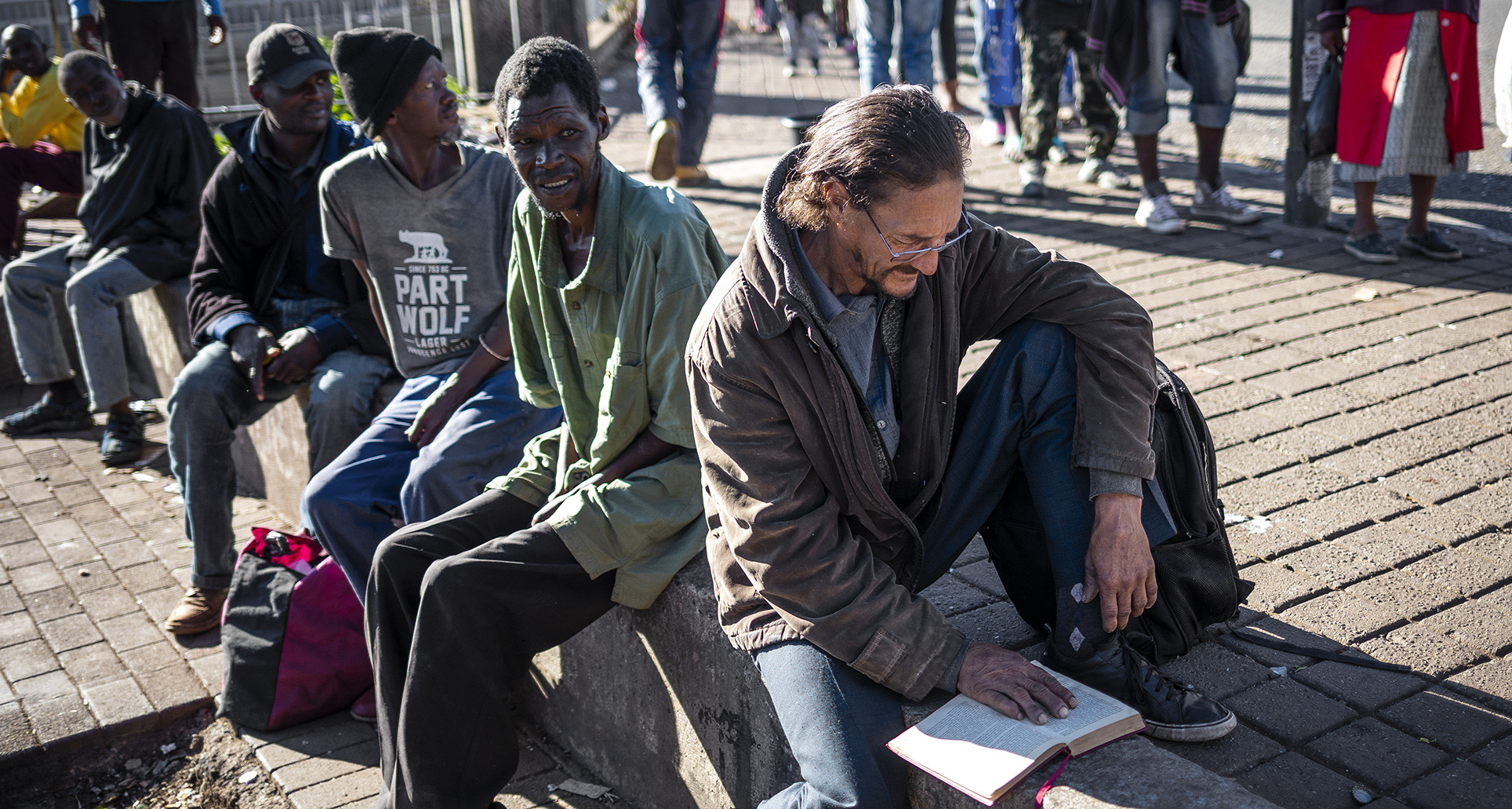
 A homeless man reads while waiting at a feeding point organised by a church group in Johannesburg during the Covid-19 lockdown in April 2020. (Photo: EPA-EFE / Kim Ludbrook)
 The nonprofit FoodForward SA is calling for bold policy-making and purposeful action to address the sharp rise in food and nutrition insecurity in South Africa over the past five years. It points to escalating living costs, soaring food prices and rising unemployment as key factors behind the deepening crisis affecting millions.
In April 2026, the organisation released research in partnership with the University of Cape Town’s Southern Africa Labour and Development Research Unit (Saldru), looking at the severity of food insecurity in households dependent on donation-based food assistance, capturing the experiences of those “for whom conventional coping strategies have been exhausted and external support is essential”.
In a 12-month reference period, the study found that about 70% of surveyed households fell into the categories of either moderate (45%) or severe (25%) food insecurity, with only 30% reporting mild or adequate food access.
The most affected households included those with children, youth-headed households and those reliant on unstable or informal employment.
Rising food insecurity
The report highlighted the rise in the overall number of food-insecure people in South Africa recorded by Statistics South Africa, going from about 14.25 million food-insecure and 5.2 million severely food-insecure people in 2019 to 17.8 million food-insecure and eight million severely food-insecure people in 2023.
It noted that food insecurity had spiked in 2023 and remained elevated relative to pre-pandemic baselines.
“Food-insecure families can’t handle shocks like food prices [and] taxi fares increasing, like electricity prices skyrocketing… and as we’ll see now with the Middle East conflict, and petrol going up... it’s going to hit hard and it’s difficult for families to absorb that,” said Andy Du Plessis, FoodForward SA managing director, referencing the ongoing war in Iran that began in February 2026, when Israel and the United States launched airstrikes on the region.
The conflict has caused a sharp rise in global fuel prices due to shipping disruptions through the Strait of Hormuz.
Read more: Relief at the pumps? How the Middle East ceasefire could affect SA fuel prices
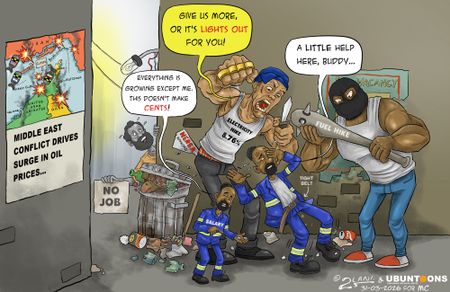
Du Plessis said that this and other global conflicts could result in a more gloomy economic growth outlook in South Africa, where people are already facing challenges in the form of high unemployment and inequality, and “poor government performance”.
“Still in South Africa, in spite of the fact that we produce more than enough food, 29% of our children under five years old are stunted. They’re too short for their age, principally because they don’t get the proper nutrition they need to be able to grow and develop,” he said.
The FoodForward SA and Saldru report found that 61% of survey respondents reported skipping meals so that children and other household members could eat, indicating that food rationing was a common coping strategy.
“Adults across households use self-sacrifice as a protective buffer for more vulnerable members, particularly children. However, the high percentage of affirmative responses for child hunger signals that protective strategies are often insufficient under severe deprivation,” stated the report.
A large majority of households (77.8%) reported talking to children about the inadequacy of food, which suggested that children were “directly engaged in the reality of scarcity”.
“The implication is that children in these households are not shielded from food-related stress, but are instead drawn into coping strategies, which may have psycho-social as well as nutritional consequences,” said the report.
/file/attachments/orphans/FoodForward-SA-panel_517419.jpg "Panelists at a FoodForward SA (FFSA) 2026 stakeholder event, including Andy Du Plessis, managing director of FFSA; Dr Noxolo Gqada, strategy lead for the Hold My Hand Accelerator for Children and Teens; Prof Reza Daniels, Dean of Economics at Stellenbosch University and former Southern Africa Labour and Development Research Unit managing director; Ravi Pillay of the Wits Business School’s Food Safety Leadership Initiative; Pavitray Pillay, World Wide Fund for Nature South Africa’s head of business development and marketing; and Dr Nicola Jenkin, impact lead for Wrap South Africa and technical adviser to the SA Food Loss and Waste Initiative. (Photo: Rezaine Desai)<br>")
Drivers of food insecurity
Prof Reza Daniels, Dean of Economics at Stellenbosch University and former Saldru managing director, identified the three main drivers of household food insecurity as:
- Unemployment;
- Ill health; and
- Number of dependents.
“South Africa has one of the biggest unemployment rates in the world, also for the youth. So, we find that there’s a lot of income vulnerability for a very large section of our population. That income vulnerability is mitigated by things like grants,” he said.
“Once you start looking deeper, you have to then find who holds these grants and how households are organised around them. Often, people move in with grandparents, if they get the state old age pension, and you’ll see a lot of household reconfiguration around the ability to provide food.”
Daniels noted that when a person fell ill, they were at higher risk of losing their job and moving into a state of high vulnerability. While they might be able to qualify for a disability grant, there could be a transition period after becoming sick, during which they were unable to access this support.
Households with more children or unemployed adults experience greater pressure on resources, he continued.
Tackling food insecurity
When it comes to child stunting and malnutrition, a positive development is the introduction of the National Strategy to Accelerate Action for Children (NSAAC), according to Dr Noxolo Gqada, strategy lead for the Hold My Hand Accelerator for Children and Teens.
/file/dailymaverick/wp-content/uploads/2024/02/5E2B3642.jpg "Tyelinzima Senior Secondary School learners queue for food in Coffee Bay, Eastern Cape, on 18 January 2024. (Photo: Hoseya Jubase)")
This plan, approved by the Cabinet in November 2025, lays out 10 national priorities for advancing the welfare and development of children, including improving child nutrition and boosting early learning and brain power.
“The NSAAC has started to drive the priorities when we focus on what needs to change. The NSAAC speaks about two critical windows: the first 1,000 days, which stunting is a critical outcome of, and then it also speaks about the last 10 years, adolescence. We often forget how important it is around [this stage], when there’s huge growth spurts, and a cognitive shift that happens,” said Gqada.
The accelerator aimed to push action and momentum around the priorities for children’s development, not only in government, but also in civil society and the private sector, she continued.
“At the moment, it’s about leaning into the opportunity and engaging in ... mechanisms that combine everyone’s opportunities and mobilise resources,” she said.
Ravi Pillay, head of the Food Safety Leadership Initiative at the Wits Business School, emphasised that South Africa did not have a food shortage problem, but a flawed system when it came to enabling access, coordination and dignity.
“We have this perverse situation in South Africa where we have food, but it cannot go to those who need it,” he said.
Pillay noted that there was not a lack of goodwill in South Africa, adding that there needed to be a “multistakeholder partnership mindset” to collectively address systemic issues in food safety and access.
FoodForward SA
According to Du Plessis, 10-million tonnes of food is still lost or wasted across the food system. FoodForward SA seeks to tackle this problem through food redistribution, recovering quality, surplus food from the consumer goods supply chain and distributing it to a network of beneficiary organisations serving local communities.
/file/dailymaverick/wp-content/uploads/Daily-Digest-Line.jpg "Homeless people queue at a feeding point organised by a church group in Johannesburg during the Covid-19 lockdown. (Photo: EPA-EFE / Kim Ludbrook)")
He described 2025 as a “terrible year” for both the organisation and the companies it worked with, marked by retrenchments and a drop in resources. FoodForward SA’s beneficiary network shrank from 2,500 to 2,200 entities, primarily because it found some beneficiaries were not meeting its compliance requirements.
“The contradiction is that we’ve had to limit applications because the food volumes from our food donors were somewhat limited because they’ve had a tough year and they’re still in the process of recovery,” he said.
However, he noted that FoodForward SA had a large number of applications to join its network.
“We have to manage that very carefully. We’ve reached 862,000 people [for food support] on a daily basis,” he said.
The organisation’s cost per meal provided has come down to 47 cents, making it extremely cost-effective, he said. More than 20,000 tonnes of food was recovered in 2025.
“Although the supply chain has been constricted somewhat during 2025, we are seeing lots of donations coming into our network,” he said.
He also noted the success of key programmes under FoodForward SA, including its mother and child nutrition programme, and Food Gardens Connect, an initiative that trained and resourced unemployed individuals to grow their own food.
Reflecting on the value of the mother and child nutrition programme, he said, “A pregnant woman that’s malnourished, food insecure and underweight is going to give birth to a child that’s underweight, and that child that she gives birth to, if he or she doesn’t get the proper nutrition, will be disadvantaged for the rest of their life. We need to intervene now.
“There’s a big push for [nutrition in] the first 1,000 days… If we don’t impact this now, we are going to see even worse unemployment… so, we need to make the investment now so that the cost to our economy is not as bad as it would be without this intervention.” DM
/file/attachments/orphans/ChildrensReporterV2_187851.jpg)