




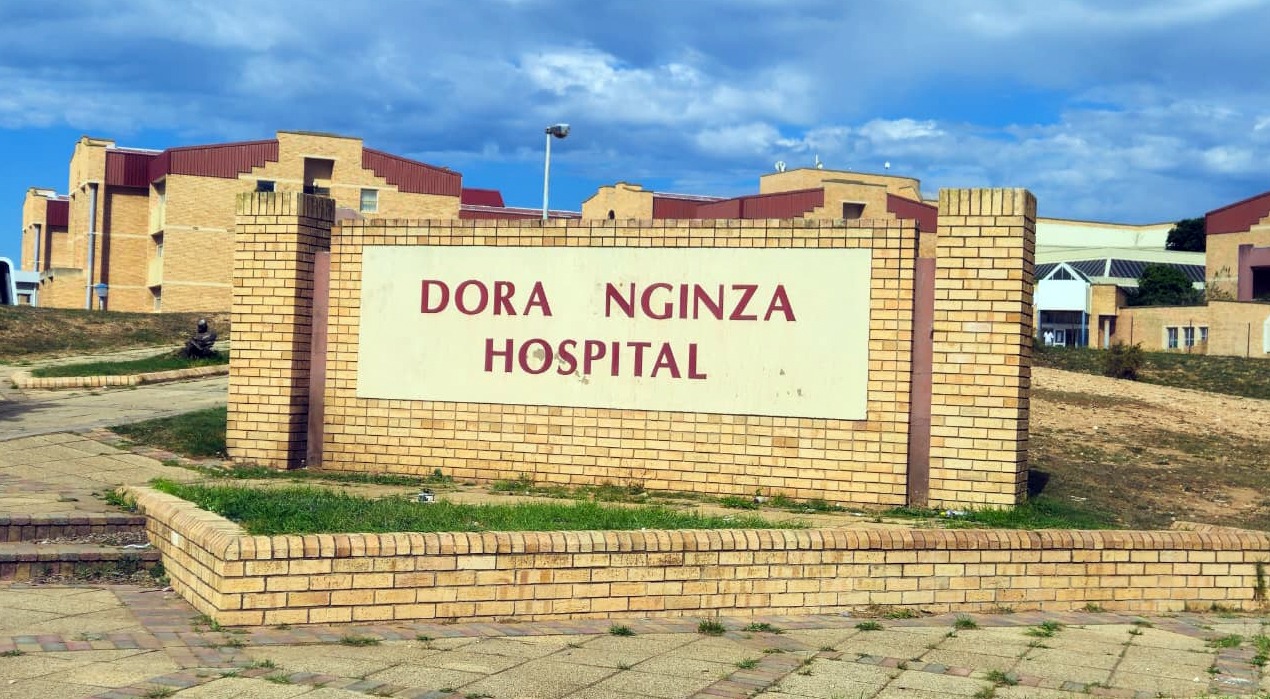
 Nelson Mandela Bay’s Dora Nginza Hospital. (Photo: Andisa Bonani)
 Less than a month ago, on 18 March 2026, Minister of Health Dr Aaron Motsoaledi said in a written parliamentary reply to EFF MP Sixolisa Gcilishe that there was no need to place the Eastern Cape Department of Health under administration to address the challenges at Dora Nginza Hospital in Nelson Mandela Bay.
“We have gone to the Eastern Cape … to meet the Premier, the MEC for Finance, and the MEC for Health, together with the Director-General of the province. This meeting discussed all the shortcomings and problems that the Eastern Cape Department of Health is experiencing.
“A plan was developed and is being followed to correct some of the shortcomings that were identified. One such shortcoming is the issue of pregnant women sleeping on benches and chairs within the hospital, because of overcrowding. The problem was identified as being caused by a shortage of district hospitals in the area, and not by Dora Nginza Hospital itself.
“This shortage of district health facilities causes every pregnant woman to be sent to Dora Nginza, thus causing overcrowding, leading to some sleeping on benches as we have seen on television,” the Minister said.
“The solution,” he was adamant, “was not to put the Eastern Cape under Section 100 [administration], but rather to put up facilities within the district, that would relieve Dora Nginza Hospital (of overcrowding).”
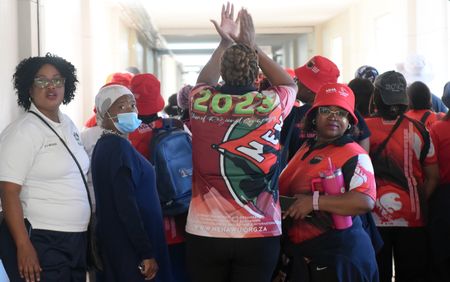
Last week, an unprotected strike by health workers has again highlighted the dire, long-unaddressed conditions hospital staff work under, driven largely by severe staffing shortages and systemic failures that have been addressed at a snail’s pace. Some critical shortages, particularly of midwives, date back nearly a decade.
/file/attachments/orphans/Staff_408332.jpg "Scores of patients are left unattended while Dora Nginza Hospital staff embark on an unprotected strike. (Photo: Deon Ferreira)")
11,000 deliveries a year
The Obstetrics Unit at the hospital, which includes a high-care unit for critical cases, is operating under extreme pressure. Confirmed statistics show that specialists perform 20 to 25 caesarean sections per 24 hours, while midwives deliver around 600 babies a month, with the unit recording more than 11,000 deliveries in some years.
When services at community health centres are disrupted — as happened last week when nurses refused to return to work after criminal attacks at clinics — all pregnant patients are referred to Dora Nginza Hospital. The same applies to all critical maternity cases from the western part of the Eastern Cape.
In 2025, head of the provincial health department Dr Rolene Wagner told the South African Human Rights Commission that a special plan was needed to improve conditions in the Nelson Mandela Bay Health District, specifically at Dora Nginza Hospital.
She said the department would provide Humansdorp Hospital with theatre staff to perform caesarean sections, allowing patients from the neighbouring Sarah Baartman district to be treated there.
She also said that Uitenhage Provincial Hospital would be provided with theatre staff to do the same. It is understood from hospital sources that, following the strike, agency theatre nurses were brought in to Uitenhage Provincial Hospital to assist with operations.
Another key part of the plan was that Empilweni Tuberculosis Hospital would be converted into a district hospital, where mothers could be referred for post-delivery care.
/file/dailymaverick/wp-content/uploads/2025/06/P9-Feature-images-4.jpg "Head of the Eastern Cape Health Department Dr Rolene Wagner. (Photo: Jay Caboz / Bhekisisa)")
Current situation
An update on Sunday provided by the department’s communications director Siyanda Manana indicated that some action was finally being taken.
He said the hospital was managing “coordinated clinical, operational and security interventions” to ensure patient care. The hospital also obtained an extensive interdict, which unions have described as “bullying”, to stop the harassment of staff, the blocking of entrances and other strike-related disruptions.
Labour union Nehawu has already indicated that it will oppose the final interdict when the matter returns to court next week.
Manana said the department was facing some “challenges”, but that all emergency and high-risk cases were being prioritised.
“These include critical maternity cases requiring urgent surgical intervention, as well as specialised neonatal and paediatric care. Patients are receiving appropriate care within available capacity, supported by established escalation protocols,” Manana said.
Emergency cases were transferred by helicopter to other facilities, including Empilweni Hospital, Settlers Hospital, Uitenhage Provincial Hospital, Port Elizabeth Provincial Hospital, Livingstone Hospital, Andries Vosloo Hospital in Somerset East and Midland Hospital in Graaff-Reinet.
These facilities had been placed on standby to receive patients where clinically appropriate. Additional capacity options across the district were also being explored to relieve pressure on Dora Nginza, including the possibility of making additional beds available at Empilweni.
“The Department has further moved to contract additional nursing personnel to reinforce capacity and ensure continuity of care, while engagements with broader health system partners are under way to secure additional critical care support where required, inclusive of the military,” Manana said.
On the labour front, facility management, led by the acting CEO and the acting district manager, remained in active engagement with organised labour to facilitate a full return to normal services.
While operations within the hospital continued, the department confirmed that security had been reinforced, with Public Order Policing and on-site teams maintaining a visible presence to ensure safety.
Clinical flaws
The plan has drawn considerable ire from obstetricians, who say it appears to have been formulated with limited clinical input. Concerns include that it is highly risky to refer critically ill pregnant patients to district hospitals for Caesarean sections performed by community service doctors with limited experience.
Doctors have also raised concerns about inadequate provision for complications, including access to specialist paediatric and neonatal care, as well as experienced anaesthetists.
The latest available official figures for nursing staff at Dora Nginza Hospital are from 2025 and were provided by Motsoaledi. At the time, the hospital had 83 professional nurses, including midwives, 32 operational managers and advanced midwives, and 187 nursing assistants.
There were 50 nursing vacancies, including in maternity services. However, the Public Protector has previously pointed out that shortages — particularly of midwives — have persisted since 2017, pushing staff to breaking point.
/file/attachments/orphans/6I1A5451_421102.jpg "Minister of Health Dr Aaron Motsoaledi. (Photo: Felix Dlangamandla)")
Discouraged doctors said they had stopped even talking about the shortages of doctors in the unit.
“The hospital was not able to fill these posts due to budgetary constraints,” Motsoaledi said. He said recruitment for 42 professional nurses, staff nurses and assistants had begun in the second half of 2025.
Oversight findings
The findings against the department on conditions at Dora Nginza Hospital have been piling up for years, including Public Protector findings in 2021 and 2025. There have also been numerous oversight visits by ministers and the parliamentary health committee, while the South African Human Rights Commission continues to monitor conditions at the hospital.
Despite this, implementation of the plan has lagged for more than a year – and the situation remains at breaking point. DM