




 A delegate draped in a Democratic Alliance flag at the party’s federal congress in Johannesburg on 12 April 2026. (Photo: Felix Dlangamadla)
 When Geordin Hill-Lewis emerged victorious as the new DA federal leader on Sunday, 12 April, he laid out a single national priority for the blue party: to stop fear ruling South Africans’ lives.
“We are a country of many crises, but there is one crisis above all others that holds our country back. It is the fear that people wake up with every morning.
“The fear that is with us all the time, while we walk in our neighbourhoods and even in our homes. The fear that our children won’t make it home from school. The fear of every woman – knowing they are a target, simply because they are a woman.
“The fear of the elderly person who double-locks the door and prays that tonight will be quiet. The fear of the small business owner who wonders whether they should just close their business and go hungry rather than pay protection money. The fear of the farmer who goes to sleep knowing that help, if he calls for it, is hours away,” Hill-Lewis said.
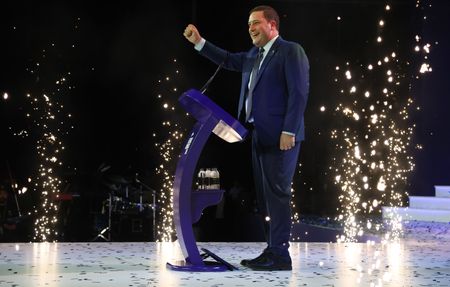
His mission is to grow the DA into South Africa’s largest party by 2029.
The 39-year-old Cape Town mayor believes he will do this by making the party’s top priority the bringing of law and order to South Africa.
“Not one priority among many. The priority,” he said.
/file/attachments/orphans/6I1A8798_572091.jpg "Geordin Hill-Lewis has been elected as the new federal leader of the Democratic Alliance. (Photo: Felix Dlangamadla)")
Fear of crime and corruption has emerged, along with unemployment, water provision and local government infrastructure failure, as the biggest factors in turning South Africans off politics and politicians.
The latest Ipsos survey has found that if an election were held tomorrow, the “party” with the biggest vote would be the “no-vote” party. Most South Africans want to vote, according to Ipsos, but feel alienated from political parties even though there are more than 500 to choose from.
Hill-Lewis has his work was cut out for him, as his stated aim is to grow the DA into South Africa’s biggest party. The DA appears to believe that it can gain enough support to win 30% of the vote by 2029, with the ANC probably set to decline, according to polls, from the 40% it achieved in the 2024 national election.
A Human Sciences Research Council (HSRC) survey for the Electoral Commission of South Africa (IEC) has found that support for democracy as the preferred system is not a majority view in any province, indicating that commitment to democracy is present, but not dominant.
Support for non-democratic alternatives is growing and notable in KwaZulu-Natal and Mpumalanga.
Demand for democracy:
Support for political regime type, by province
/file/attachments/2990/Screenshot2026-04-07at130806_142773.png "(Source: HSRC South African Social Attitudes Survey 2025/26)")
While the DA Congress featured a narrative that the government had improved since it entered the GNU in 2024, satisfaction with democratic functioning plummeted, according to the survey, which is one of the oldest and deepest in South Africa.
Four-point plan
South Africa’s local government elections must be held between 2 November 2026 and 31 January 2027, and the DA is gunning for some of South Africa’s biggest cities.
This weekend, newly elected chairperson of the DA Federal Council, Ashor Sarupen, said that the party had already registered more than 70,000 new DA supporters on the voters’ roll.
“In just a few months’ time, South Africans will choose their councillors and mayors in the local government elections. If we work hard, we can win more towns and cities than ever before: Joburg, Tshwane, Ekurhuleni, Cape Town, Nelson Mandela Bay, Durban, and others. These will be the first steps on a longer journey,” said Hill Lewis.

“In 2029, our people will once again choose the national government that leads this country. That is our chance to restore hope in South Africa as a whole, and build the country we all know in our hearts is possible. Because, I don’t know about you, but I am not satisfied with being a junior partner in a Government of National Unity.
“Our ambition must be to lead the national government,” Hill-Lewis said.
He outlined a four-point plan to expand the party’s electorate, which includes connecting “more deeply” with non-DA voters and leading with belief in SA.
Generational mix
Fresh leaders, like newly elected first deputy federal chairperson, Siviwe Gwarube, hammered home compassionate leadership when the DA changed guard at the weekend.
“If we want to be the largest party in 2029, we’ve got to grow the DA in communities who have never considered voting for the DA before… My view is that we have to move away from being just a party of competence to being a party of compassion. Sometimes people are missing that in the DA. People know that where the DA governs, it governs well,” Gwarube told Daily Maverick.
But the biggest question is: can the DA grow in these communities? Gwarube believes it can, through the empowering of activists who undertake door-to-door campaigning, whom she described as the DA’s “frontline workers”.
The party could also improve its chances in Gauteng metros, especially with Solly Msimanga elected as federal chairperson. The move is seen as tactical, with Msimanga likely to appeal to a broader black electorate in a province that the party clearly needs to grow its existing support base.
/file/attachments/orphans/6I1A8871_849030.jpg "Ashor Sarupen, Solly Msimanga and Geordin Hill-Lewis celebrate at the DA Federal Congress 2026 in Johannesburg on 12 April 2026. (Photo: Felix Dlangamandla)")
Equally important is the election of the second deputy federal chairperson, Cilliers Brink, a young white man who served as the executive mayor in the City of Tshwane from 2023 to 2024. Ahead of the local elections, Brink is once again the party’s mayoral candidate in Tshwane, a nomination he said he would not relinquish.
“I would [not] have run for any position that would have compromised my campaign in Tshwane. For me personally and professionally, that is the most important thing. We have to save our city, we have to stop the water tanker mafia.”
Brink, Msimanga and Sarupen are all from Gauteng, which signals a clear push to grow support in the province and build toward 2029.
But while the DA seeks to expand beyond its traditional base, it is also being careful not to alienate its existing voters, balancing growth with consolidation – a challenge the party has previously struggled with.
“Of course, connecting with more voters doesn’t mean neglecting the people that have supported us over many years,” said Hill-Lewis on Sunday.
“I completely reject the idea that politics is a choice between competing groups, or that we must trade one community’s support for another. I believe that, if we work with focus and discipline, we can build a party that truly represents the hopes and aspirations of all South Africans.”
Hill-Lewis is popular within the party’s powerful Western Cape faction. Despite being elected federal leader, he intends to run for a second term as Cape Town mayor in the forthcoming polls, which will help the party’s provincial ticket, with the Western Cape historically the DA’s crown jewel of good governance.
The 2026 Congress, attended by more than 2,000 delegates, ushered in a new generation of leaders, replacing stalwarts such as Helen Zille with younger successors. Zille’s position as federal chairperson, for instance, was taken by the 36-year-old Sarupen.
The party’s new top cohort is now among the youngest leadership groupings in South African politics, with only two of the top 10 leaders aged 50 or above. DM
Additional reporting by Ferial Haffajee.