



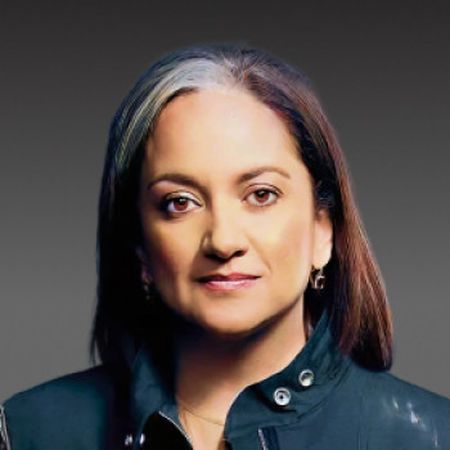
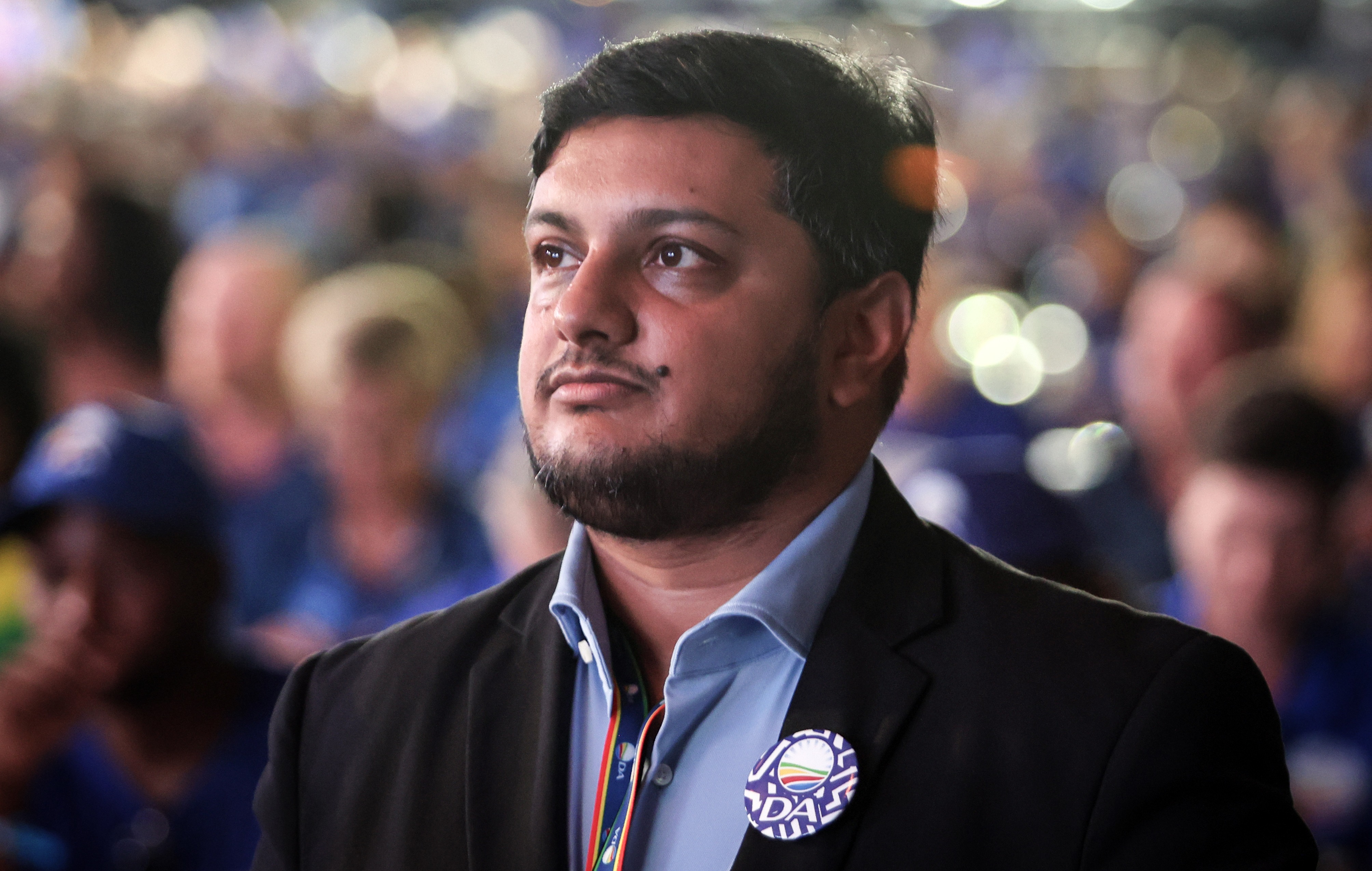
 Ashor Sarupen at the Democratic Alliance Federal Congress 2026 at Gallagher Convention Centre in Johannesburg, taking part in key decisions on leadership and policy. (Photo: Felix Dlangamandla)
 At 37 years old, Deputy Finance Minister Ashor Sarupen is also now the DA Chairperson of the Federal Council, a powerful role in which he will run the party that wants to become South Africa’s largest in three years. Ferial Haffajee asked him if he had imagined he would be in this role after starting as a young councillor.
Question: As a young man growing up in Ekurhuleni – in Springs – did you ever think that this day would come?
Answer: I never, in a thousand years, thought I’d even have a political career. It was never my ambition to be in politics. I never, as a kid, thought about it. So, no, I didn’t ever think this day would come.
Even as I sort of progressed in politics, and you’ve seen me around in politics for a long time now as well, I didn’t think this would be where I would, you know, reach. It was never even a consideration until recently, quite frankly.
Q: And what did your family say? They must be excited for you.
A: Well, my mother’s obviously sent me a very nice WhatsApp, and so my sisters are very excited, and various relatives are sending very nice messages.
/file/attachments/orphans/WFD_9308_918468.jpg "Ashor Sarupen during the DA Federal Congress 2026 on 12 April in Johannesburg. (Photo: Felix Dlangamandla)")
Q: Will you stay on as deputy finance minister, because you have accomplished a lot in that role and struck up a relationship of some rapport with Finance Minister Enoch Godongwana?
A: I think the Democratic Alliance needs to now get used to something which wasn’t true of the party [throughout] its history, that is, its leaders being in government.
I think that some of the way the party has structurally functioned is as a party of opposition. Parties of government have leaders in government.
So I intend to continue. Geordin [Hill-Lewis], of course, will decide whether to keep me on as the deputy minister of finance. It is the leader who will make that decision. But it is my intention to continue.
Q: And how will you do both jobs? Because they are both taxing and demanding jobs, and important ones?
A: It’s very important. I’ve had a very long chat with Helen [Zille]. Thankfully, I’ve had six years of understudy with Helen, as deputy, and she [was] both the leader of the DA, which is a very hard job, and then the [Cape Town] mayor in a complicated coalition, and then the premier in the Western Cape.
I’ve learned about how she set things up. A satellite office is important. This is always going to be necessary because I’m from Gauteng, whereas my two predecessors were from Cape Town.
We will obviously have to look at how party operations are structured so that there are things in Gauteng that can work. But the most wonderful thing about 2026 is that these things called Zoom and Microsoft Teams – which means I can go to a government meeting, if there’s an urgent party meeting, I can do it on Zoom in the car on the way up, and all of those sorts of things.
So there are ways that you can make things work.
/file/attachments/orphans/WFD_9324_226389.jpg "Ashor Sarupen and Helen Zille at the DA Federal Congress 2026 in Johannesburg. (Photo: Felix Dlangamandla)")
Q: Geordin Hill-Lewis, when he spoke now as newly minted party leader, said that what we were seeing was a clear generational shift in the leadership of the DA. Could you unpack what that means?
A: I think the last time we had such a big generational shift in the DA was when Tony Leon was elected leader of the DP [Democratic Party] in 1996.
Consider this: Every single person on that stage [as elected leaders in the 2026 congress], apart from JP Smith and Thomas Walters, was not a public representative when Tony Leon was leader of the party.
Geordin Hill-Lewis became one, I think, in 2014, or it might have been a bit before that. Mmusi Maimane in 2011, myself in 2011 as well.

There are no throwbacks to a previous era. These are people who have come through more recently. So it is a generational shift. If you look at the average age of the DA’s leadership, it’s very young.
We are now the youngest party in the country, leadership-wise – younger than the EFF. That says something about the ability of the party to renew itself.
Q: As Geordin Hill-Lewis stood up there, I realised something: here is a 39-year-old white guy who has set himself the audacious goal, along with all of you, of the DA becoming the biggest party in a largely black South Africa. Does race matter?
A: What we’re seeing, interestingly, in South Africa is that the idea of black nationalism is on the decline. That’s not to say that it’s not a potent force. You see that with the MK party and so on, but the decline of the EFF begins to show how hardened racial nationalism is on the decline electorally. [The EFF has struggled to break the 10% barrier in national elections.]
If you look at by-election results, the pattern is being broken: In Gauteng, the DA, in a 100% black ward, the DA won 25%. The same thing in Mpumalanga. In the Eastern Cape, in a completely rural, 100% black ward, we got 35%, and so on.
In Cape Town, in Dunoon recently, we got a pretty good result, I think it was around 16% as well.
/file/attachments/orphans/WFD_9458_916885.jpg "Geordin Hill-Lewis takes the stage at the DA Federal Congress 2026. (Photo: Felix Dlangamandla)")
So there are large swathes of the country now, in townships and rural areas, where we are the second-largest party already. As the minority population of South Africa declines, I don’t think it matters, actually.
I think that people want things to work. There will always be a set of voters who are animated primarily, in the context of politics, by their identity. But there is also, equally, a large number of voters who are animated by their circumstances.
I think the mission for the DA now is to help people understand that the core democratic hypothesis is that changing your vote can change your circumstances. That’s never been culturally embedded in South Africa. And that’s our mission now, I think, going forward.
Q: It’s quite a mission you’ve set yourselves in a time where the statistics are showing the following: if an election were held tomorrow, the party with the biggest number of votes would be the no-vote party. [This is according to a recent Ipsos survey.]
A: Correct. People no longer see that the vote results in a substantive change in the condition of their lives – be it a job, be it a local opportunity, be it living without corruption, be it water, be it electricity.
I think that the challenge we have is that people have disengaged [from] politics. But you must understand the context. People fundamentally believed that the objective of democracy is, firstly, liberation, and after that loyalty to the liberation movement, and not that changing your vote changes your circumstances.
I think large numbers of ANC voters are completely disengaged rather than changing their votes.
What we have to do, again, is make that link for voters between the circumstances of their lives and electoral outcomes, which hasn’t been inculcated in South Africa.
When World War 2 ended, and there was reconstruction in Germany, it took five years to have their first election, because there [were] five years of civic education to inculcate what liberal democracy is, what democracy is, what political parties stand for, and so on.
All these foundations that exist, that do good work – the Friedrich Naumann Foundation, the Hans Seidel Foundation, the Konrad Adenauer Foundation, the Rosa Luxemburg Foundation – they were created in Germany to help foster that.
In South Africa, we went straight from a terrible system into democracy without the concomitant civic education view. So that’s the challenge of what we have to do now – civic education. That’s how we’re going to energise those voters and give them a reason to vote again.
Q: When I read through your Congress documents, listen, watch everything being said, it says that with the DA in government, South Africa is beginning to turn the corner. But if you look at the latest statistics from an HSRC survey, people do not experience that functionality in their lives yet. The key finding is that the number of those who have given up on democracy, are beginning to say they will consider non-democratic forms of government because it doesn’t really matter, are growing. How do you turn that around?
A: There was a very disturbing poll that said more than half of South Africans would accept military rule. That was the most disturbing. What that, again, tells you is that people presumed in ’94 that liberation would bring tangible improvements. For too many people, it hasn’t.
Which tells you the policy suit has not delivered those improvements. We have delivered improvements at the margins. We have not yet delivered the kind of rapid economic growth that we need.
Of course, this is because the ANC still governs with some of its [ideological] edifices and sometimes core ideas. And so the ANC needs to reshape some of those core ideas. We’ve tried these things since ’94, in some cases since ’97 or the early 2000s, and it’s been perpetuated.
We need to undergo policy shifts for people to begin to feel those changes.
/file/attachments/orphans/6I1A8871_849030.jpg "From left, Ashor Sarupen, Solly Msimanga and Geordin Hill-Lewis celebrate during the DA Federal Congress 2026 in Johannesburg. (Photo: Felix Dlangamandla)")
However, that being said, the biggest reason why people are not feeling tangible improvement is when the water isn’t coming out of your tap, it doesn’t matter that the national Department of Water and Sanitation has an excellent DG who has sorted it out, because the municipality is not correctly reticulating water.
It doesn’t matter that Eskom isn’t load shedding us any more, when all the [municipal] substations are blowing up, because the municipality hasn’t maintained them for 20 years.
And I think the complete collapse of local government is driving that in a way that makes people feel like nothing will get better.
Q: You have set yourselves a really big, hairy, audacious goal – you want to be the biggest party by 2029. What does biggest mean? Is it 30% as an electoral outcome? Is it 35%? Is it 40%? Can you put a number on it?
A: The thing about putting a number on it, what I’ve learnt is that you can never actually, this far out of an election, predict it.
What is going to happen – there’s a big thing in November, and that is the local government elections. If the DA is successful in Gauteng, in capturing and then holding, all the way to 2029, Johannesburg and Tshwane, possibly Ekurhuleni, then that’s progress.
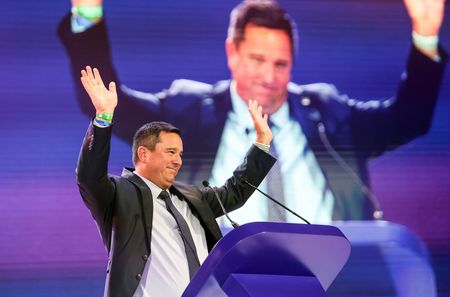
If we govern it well and can get to that point, and we can be in stable coalitions, then I think 30% plus is on the cards. And then you can be competitive with the ANC, which is going to be the [other] largest party, because it could be one or two points that determine it [the divide between the two].
We need to do a good job in the Gauteng metros, particularly in Johannesburg, where things have really fallen apart and because it also represents so much of South Africa’s aspiration.
If we govern it well, and we just get the basics working – the street lights, the traffic lights, the potholes get filled, the water gets back into everyone’s taps, if we just do those things, then I think we’ll make a compelling case, considering how much South Africa’s aspiration looks towards Johannesburg.
From the point at which the mining gold rush led to the creation of Johannesburg as a major city, everyone in South Africa has looked to it as a cultural heartland, the sociological heartland.
I think if we can govern Johannesburg well, then 30% plus is on the cards.
Q: Finally, so often when I read the DA now, it feels like history only began when you became part of government. But our country’s story goes back way further than that. Can you avoid our past in the ways that I sometimes feel you all try to do?
A: I think the key thing is that the ANC’s political strategy has been to promise a better yesterday. Our political strategy is to promise a better tomorrow, because at some point, voters are not voting about the past.
In most democracies, nobody looks to the past, they look to the future. They look at what their life is going to be like in five years’ time.
Some of the DA’s policy is historical. If you look at how Mat Cuthbert has, as head of policy, really pushed economic inclusion – and yes, we don’t use race as a marker of disadvantage, we use poverty as the marker – it really is to try to acknowledge that there is a set of historical circumstances that led to a whole lot of people suffering material deprivation, and living lives that you cannot value because you can’t take advantage of opportunity.
That’s core to what we believe – that we must give people lives of value and give them access to opportunity.
But we’ve got to start running a political system that promises a better tomorrow and is future-oriented. The world is changing. DM
This interview has been edited for clarity and brevity.